Friday, January 18, 2013

Area megas: Ivory Gull and Common Crane!

It's been a wild week for the Colorado River below the Grand Canyon.

Two days ago (January 16), the news came in that an Ivory Gull had been photographed along the Colorado River somewhere near Willow Beach, but it had a broken wing and the report was a few weeks old.  I held out hope that it might be loafing at Willow Beach eating fish scraps, but in fact it was several miles below Willow Beach, on a small (likely ephemeral) sand bar, and it was photographed December 30--nothing encouraging about its continued survival or any likelihood of ever refinding it.

Still, this is an amazing first state record if accepted by the ABC! It's so fortunate that the observers, who I gather were not birders, thought to photograph the bird and send them to Andrew Core. Check out the stunning photos here!

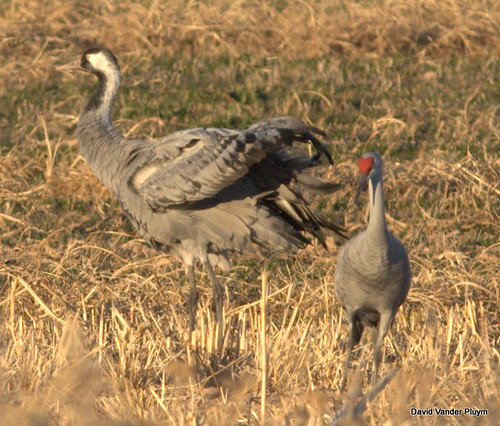
Three days ago (January 15), Norman Parrish visited Overton WMA near the north end of the Overton Arm of Lake Mead and photographed a Common Crane! Carl Lundblad got the word out, and it was seen two days later by Rick Fridell, who posted early that it was indeed a Common Crane and still present. David and I debated for about 30 seconds before deciding to go for it! The drive only took about three and a half hours one way, completely reasonable for a lifer for both of us and first NV state record if accepted by the NBRC.

Often in birding we spend a lot of time looking at dull-but-exciting birds like Nutting's Flycatchers. The Common Crane combined local rarity with a high degree of sexiness, so much so that we watched it for about an hour and a half and only left because we realized it was getting late and we still had to drive three and a half hours home.

Common Crane
One of David's shots of this beautiful MEGA
After seeing the bird, we stopped to get gas and celebratory hot chocolate and I mentioned the bird to the attendant inside.  She was excited about it, and immediately said she'd take her son out to see it, since he loves birds and it sounded interesting. Cool!

Overton WMA, where we stood and watched the cranes feed
 Unfortunately there was a bit of a damper on the experience. When we arrived, a photographer was on the field, walking toward the cranes. The birds were clearly agitated, but she continued moving forward, slowly, in increments. Once it became clear that she was pushing the birds beyond reason, I started calling for her to back off, but she didn't hear me. Finally, she did hear David, and quickly turned and started walking back. At that point, though, she was about 20 meters from the birds, and the sudden movement caused them to flush. There was no reason for her to get that close to the birds. I don't quote the ABA Code of Ethics often, but it is worth a read once in a while.

This should not happen--and take note that this was taken with a 300mm lens (David's photo)
Fortunately, at least, the birds did not go far, just a few fields away. More information about this bird is here. Many thanks to Norman Parrish for finding the bird, to Carl Lundblad for getting the word out and nudging us to go, and to Rick Fridell for confirming that it was present Friday morning!

Thursday, December 13, 2012

2012 AZFO Meeting Summary

This fall, Arizona Field Ornithologists held their sixth annual meeting right here in Lake Havasu City.  The meeting was a great success, honoring Gale Monson with talks memorializing him and his work, discussion of the lower Colorado River Valley where he spent many years, and recognition of past and present recipients of AZFO's Gale Monson Research Grants.  Two days of field trips resulted in an array of unusual sightings.

Read all about the meeting and field trips here!

Wednesday, December 12, 2012

CBC Season

It's CBC season again!  A time of year when birders organize their efforts and agree to spend a day counting every bird in some small corner of the world, then celebrate together at a greasy local restaurant.  I missed the CBCs entirely last year, but this year I'm glad to be participating in at least two, the Yuma/Martinez Lake count and the South End of the Salton Sea.  I'm all about Imperial County, CA in my CBCs.  My December plans are up in the air, so who knows, maybe there will be more for me...

If you're not sure about the CBC schedule this year, have a look at Arizona counts or California counts.

Have you seen eBird's recommendations for entering your CBC data into eBird?  Read about it here!

Tuesday, December 4, 2012

Birding Planet Ranch Road

With the recent return of the Nutting's Flycatcher, the Bill Williams River National Wildlife Refuge and Planet Ranch Road in particular are once again getting attention from the birding world.

Map of the western portion of the refuge
On the map above, note the location of the visitor center, a good place to stop in for information.  It's also a good place to scan the Bill Williams Delta, also known as the Bill Williams Arm of Lake Havasu.  Just down the road east of the headquarters, marked in both directions by brown binoculars signs, is the entrance to Planet Ranch Road.

Sonoran desert and cottonwood/willow/mesquite riparian come together on the Bill Williams River.  This photo was taken just after the gate on Planet Ranch Rd.
 Some caveats.  Note that asking a GPS to point you to Planet Ranch Road is not likely to be useful--I've heard stories of people turning up in random locations in Parker, and also being pointed to the other end of Planet Ranch Road, a long drive through the desert to a section of the river that is privately owned and not accessible.  The road once ran all the way from Lake Havasu to Planet Ranch, but was washed out in floods several years ago.  Many maps still show it as it was, but it now ends in a gate at the red triangle shown on the map above.

A person walking along the edge of the forest anywhere along Planet Ranch Road is likely to encounter flagging, some of which marks trails entering the forest.  I can't stress enough the importance of staying off these trails.  Researchers create and use them for a variety of projects on the refuge.  The flagging comes in many colors depending on the project, year, and type of trail.  The trails crisscross and backtrack, some lead into ponds or river channels, and many are disused and being reclaimed by the forest.  Sometimes the flagging just ends.  Navigating these trails requires a knowledge of the flagging systems, a detailed and updated map, and a good handheld GPS unit and compass (not to mention a willingness to crouch, squeeze, climb, bellycrawl, wade, and be scratched up).  Recently, hikers entered the trail system at Mosquito Flats, and eventually became hopelessly lost.  They managed to find a spot with cell reception and called the Sheriff's department.  The Sheriff's department flagged their way along the trails, got lost, but eventually (miraculously) found the hikers on the other side of the river, dehydrated but otherwise okay.  Don't try to hike the trails.

There's a trail in there somewhere
Sorry for the doom and gloom, but I had to get that out of the way.  So, what is the best way to bird Planet Ranch Road?  The road winds through desert hills, cutting through interesting rock formations and running by washes and canyons.  All of this makes for great exploring, and the dense mesquite edge of the riparian interface can always be good birding.  In my opinion, the best place to bird along the road is Mosquito Flats.  Of course, this happens to be where the Nutting's Flycatcher is.  This is the only place where the riparian abuts the road, and the mesquite edge even crosses the road.  Birds to be found here regularly include species of cottonwood/willow riparian, mesquite bosques, and Sonoran desert.  Rarities that have been found here include Northern Parula, Black-and-white Warbler, Hutton's Vireo, Painted Bunting, Gray Vireo, Winter Wren, and Broad-billed Hummingbird.

Birding along the road, you may run across a binoculars sign underneath a double power pole, indicating a nature trail.  More than once I've overheard people saying "Hey, this isn't a trail!"  It is just a short trail that cuts through the thick mesquite and reaches into the forest, where it ends at one of those research trails I mentioned.  Still, even though it is short, it's worth checking out.

Check out this short jaunt into the forest
So, how about a hike?  I mentioned that the road ends in a gate, but the track continues for miles, ending around the Cougar Point area.  Park at the gate, make sure to pack some water, and explore.  In places the forest is very dense, but in other spots the river channels are very open, and an adventurous hiker can wander to a variety of areas.  Generally, the track is the most direct way to access the best habitat (there are usually tire tracks to follow from ATVs used by the refuge).  Be aware that this hike requires a chilly wade from about December through May, when the river is flowing.

The end of the road
Biologists wading in the river
 After a little more than a mile, the road crosses the river and forks.  The left fork runs through some very nice riparian habitat and passes through the old Kohen Ranch.  There isn't much left of the ranch except for overgrown Bermuda grass fields being invaded by mesquite.  The refuge is working on mesquite restoration in the area, and the resulting brushy mesquite bosque is wonderful habitat for sparrows in the winter.  If you can find the right fork running alongside the river, it passes into more open habitat with some spectacular scenery.  It ends after another mile or so around Cougar Point.

The river crossing just before Kohen Ranch
Bermuda grass fields at Kohen Ranch
Scenery between Kohen Ranch and Cougar Point
What season is best to bird the area?  I recommend late April or early May, when many of the breeders have returned but spring migrants are common, sometimes in large numbers.  Summer can be great birding, with a good variety of breeding species, some of which are amazingly abundant (especially Song Sparrow, Yellow Warbler, and Yellow-breasted Chat).  Black Rails and Elf Owls are some of the more sought-after breeders.  Black Rails will call at night and, sometimes, all day.  Listen for them at Mosquito Flats.  Elf Owls are common in the area--go out on a spring night and keep an ear out, and you will be sure to hear them.  Just remember that they are at the edge of their range here, so please don't disturb them or play tapes.  Remember that summers are hot in the desert, so it's best to be out early and back to the car by 10-11.  Fall is more subdued than spring, but can carry surprises of its own, such as the Northern Saw-Whet Owl found at Kohen Ranch this fall.  Winter is more hit-or-miss, with some stretches seemingly birdless until you happen upon a flock, which will typically include many Yellow-rumped Warblers and Ruby-crowned Kinglets.  No matter which time of year you visit, be sure to bring plenty of water.  Allow plenty of time for exploration and enjoy this beautiful and unique area!
Sunday, December 2, 2012

ANOTHER Lesser Black-backed Gull

November 30th, after a lovely day rediscovering the now-returned Nutting's Flycatcher, hiking in the Bill Williams, and finding my La Paz County Winter Wren, I thought I had used up all my birding karma for a little while.  Still, when I pulled into the refuge headquarters to scan the Bill Williams Delta, a not insignificant part of me was hoping that the Lesser Black-backed Gull would show up (click the link for more on LBBG identification).  So while I was sitting in the car starting a BirdLog checklist and I happened to put my binoculars on a brown gull that looked awfully white-rumped, I wasted no time grabbing camera and scope, jumping out of the car and setting up to scan.  I quickly got the scope on a brown gull, but was disappointed to see just another California Gull.  Used to disappointment after three solid days doing nothing but looking for that LBBG, I sighed and scanned on.  Then immediately got on another brown gull, this one with a white rump and white-based tail with a contrasting black band.  The Lesser Black-backed Gull!!

Long wings, masked appearance and white tail with black band.
To say that I was excited to see this bird would be something of an understatement.  Not that it wasn't fun birding around Havasu for three days and finding some other rarities and all, but I kind of ran myself ragged looking for that bird in Lake Havasu City.  I chased and missed the first state record, as well, a bird near Phoenix in 2006.  So after snapping some photos, I laughed and danced a jig and I'm sure some refuge visitors wondered what was going on with the lunatic with the scope and camera.

Fishing with Ring-billed Gulls
Soon, David had arrived from Havasu.  The bird had flown to nearby Havasu Springs, so we drove over and found it loafing on a beach.  David, being the real photographer between us, had taken control of his camera and got some much better shots.  It was he who first wondered whether it might be a different bird.  I had noticed that it seemed much whiter than in John's photos, but I didn't think much of it.  Now much closer to the bird, I checked it out in the scope, and sure enough, it was messier-looking than John's bird, without those nice clean edgings on the mantle feathers.  It was a single feather, though, that finally convinced us that it was a different bird.  In the flight shots above, note an obvious missing primary on the left wing.  One of David's photos shows that this feather isn't missing altogether, but is actually growing in, and it's more than four days along.

Narrower tertial edgings and messier scapulars and wing coverts than the Lake Havasu City bird

Better photo showing how white the plumage is.  Photo by David Vander Pluym
White plumage streaked with brown, masked face.  Photo by David Vander Pluym
The magical photo showing the primary growing in!  Photo by David Vander Pluym
Exciting times here on the river!

Friday, November 30, 2012

The Nutting's Flycatcher is back!

Just after 8:00 this morning, after about 15 minutes of birding, I was walking down the road at Mosquito Flats in Bill Williams River NWR, planning out my post to the listserv about the continued absence of the Nutting's Flycatcher.  Of course it was at that moment that I heard that singular "WHEEP!"  I didn't think I had missed it so much, but that sound brought a huge smile to my face. It's back!

The flycatcher is behaving much the same way it did last year.  It called infrequently and was difficult to pin down, but once I located it foraging next to the road, it gave me some great looks.  Photos and sound recordings below from this morning.

"Miss me?"

Eating a mantid.  Check out the cinnamon secondaries!

Short, stout bill, bright yellow belly, cinnamon secondaries, and a greenish back are all good field marks.


The Bill Williams River NWR is about halfway between Parker and Lake Havasu City.  You can get to the flycatcher from Highway 95.  Take Planet Ranch Rd east from the highway (between the refuge headquarters and the Bill Williams bridge) and drive to mile marker 2, where cliffs rise on the east side of the road and riparian vegetation borders the left side.  Also check out the map.

Wednesday, November 28, 2012

Lesser Black-backed Gull - Lake Havasu

Two days ago (26 November 2012), John West photographed an odd gull on the beach at Rotary Park.  He sent the photos to David Vander Pluym, who immediately identified it as a juvenile Lesser Black-backed Gull!

Photos by John West

Above are two of John's photos of the Lesser Black-backed Gull.  I have fairly limited experience with Lesser Black-backed Gull, but I do see California and Herring Gulls regularly.  This bird is striking to me because the scapulars, tertials, and some of the wing coverts are solidly dark with narrow white edging.  Some important ID points are the long wings, narrow white edging on the tertials not reaching the greater coverts, fairly small black bill (though it seems to be on the large side for LBBG), fairly white ground color, masked face and streaked sides, and a dark bar on the greater coverts formed by dark bases growing broader distally.  In flight, it shows a black band on the tail (white bases to the outer rects) and plain dark underwing coverts.

There are two records of Lesser Black-backed Gull for Arizona.  Photos of those birds are here and here.

I've spent the past two days running around Havasu looking for this bird, without success.  However, I have seen a number of other goodies just being out and about.  In the Bill Williams, David and I saw the continuing two White-winged and four Surf Scoters.  At Rotary Park, we saw the two Pacific Loons which John found two days ago.

Pacific Loon on Thompson Bay, photographed 28 November
Also on Thompson Bay yesterday were two Arizona Review Species, a Black Scoter and a Red-throated Loon.

Red-throated Loon on Thompson Bay, photographed 27 November

Black Scoter on Thompson Bay, photographed 27 November
Today, I did something new, and bought a day pass to Lake Havasu State Park.  I think $10 is a bit steep to walk around on otherwise abundant lakeshore, but there is usually a nice gull flock there.  Not so today, but I checked the small cactus garden there, where I ran into a male Yellow-bellied Sapsucker.

Yellow-bellied Sapsucker at Lake Havasu SP, photographed 28 November
Best of all these birds, though, was a White-winged Scoter on the California side of the lake.  A county bird for me yesterday, and for David today.  I'm planning to give the Lesser Black-backed Gull another day of searching.  After all, the Glaucous Gull was notoriously difficult to find, and that bird was a cinch to pick out and ID even when it was over a mile away!