Saturday, April 9, 2011

Migration and Big Year Update, spring storms

Blogging has been put on the back-burner in the past few weeks, due to increased demands from birding, work, and my immune system.  I'm starting to get back into the swing of things, though, so here is an update about avian goings-on around here!

Life became exciting on March 30, when a scan from the north end of Lake Havasu produced a push of waterbird migrants!  Among the birds moving by were a flock of 45 Bonaparte's Gulls, 35 Long-billed Curlews, 3 American Avocets, and 45 Red-breasted Mergansers.  Another flock of 44 Bonaparte's Gulls was at Rotary Park that day.  This was a great count, given that Bonaparte's Gull is considered rare in the LCRV!  The next day, we went back to the north end and observed moving north: 6000 Tree Swallows, 23 California Gulls, 10 Bonaparte's Gulls, a Marbled Godwit, and a smattering of waterfowl.

Marbled Godwit
Since then, the waterbirds have been shuffling about and moving through.  Scaup, Redhead and Red-breasted Mergansers have been on their way out, while Bufflehead have also gradually decreased.  The Black Scoters and Long-tailed Duck consistently seen at Bill Williams Delta seem to have taken their leave.  Today, 83 Marbled Godwits graced the beach at Rotary Park.  Caspian Terns are moving through as well.

Songbirds have been late to arrive.  Typically, the LCRV leads the rest of Arizona in spring arrivals.  This year, however, we have lagged well behind.  The sudden arrival of White-winged Doves around April 3-4 was a welcome change (remember the early loner that showed up at Rotary Park in late February?).  Male Lucy's Warblers are singing up a storm, but Wilson's Warbler migration is still just a trickle, and no Yellow Warblers or Yellow-breasted Chats have been reported yet.  A few Bullock's Orioles have arrived and started singing, and a Western Kingbird in Needles today was my FOS.  Meanwhile, the resident birds - Anna's Hummingbirds, Great-tailed Grackles, Abert's Towhees, Black-tailed Gnatcatchers - have already begun nesting.


Just passin' through - Wilson's Warbler
The Big Year stands at 181.  Since my last update, my 16 new species have all, save two, been migrants.  Most were listed above.  Most were expected or overdue, although a few, such as American Goldfinch and Cattle Egret, are less common in the area.  For those who are wondering, #166 was Virginia Rail, heard on a solo night hike around Pintail Slough.  And the newest addition, seen today, at long last, was my big year nemesis, Common Moorhen!  After a thorough scope of Beal Lake searching every visible cranny for this recently-elusive Rallid, I decided to double-check one nice-looking patch of marsh...and there it was, swimming across the open water as fast as its lobed toes would take it!

I would be remiss not to mention the storms going through town the past few days.  Last week, temperatures broke 100, and I was preparing to live in a furnace until October.  Relief came swiftly, with highs below 70 (!) and rain falling Thursday, Friday, and today (Saturday).  I-40 was closed today due to snow at higher elevations, and trucks piled into the gas stations at Highway 95.  As we were leaving Beal Lake, great big gloppy raindrops began to splatter on my windshield, and before long it was pouring, with freezing rain, and lightning striking around us.  As we were driving, paralleling Topock Marsh, I noticed a plume of black smoke.  Getting closer, we could see it was a fire in the marsh - presumably caused by lightning - with tall flames licking the damp sky, pouring out a stream of cattails reduced to ash.  It was a memorable sight to see, a completely natural process at work.  In the short term, habitat was burning up, undoubtedly taking some wildlife with it.  In the long term, though, fires open up the marsh, recharge the soil, and keep the marsh healthy and functional.

Topock Marsh fire

Snowing in the Hualapais

The north end of Lake Havasu after a storm

Monday, March 28, 2011

Get Involved!

I think one of the great things about birding as a hobby is that anyone, everyone, can get involved and contribute to our knowledge of birds.  Citizen science also allows amateur enthusiasts to affect conservation and provides a learning opportunity.

What I want to mention is the North American Migration Count.  It's a lot like a CBC, an annual nationwide snapshot of bird abundance.  There are some differences.  For one thing, rather than a count circle, the NAMC runs at the county level.  The other important difference is that the NAMC occurs on only one day, the second Saturday of May.  This year, it's happening on May 14.  If you can be out in the field that day, consider joining in the count, and contact your local coordinator!  The link above lists all the county coordinators in Arizona.  Another thing to consider is birding a new area.  If you live in a county with a lot of birders, how about volunteering in an underbirded county like Greenlee, Graham, or La Paz?

Another way for Arizonans to get involved is to join in one of AZFO's Field Expeditions.  These are like super field trips, outings with a purpose, with some goal towards better understanding the status and distribution of Arizona's birds.  This May (21-22) there will be a backpacking trip to the Galiuro Mountains in southeast Arizona.  Who even knows what that could turn up!

Friday, March 25, 2011

Links (part 2)

In my original "Links" post, I included several links relevant to birding in the LCRV.  Not wanting to lose these pages in the dusty archives, I figured out how to add a "Links" section to the sidebar of the blog.  Now relevant information is always available!

Also, I just added a new one, an eBird bar chart for all three western Arizona counties.  I blogged previously about eBird and their amazing bar charts, so I wanted to provide a quick link for folks visiting the area.  Dates and relative abundance at your fingertips!

Wednesday, March 23, 2011

Big Year update

Things have been very busy lately, and unfortunately I'm not referring to birding!  The past two weekends I've gone out of town, first to Phoenix then to Santa Cruz, CA.  Not to mention the intervening week which I spent working full-time!  At least in both cases I did get some birding in, and both weekends were fun, but I've gotten a bit off track with my Mohave County big year!  Since I've been neglecting this blog, I thought I'd post a status update on my big year.

The total so far stands at 165.  I was pretty pleased when my FOS Cliff Swallow (flying over LHC February 24) landed me 150, halfway to my goal of 300!  The latest addition was actually a completely new (though overdue) county bird, Yellow-headed Blackbird.  Yesterday while I was outside for work (not birding), a flock of 14 flew over!

I'm feeling pretty good about the year so far.  This project has gotten me out birding in some places pretty far off the beaten track, and I've found two second county records - the Rufous-backed Robin in Kingman and the Dusky-capped Flycatcher in Wikieup.  It's also gotten me looking for some birds that are very local in the county, and David and I were successful in finding a pair of LeConte's Thrashers.

Cold Rufous-backed Robin
Winter is the time for waterfowl, and this winter has been great.  Three species of geese (no Greater White-fronted or Cackling), Tundra Swan, and 24 duck species.  Mohave County is great for diving ducks, and I've already added all three scoters, Long-tailed Duck, Barrow's Goldeneye, and of course, Greater Scaup.  The only duck I'm likely to add at this point is Eurasian Wigeon...though I'm still looking for the really rare ones!

I've been doing fairly well with raptors, though there are some gaps I hope to fill.  The highlight so far was the Red-shouldered Hawk at Pintail Slough, which John West found and pointed out.  I didn't make it up to the Arizona Strip this winter, so I'm missing Rough-legged and Ferruginous Hawk (as well as Northern Shrike).  I have some very local breeding raptors to look for...Northern Goshawk on Mt. Trumbull, Common Black-Hawk on the Big Sandy River, and Harris's Hawk around Wikieup.  Swainson's Hawks haven't arrived yet, but they are a widespread breeder in the central part of the county.

The most skittish of Red-shouldered Hawks
Four species of gulls includes the Bullhead City Mew Gull, and 13 species of sparrows isn't bad for a start--I'm still checking every White-crowned Sparrow flock for a White-throated!

As the migrants come in over the next two months, I'm hoping to add plenty of "easy" birds: warblers, flycatchers, hummingbirds, shorebirds.  Another few trips to the mountains will hopefully bring new woodpeckers, finches, and corvids.  Then of course there's no telling what vagrants will find their way here!  In the short term, I'll be looking for more night birds - I've seen Lesser Nighthawk and found three species of owl, but there are more owls and Common Poorwill out singing!

My bet for #166?  Common Moorhen.  They are plenty common out here, and I am amazed that I haven't managed to find one for the year.  I know one will turn up eventually, and I'm looking forward to seeing what's next!

Always a coot, never a moorhen!

Thursday, March 10, 2011

Long-tailed Duck

On February 28 of this year, refuge volunteer Jan Richmond spotted a drake Long-tailed Duck near the Bill Williams River NWR headquarters.  This is a rare bird in Arizona, a "Sketch Details" species found mainly on the Colorado River.  I was very pleased that this guy hung around long enough for others to see it - partly because it's such a beautiful bird, and partly because it was a new species for me for Mohave County!

I went out to the Refuge HQ this morning for a bit of birding.  The Long-tailed Duck was much closer today than it was when I saw it before, swimming contentedly in La Paz County, in the CAP inlet.  I got a few low-quality images, which I doctored up a little bit by darkening them.


I can't say I fully understand the complex molt strategy of this species, but this guy appears to be pretty squarely in his "winter" plumage.  The short tail feathers, however, suggest a young bird - maybe a third-year?

Wednesday, March 2, 2011

First spring migrants

Migration is complex in the LCRV.  Spring migration begins in January, when swallows and some waterfowl begin to move north.  The latest of spring migrants are here in June, which is also when fall shorebird migration begins.  November marks the arrival of many wintering duck species.  At practically any time of year, something is migrating in the LCRV.

The appearance of spring migrants in late winter is probably related to the mild climate and abundant food resources of the region.  Also, some of these movements may not pertain to migration as much as shifts in the wintering range.  According to Rosenberg et al. (Birds of the Lower Colorado River Valley, 1991),

 "...there is evidence that some species may make midseason adjustments in their winter quarters in response to sudden changes in local weather or food supply.  These moves may be in the form of continued migratory behavior, as in some small insectivores, or as massive invasions into more suitable habitat, as in berry-eating waxwings and thrushes.  ...Thus, the notion of a static winter range for many species may be inappropriate, as winter in the lower Colorado River Valley is very much a time of flux."

Below, I've recorded some of the early movements that we have seen in January and February.  (This only includes a few observations from other birders.)  Our field observations are compared with Rosenberg et al., the standard reference for the region.

Cinnamon Teal
The first report of this species in the region this year was by John West, who counted nine in the Castle Rock area on January 2.  David and I had two at Pintail Slough January 24, and Kathleen Blair had two on the Bill Williams January 25.  Our first flock of the season was at Pintail Slough February 20, when we had ten.  By February 26, the number at Pintail Slough increased to about 80.  It is not unusual for a few individuals to arrive in early to mid-January, with migration picking up in early February.  It seems that Cinnamon Teal migration is happening a few weeks later than "typical".

Blue-winged Teal
Our first and only Blue-winged Teal this season was a drake in Lake Havasu City January 27.  This species occurs irregularly in the LCRV, though spring migration typically begins in mid-February.

Red-breasted Merganser
David's FOS Red-breasted Merganser was off Take-Off Point on February 4.  Sightings of one on Lake Mohave February 20 and two on Lake Havasu February 22 were more typical of early migrants, which usually appear around mid-February.
 
Turkey Vulture
This winter had Turkey Vultures wintering further north and migrating earlier than listed in Rosenberg et al.  While this species was formerly absent in winter north of Parker, we had about 11 wintering in the Parker Strip, as well as one individual in the Mohave Valley seen January 5.  We observed migration beginning in mid-January, when scattered individuals arrived around Lake Havasu City.  The first flock we saw north of Parker Dam was of 19 birds near Catfish Paradise on February 22.  Other flocks have been observed since that date.  This is slightly earlier than noted in the book, when spring migration began in early March.
 
Ash-throated Flycatcher
This species is an uncommon winter resident.  Our first migrant of the season, a singing bird at Pintail Slough February 20, was right on time.
 
Tree Swallow
We observed the largest concentrations of wintering birds on Lake Havasu, especially the north end.  Estimates of larger flocks during the winter ranged from 200-400.  We observed the first influx on February 18, with 770 at the north end.  Flock sizes then began to increase throughout the region, and our high count in February was 1200 at the north end of Lake Havasu February 26.  Distribution of this species is complex and highly variable year-to-year, though peak spring migration occurs in March.

Violet-green Swallow
Migration of this species began as a trickle this year.  The first report of the season was January 19, when Kathleen Blair recorded five at Kohen Ranch.  My FOS was one in Lake Havasu City February 1; I saw another on the Parker Strip February 3.  We didn't see more until February 20, with two at Pintail Slough and one on Lake Mohave.  Since February 21, numbers have greatly increased, with a few counts of 10 to 30 birds and widespread scattered individuals.  This seems to be a slightly late arrival of this species; migration typically begins in early February.
 
Northern Rough-winged Swallow
Numbers of this species seem to be low this year.  Small numbers wintered south of Parker Dam.  Beginning in late January (as is typical), we began to see small numbers as far north as Willow Beach.  Our high count is 15, from Pintail Slough February 26.

Cliff Swallow
Arrival of Cliff Swallows this year seems typical.  The first reported in the region was on February 22, when Kathleen Blair had one at the Bill Williams NWR HQ.  David and I had our FOS two days later in Lake Havasu City.

Monday, February 28, 2011

Big Sandy River

Yesterday, David and I decided to spend the day birding around Wikieup.  We both kind of wondered whether it would be worth going in the winter, since our main targets there are breeding species: Northern Cardinal and Bridled Titmouse, both of which were found on the Breeding Bird Atlas.  We decided to go anyway, check out the area, and see what we might find.

A big front had passed the night before and dumped snow on all the mountain ranges (including the Mohaves, uphill from LHC).  Driving through Kingman, we were dazzled by all the snow that had fallen there and in the Hualapais.  Soon we came to signs saying "ROAD CLOSED" and we thought, they can't mean I-40?  But they did, and as luck would have it, the interstate was closed just past our exit, highway 93.
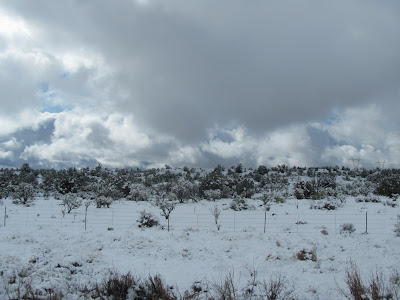
Snowy desert near Kingman
Heading south, we soon passed into the shadow of the Hualapais and the snow disappeared.  We started exploring around Lower Trout Creek Road, but didn't manage to find much birding.  Eventually we made it to the only eBird hotspot in the region, Burro Creek Campground, on a tributary of the Big Sandy.  The scenery certainly didn't disappoint.


After a slow morning, it was a relief to bird a spot with even moderate bird activity.  About 30 migrating Violet-green Swallows flew over in a stream, along with a few Trees; some typical riparian birds were active along the creek.  It was certainly a surprise when a Golden-crowned Sparrow turned up with a handful of White-crowned Sparrows - a new state bird for David and a county bird for me!  I've been checking sparrow flocks all winter looking for this species, so it was great to finally find one.  This has been a very slow winter for Golden-crowned Sparrows in Arizona; the only report I know of was a few weeks ago in southeast AZ.

Photo by David Vander Pluym
With plenty of time left in the day, we did a bit of exploring around the Poachie Mountains south of Burro Creek.  Driving Seventeen Mile Road, we followed eBird's County Birding protocol to see what birds were typical there.  The habitat was an interesting transition zone:  juniper and other higher-elevation plants were mixed with saguaro, creosote and such desert plants.  Most of the birds were desert species such as Cactus Wren, Gilded Flicker, Phainopepla, and Black-throated Sparrow.  There were also some species more typical of juniper woodland, like Bushtit and Oregon Junco.

David enjoying the scenery at a randomly selected birding location

Saguaro


When we reached the Big Sandy River once again, we were a little disappointed with the lack of riparian habitat.  However, we spied a few ranches just across the river with nice-looking open fields with scattered brush, and decided to check them out.  Walking down the road, we didn't have many species, but there were a lot of birds.  A single Mountain White-crowned Sparrow was among many Gambel's White-crowns.  Brewer's Sparrow was an overdue addition to my Mohave County year list.

Our last stop of the day was along the Big Sandy River in the town of Wikieup.  Driving along Cholla Canyon Ranch Rd, we were frustrated by a whole lot of "No Trespassing" signs, but finally found a way to access the river that seemed legitimate.  Once we got into the habitat, we were floored.  Extensive riparian habitat stretches for miles, with tall cottonwoods and patchy understory.  This place seems golden.  It wasn't long before we hit a flock, with more birds than we'd had most of the day.  A harsh scolding call alerted us to a Plumbeous Vireo, rare in winter.  Wandering through the sandy riverbed, we reached another area with budding cottonwoods and good bird activity.  While David was checking out a tree full of Gila Woodpeckers and Audubon's Warblers, I stopped to scan the tops of another set of cottonwoods.  While I scanned, I heard a faint call that I couldn't place.  I figured it must be something really distant at first, but eventually I heard it clearly:  a mournful, descending "wheeeeur" call that I know well.  It was a Dusky-capped Flycatcher, calling softly but regularly.  I called David over and we both listened to the calling bird.  Unfortunately, it was in one of the few areas with a really thick understory, and a solid wall of tamarisk stood between us and the bird.  That didn't stop us from trying to see it, and we crawled through tangles of tamarisk in a vain attempt to see the flycatcher.  In the end, all we had to show for it were tamarisk needles everywhere.

Prior to this winter, there were only about five records of Dusky-capped Flycatcher in Arizona in winter.  This winter, though, one turned up in Maricopa County, then the bird at Parker Oasis (La Paz County) was discovered, and now there is this one in Mohave County.  In summer, this species is typically found in southeastern Arizona but does wander northwest of its typical range.  Rosenberg et al. gives one record from Topock, but I know of no other sightings from Mohave County.

Needless to say, we were pretty satisfied with our day on the Big Sandy, even though we never got to see the Dusky-capped.  More than anything, I am really excited to see what else may turn up in this spectacular area in the future!