Showing posts with label 'Ahakhav Tribal Preserve. Show all posts

Sunday, July 1, 2012

Early Fall Birding

It feels a little weird to call it "fall birding" on July 1st, but with temperatures spiking over 115 recently*, it is much more pleasant to think of fall than summer.  Besides, as I have written before, something is always moving in the LCRV, and a few species begin to migrate south by mid-June, which is when the last of the spring migrants pass us by.

*Temperature range for today's outing: low 66; high 110

Today's birding trip with David to the Blythe area had many purposes.  Primary among those was just to get out birding, as I haven't had much chance lately.  Then there were the cuckoos, the shady forest birds known to be inhabiting the restoration sites in the Blythe area, representing potential ticks in La Paz and Riverside Counties.  Not to mention, of course, that they are all-around cool birds.  Finally, as always, there were migrants to track, and potential vagrants to find!

Today started where every good birding trip starts, 3:00 a.m.*  The plan was roughly to work out way south through western sites, then back north through eastern sites.  We started at Palo Verde Ecological Reserve (PVER), one of the Bureau of Reclamation's excellent riparian restoration sites.  It is particularly interesting being located in California, since most restoration sites (as well as remaining riparian habitat) fall in Arizona.  Along with Picacho State Recreation Area, PVER has some of the best landbird habitat along the California side of the lower Colorado River.

*I do not stand by this statement.

Dawn at PVER.  Tiny Bigfoot at the edge of the trees in the distance is a cuckoo researcher.
Breeding season at PVER.  Park in the parking area and you will be greeted by the cacophony of calls typical of an active Red-winged Blackbird colony.  Birds are abundant here, although most are blackbirds, cowbirds, and doves.  Several countersinging Blue Grosbeaks provided an easy Riverside County tick for me, but we were there for the cuckoos.  Sauntering along the road pictured above, it was not long before we heard the series of knocking calls typical of Yellow-billed Cuckoo.  Success!  Icing on the cake were flyby Long-billed Curlews and a single Whimbrel, and a female Indigo Bunting on our way out.

Today's INBU at PVER looked much like this one, but less thoughtful.
After a quick stop to check on a small heron colony and ogle fledgling Great Egrets, we were off to our next cuckoo stop, Cibola Valley Conservation Area!  I was glad to explore a plot I surveyed in 2011 that seemed great for cuckoos.  It took a bit of walking, but we finally heard a slow knocking, quickly answered by another bird hidden in the willows.  While walking out, we heard another bird knocking to itself.

Our next stop was at a most intriguing place, a Birding Site Without a Name in Imperial County, CA.  This is one of the earliest restoration plots along the river, and its character is very different from its younger siblings.  Dead and half-alive cottonwoods stand along the levee road adjacent to the river for the long stretch of this site, while healthier, bigger cottonwoods share the other side of the road with a mixture of Eucalyptus, Athel tamarisk, mesquite, and palo verde.  The site is narrow but long, with farm fields on the other side.  David and I birded this area once before, but approached from the farm field side and found it difficult and unsatisfying to bird.  Today, we discovered the access from the Levee Rd near CVCA, and were excited to see this habitat was not only very nice for migrating birds, but also very easy to bird.

"Palo Verde--Old Restoration Site"
The site is reminiscent of Parker Oasis on a grander scale.  I can imagine this spot being very good birding in winter or fall, but it could really have some amazing birding in spring, when birds gravitate to trees along the river as they work their way north.  Today, it was hot by the time we reached this spot, and birds had gotten quiet.  Still, I was surprised to pick up two Imperial County birds, Brown-crested Flycatcher and Lucy's Warbler!

Now on to fall migration.  La Paz County doesn't have a lot of shorebirding spots, but what it has is quality.  No mediocre sewage treatment plants around here.  The three main sites are the Parker Valley (pretty good), the Bill Williams Delta (great, as long as there are veg mats for the birds to loaf on), and Hart Mine Marsh (solid gold!).  Once the day had gotten too hot for landbirding, we cranked up the AC and rode on to Hart Mine Marsh.

Hart Mine Marsh, home to shorebirds, herons, rails and many other marsh fowl
Most of our notable birds here turned out to be ducks, which are likely oversummering birds.  In addition to the expected Mallards and Ruddy Ducks, there were Gadwall, Cinnamon Teal, a Northern Shoveler, and a Redhead.  Fall migrants were numerous: an avocet, a Greater Yellowlegs, 2 Willets, 3 Marbled Godwits, a Least Sandpiper, and 2 Caspian Terns.  Two Snowy Plovers were good to see, although we don't know whether these were early migrants or potential (failed?) breeders.  This was my first real taste of fall migration this season!  Still, the highlight here was an unusual short-tailed bird that crossed the road in front of us...

Photo of a (different) bobcat by David Vander Pluym

After this fine morning it was time to head home, but since the Parker Valley lies between Blythe and Lake Havasu City, there was still more birding to do.  Several flooded fields in the area hosted gobs of Cattle Egrets and White-faced Ibis along with a few Long-billed Curlews and Marbled Godwits.  We made a thorough check of the Twelvemile Slough Rookery, which includes nesting Cattle and Snowy Egrets and White-faced Ibis.  None of these are common nesting birds in the LCRV, and this may be the only active nesting location for Cattle Egret and White-faced Ibis.  All the more exciting to come here and count 950 Cattle Egret and 50 White-faced Ibis nests!  The Cattle Egrets were particularly exciting, most nests holding two near-fledging chicks at varying stages of awkwardness.

Cattle Egret awaiting its next meal

Each pair of white specks represents a Cattle Egret nest
Despite temperatures creeping into triple digits at this point, we decided to make a quick stop at 'Ahakhav Tribal Preserve to check on the Tropical Kingbirds.  This pair returned to the same spot where they raised two chicks last year, and had already been found nest-building in May.  More recently, incidentally, the pair at Pintail Slough returned to their territory as well.  Since we hadn't had any recent news on the 'Ahakhav birds, we wanted to find out how they were doing.  Long story short:  three chicks in a nest!

Tropical Kingbird broods its chicks
Next, our requisite shorebirding stop in the Parker Strip: Emerald Cove sewage ponds.  The habitat looks nice, but there was not a lot around today.  One surprise was a pure-looking drake Mexican Duck that stood out from all the other brown male Mallards in eclipse plumage.  Not only was he darker overall, but the clincher was his tail: medium brown, not white.

Finally, we had to make one last stop at the Bill Williams Delta, premier Arizona birding location for Just About Everything. Of course, it's not such a happening place in early July, but we did see two Black and three Caspian Terns and three Eared Grebes as well as the continuing Neotropic Cormorant.  As I said earlier, it is a very attractive place to shorebirds when there are vast veg mats for the birds to loaf and gather on.  Even before the summer bloom of these mats, though, we found shorebirds trying to use the available space:  40 Marbled Godwits were crammed onto a small spit of rocks jutting into the water, and the Caspian Terns were repeatedly trying to land among them (without success)!

Today was filled with some wild temperature extremes (44 degrees difference!), great birds, exciting migration, good food (burritos from Ruperto's in Parker), good company, and all you expect from a birding trip.  When all is said and done, I just have to say it was good to get outside.

Thursday, April 26, 2012

Spring Migration Birding

With temperatures creeping above 100 in the past week, those of us along the river here were happy to hear that a front was coming through, bringing possible rain and highs in the 80s.  Of course, there is always a potential for a front like this to drop migrants and make for good birding.

In general, spring migration has been fairly slow along the Bill Williams River this spring.  I've had most of the expected species (including my FOS Hermit Warbler yesterday), but numbers have been fairly low.  My high count of Wilson's Warbler for a survey, for example, is only 15.  Western Flycatchers have been moving through in small numbers, as well.  With reports of dozens of migrants around Yuma and Blythe, we've been eagerly anticipating some real numbers coming through.  With overcast skies yesterday and anticipation of a temperature drop, there was hope for a good day of birding soon (predicted by radar this morning by Tim Schreckengost).

This morning, David and I met Tom Johnson for a morning of birding on Lake Havasu.  We started at the north end viewpoint (which Tom has renamed Cape Havasu, a name I find very fitting), but the wind was gusting so hard it was difficult to stand on top of the hill, let alone set up a scope!  We estimated the swarms of Tree Swallows (2000) and headed to Rotary Park, hoping it would be more sheltered.  There wasn't much on the beach at the park, but the wind turned to rain so we were able to amble around the park and look at (soggy) migrant Passerines.  It was a good thing we did, as there were plenty of birds to see, including an estimated 60 Wilson's Warblers.

With some signs of movement in Lake Havasu City, we decided to head down to the Bill Williams Delta to look for waterbirds.  The Delta was slow, but we did have some lingering Greater Scaup and the continuing male Surf Scoter.  Before long, the rain stopped, and we felt inspired to continue further south.

After the customary stop at Ruperto's in Parker, we arrived at 'Ahakhav Tribal Preserve.  We checked out the park area, typically the best spot at the preserve for migrants, and were not disappointed.  A good variety of migrants was present, including about 11 Empids and eight species of warblers (about 60 were Wilson's and 15 were Nashville).  As we were walking out of the park I stopped to look at a hummingbird, and immediately called David and Tom to check it out, as I knew from its buffy underparts that it was something good.  At first I thought it was a Broad-tailed Hummingbird, but was not disappointed when I realized it was a Calliope Hummingbird!  A county bird for David and I, which Rosenberg et al. list as rare and irregular in the LCRV.  Naturally, it flew away as soon as I called out "Calliope", and was not cooperative in allowing more good looks.  Eventually, while it was skulking in a big mesquite, David got a look at it sitting next to another small hummingbird--amazingly, it was another Calliope!  We all got looks at both birds, and 'Ahakhav lived up to its reputation as a magnet for rare birds.  Check out the eBird list for our full bird count.


Calliope Hummingbirds (note difference in throat patterns).  Photos by Tom Johnson.
On our way north, we passed by Parker Oasis, and at first were thinking of passing it by.  David decided to stop briefly just to see if there were birds around, and good thing he did!  As soon as we pulled in, we saw dozens of warblers flying between trees.  After 45 minutes picking through warblers and other migrants, we estimated there were 150 Audubon's Warblers and 100 Wilson's Warblers in this small patch of habitat!  Six species of flycatcher and of swallows, nine species of warbler and others.  No rarities, but it was an exhilarating stop with migration in full swing!  Check out the eBird list here.

We then birded our way north along the California side, not running into any more huge numbers but finding decent numbers of migrants at Quail Hollow and good shorebird habitat (but low diversity) at Emerald Cove.

With this weekend's upcoming AZFO Expedition to the Big Sandy Wash and several more weeks of surveying in the Bill Williams ahead of us, I'm excited to see what will happen next!

Tuesday, September 27, 2011

LCRV Rarity Photos

I've been promising for a while to post photos of rarities that have been seen lately in the LCRV.  The thing is, the rarities just keep coming!  I have finally caught up, for now, and I present a suite of photos of recent rarities (all photos by Lauren Harter unless otherwise stated).

First, remember the Long-tailed Jaeger from my last post?  Since that sighting, we were having continual sighting of distant jaegers identified as "probable Long-tailed".  I was getting pretty sick of jaegers after a while.  Finally, though, David managed to get some good, identifiable photos of a Long-tailed Jaeger.  Then, David and I spotted the bird sitting on the water not far off Pittsburgh Point.  It was gorging on a dead fish.  We were puzzled when it flew up into a cove and out of sight, and we couldn't refind the bird!  I scanned from a rocky ridge while David walked the shoreline, both of us trying to turn up this bird.  Eventually David gave up and started walking up the next ridge over, only to see the jaeger sitting on top of the ridge!  David having inadvertently flushed it, the bird flew back to its dead fish--and right over my head.  I mean if I had stretched out my arm I could have pet this bird's belly.  With the jaeger back at its fish, I digiscoped some better photos.

Photo by David Vander Pluym

These photos show the most important marks for Long-tailed Jaeger - lack of cinnamon tones in the plumage, bold black-and-white barring on the undertail coverts, two white primary shafts, boldly marked underwing coverts, whitish tips to upperwing coverts, and especially the two long central tail feathers.  The bill does look a little large for LTJA - remember that was one of the confusing features I mentioned in my earlier post - and just shows how important it is to note multiple features in juvenile jaeger ID!
In case anyone is wondering why I think this is the same bird I photographed before...

Photo from 15 Sept
Photo from 9 Sept
To get a bit more chronological, I'll go back to August and our great shorebird migration.  Several Sanderlings were seen, particularly in the Bill Williams Delta, where up to nine were present at a time.  This bird was photographed in the Parker Strip on the California side, at Emerald Cove Sewage Ponds, August 30.


On a county level, one of the "better" birds in the LCRV this fall is the Tricolored Heron at the north end of Lake Havasu.  If accepted by the CBRC, this will be a first county record for San Bernardino County (CA) as well as Mohave (AZ)!  Oddly enough, Tricolored Heron turns up regularly in southern Arizona, but there are few records for the LCRV, and it is rare enough to be a review species in California.  This bird is also unusual because it is an adult.  It was first spotted August 10, and as far as I know it is still around!

Sept 4, being chased by a Ring-billed Gull
Sept 12 photo by David Vander Pluym
John West has gotten some beautiful shots of this bird, which will hopefully be posted at the link above.

Back to jaegers for a moment is a single photo of our first jaeger this fall, a Parasitic.  This bird flew by us on the hill without stopping for a moment, heading north.  It came by close enough for photos, but not close enough for good photos!

Sept 6 photo by David Vander Pluym
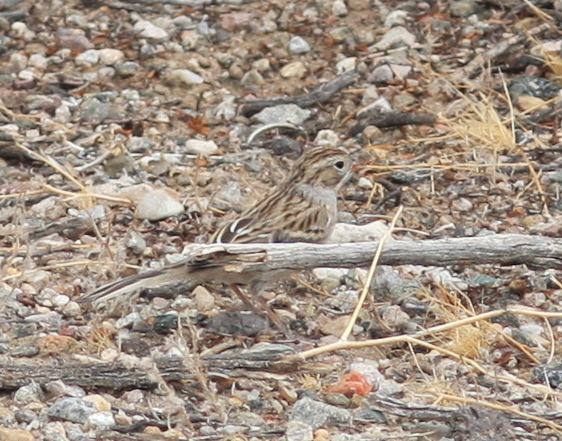
Next up is a round of photos of Spizella sparrows.  Usually, there is little difficulty in distinguishing Clay-colored and Brewer's Sparrows.  Clay-colored is a much brighter, more distinctly marked bird, with a broad buffy supercilium and gray nape, both unmarked.  Clay-colored also has a distinct dark lateral throat-stripe and a less distinct, partial eye-ring.  Brewer's typically shows a much more muted face pattern, with short dark streaks on the supercilium and nape, a dull, indistinct lateral throat-stripe, and a bright, complete eye-ring.  Clay-colored also shows a distinct pale central crown-stripe - Brewer's can show a less distinct stripe, but this is one feature that doesn't seem to overlap.

On Sept 9, I encountered a flock of Spizellas that seemed to be mixed Clay-colored and Brewer's.  Being inexperienced with fall Clay-colors, I just started snapping photos of every bird I could get close to.  Later I examined the photos and read up on Spizella identification.  An excellent article by Peter Pyle and Steve Howell can be found in Birding 28:5 (Oct 1996), "Spizella Sparrows: Intraspecific Variation and Identification".  After reading this article and other information on Spizella ID, studying my photos and grouping photos of individuals based on individual feather patterns, I concluded that I had photographed four Clay-colored Sparrows in this flock.  As Brewer's Sparrow migration has continued, I have come to appreciate the range of variation that this species shows.  Many of the birds I encounter have gray napes and broad supercilia only slightly marked with streaks, as well as distinct dark lateral throat-stripes.  The mark that these birds do not show is the distinct pale central crown-stripe.

I would be interested in hearing comments on the four birds that follow from anyone familiar with fall Clay-colored Sparrow, as none of these birds are quite as bright as I would expect from a typical CCSP.  I have plenty more photos and full-size versions for anyone who is interested.

Bird #1 (left) with Brewer's Sparrow (?)

Bird #1, showing central crown-stripe

Bird #1, closer look at face and nape pattern
Bird #2, the most confusing individual to me.  It has a muted face pattern, although the supercilium and nape do not seem to be streaky, but it shows a distinct central crown-stripe.

Bird #2, side view.  Is this a Brewer's Sparrow with an unusually distinct central crown-stripe, or a very dull Clay-colored Sparrow?
This was bird #4, but as I went to add these photos I realized that it's the same as bird #2...

Bird #2, blurry but in better light?  Looking much more distinctly patterned...
Bird #3

Bird #3 and its central crown-stripe
The next Clay-colored Sparrow showed up September 10-11, and this bird was a beauty!  After straining my eyes looking at individual feathers on the preceding birds, it was nice to see a CCSP that was very brightly marked, and buffy on the breast.


Both photos Sept 11 by David Vander Pluym
But that's not all the CCSP observations!  At the same location, I saw one September 14.  I saw it well but briefly when I first arrived at the spot, then later I believe I got a fuzzy photo of the bird (below) - I was focusing on taking pictures so I didn't get a clear view in the field the second time I saw it.

CCSP?

Just for fun, I think this is one of those well-marked Brewer's Sparrows that shows a central crown-stripe.  Or maybe it's another Clay-colored...

Birding the same spot Sept 25, I saw yet another CCSP - this really seems to be a hotspot.  Finally, I have heard that David found on on the California side of the Parker Strip this morning!

Back to September 14, a day when the north end viewpoint was alive with migrants.  In addition to the Clay-colored Sparrow, I had a Virginia's Warbler and Dusky Flycatcher, both good birds in the LCRV.
Virginia's Warbler
Dusky Flycatcher.  The short primary projection and long tail are visible in the photo; it was also giving a "whit" call in the field.

Moving on to the next bird, the Bobolink.  The story of its discovery is pretty amazing, I think.  I was birding the north end viewpoint with my friend David Rankin.  While he was standing on the hill and I was birding the riparian below, I saw him suddenly look at something with binoculars, and I heard this weird soft call.  As a bird flew over his head, he took his binoculars down, pointed at it, then raised his binoculars again.  I got my binoculars on it as it flew over, calling again, "boink".  I saw a yellow bird with a few distinct streaks on the flanks.  We both agreed that this had to have been a Bobolink, but for such a rare bird in Arizona, our view was frustratingly brief.  I had to forget about it, because as I told David, there was no way we would be able to find it again - it showed no signs of stopping, and even if it did, there is plenty of potential habitat for it along the lake shore!  So we continued birding and, over an hour later, made our way to Rotary Park.  David got out of the car and started scanning the golf course--and almost immediately spotted a yellow bird among the sparrows.  I got my scope on it and, sure enough, it was the Bobolink!  It happened to land on this golf course, over 4 miles from the north end where it had flown over us, and in a place where David was able to find it again!  This was September 21, and it was still present as of yesterday (Sept 26).  It has been seen by many birders, fortunately.  Following are a few of my photos from the day it was found, but better photos can be seen here.


The next bird was very frustrating in the field.  Birding 'Ahakhav Tribal Preserve, I spent quite a bit of time in pursuit of an Empidonax flycatcher giving a "whit" call.  Typically the only two species that give such a call in the LCRV are Willow and Gray Flycatchers.  Once I got a brief view of the bird, I could see that it wasn't a Willow, and the bill wasn't right for Gray.  I tried to get a better view, thinking it may be a Dusky, a fairly rare bird in the LCRV.  Eventually the bird sat in the open for a moment, and I saw very contrasty wings, and odd tail-flicking behavior - it was flicking its tail quickly down.  Both are features of Least Flycatcher.  David and I spent the next few hours trying to get good views of the bird, and David finally managed to get some decent pictures.  It's the bill that clinches the ID - the long narrow bill with about a substantial dusky tip points to Dusky Flycatcher, not Least.  Not the rarity we would have liked, but still a good bird!


Both photos Sept 25 by David Vander Pluym.  Bill shape and pattern characteristic of Dusky Flycatcher shown well in the first photo.  Wings looked more contrasty in the field than they do in the second photo.
Birding along the state line between Arizona and California produces some interesting patterns.  One thing we have noticed is that sometimes, you see a bird that is a much more interesting record on one side of this imaginary line than the other.  Neotropic Cormorant is one example--they always seem to turn up in Arizona, but they are a Review Species in California.  Similarly, a jaeger on the California side is a good bird for the inland counties, but all three jaegers are Review Species in Arizona.  Yesterday, I saw one of these species: a Cassin's Sparrow.  While this species is common in southeastern Arizona, there are few records for the northern and western regions of the state.  Rosenberg et al. only lists one record from the LCRV, in La Paz County.  This summer, David and I found the first in Mohave County - around Peach Springs, we had several singing birds.  This was a good year for them in northern Arizona, with reports across the northern tier of the state.  Across the lake in California, Cassin's Sparrow is a Review Species.  There have been several records of singing and even breeding birds in San Bernardino County, but only in very good years.

The Cassin's Sparrow I saw yesterday was in Mohave, at the north end viewpoint.  This was a very surprising find, with the bird not only out of range but in unusual habitat.  I came around a corner to see a sparrow feeding on the edge of some dense vegetation on the lake shore.  Thinking it would be a Brewer's Sparrow, I got my binoculars on it in time to see a scaly pattern on the back and crown, and I knew it was a Cassin's Sparrow.  It disappeared into the brush as soon as it saw me, peeking out only for a moment so I could see a distinct eye-ring.  I then waited and waited, staring at the brush pile and trying to ignore all the Brewer's and Chipping Sparrows, Orange-crowned Warblers, and other birds flitting all around me.  Eventually, the Cassin's Sparrow did come out, and I managed to get some decent photos.

Note plain dark tertials with distinct white edging, scaly-striped back pattern, eye-ring, and yellow supraloral, as well as shape.

Note faintly streaked breast, yellow at bend of wing, and dull yellow supralorals
That's it for now.  Until next time!

Wednesday, July 20, 2011

How I Spent My Spring

To say I had a busy spring would be an impressive understatement!  I continued my part-time job with the City of Lake Havasu, but caved to my desire to get out in the field by working for the Great Basin Bird Observatory.  The GBBO is doing work for the U.S. Bureau of Reclamation, which is doing a lot of work creating and monitoring habitat on the LCRV.  The main part of this work that I've been involved in is the Multi-Species Conservation Plan (MSCP), through which the Bureau monitors certain focal species that are not federally listed.  Those that are listed or candidates - Yuma Clapper Rail, Yellow-billed Cuckoo, Southwestern Willow Flycatcher - are covered by species-specific projects.  The Bureau has done a lot of great work with the MSCP and gathered an impressive amount of data.  The technical reports are available online here, a very interesting resource.

The project I helped with this spring was aimed at quantifying the use of different riparian habitats by breeding birds, especially MSCP covered species - Gilded Flicker, Gila Woodpecker, Yellow Warbler, Bell's Vireo, Summer Tanager, and Vermilion Flycatcher.  Essentially, we were surveying 400m x 400m (ish) plots, recording migrants and mapping every breeding bird we could locate in a morning.  The plots were randomly selected, falling from Laughlin to Yuma, and up the Bill Williams River almost to Alamo Dam.  I won't go over the protocols and study design in detail here - you can read about it in the 2009 report.

Since I was also working for the city, I was working a bit less than the others on the project, but I was still plenty busy.  I surveyed one site twice a week, another site once a week, and several sites only twice over the season.  The twice a week site was my "extreme intensive" at 'Ahakhav Tribal Preserve.  I was pleased as punch to visit that site 16 times over the field season!  Since it's a habitat creation site, it's easy to walk around and find nests, and it is also full of birds.  The Vermilion Flycatchers and Lawrence's Goldfinches breeding there were especially fun to watch.  The site I visited once a week was actually immediately adjacent to the hill we scan the north end of Lake Havasu from, which we call "Lehman Hill".  The hill is the southern boundary of the plot, which extends north about a kilometer in a dense tamarisk/mesquite stringer with patches of arrowweed and some big willows.  The breeders weren't as interesting, but the site was great for migrants.  Since the site ran along the shore of the lake, I surveyed it by kayak several times.

Ahakhav, great spot to spend two days a week
Vermilion Flycatcher babies!

Kayaking the north end

My other surveys were mainly in La Paz County.  Several were in Cibola NWR, one was in Mosquito Flats on the Bill Will, and one was up the Bill Will at Lincoln Ranch, about six miles downstream from the Alamo Dam.  One fell in San Bernardino County near Needles, and I also surveyed the Island STP in Lake Havasu City.

Lincoln Ranch Rd
Lincoln Ranch

Just for fun, I put together this summary of spring migration on the LCRV.  This only includes regular migrants, not rarities.  I also omitted any species for which I didn't get a good sense of their migratory patterns - for example, I missed the arrival of Lucy's Warblers and saw my FOS long after many had arrived.  This only includes my sightings, so it is by no means a complete summary of migrants this spring.  To read about rarities and overall sightings, we'll have to wait for AZFO's spring Seasonal Report.

This being a 12-page word document, I thought I'd stick it behind a cut...

Friday, January 28, 2011

'Ahakhav Tribal Preserve

The 'Ahakhav Tribal Preserve lies just outside of Parker, AZ.  The preserve was established in 1995 by the Colorado River Indian Tribes as a place to restore the natural and cultural heritage of the Colorado River.  Now it stands as a bright green patch among the agricultural fields of the Parker Valley and the River's invasive tamarisk sprawl.


David and I visited the preserve two days ago, on January 26, to see what birds were about.  We didn't even have to leave the picnic area!  There were plenty of the expected species, like this Phainopepla.


Bell's Vireos are a declining riparian breeding species, and they respond very well to restoration projects like this.  Still, it was quite a surprise to see this Bell's Vireo at 'Ahakhav, since there are only a few winter records for the entire state!


 We went to the preserve hoping to see a certain sapsucker, first reported by Paul Lehman on November 26 last year, and recently seen by Henry Detwiler et al.  This guy turned out to be very confiding, and had no problem with me snapping photos.


This is a hybrid between the expected Red-naped Sapsucker and the rare Red-breasted Sapsucker.  The black mottling in the breast and the relatively limited red in the face pattern give this away as a hybrid, as a pure Red-breasted would have a solid red breast and much more red on the head.  Red-naped Sapsuckers shouldn't have any red in the breast, and have more limited red in the face pattern.  Even though this bird isn't "countable" as either species, it was an interesting individual to study.  These hybrids are probably more regular in Arizona than pure Red-breasted Sapsuckers, so it is important to be able to recognize hybrid characteristics when a possible Red-breasted is seen.

This point was illustrated the same day, when David spotted a different sapsucker, this one with an apparently solid red breast!  Unfortunately the bird was extremely skittish and did not allow us to get good looks or decent photos.  While the bird looked good in the field, my one photograph shows a bit too much white in the face pattern for Red-breasted Sapsucker, so this was probably another hybrid.  We're hoping to see the bird again and study it more.

Of course, these birds were considered conspecific until the 1980s, and this may not have been a good split.  Extensive hybridization in a broad area of range overlap is an indication of subspecies within a single species, which seems to be the case with these sapsuckers.  Many ornithologists believe that these taxa should be "re-lumped" as one species.  Read more about sapsuckers and hybridization here and here.  No matter what happens with these taxa, I will continue to look for unusual individuals and try to understand variation within this complex!

Departing from 'Ahakhav, we checked some agricultural fields around the Parker Valley and drove back to Lake Havasu City along the California side of the river, searching for the Yellow-billed Loon.  After a group of us found it just north of Parker on January 15, it has been giving birders a hard time, moving miles up and down the river within a single day.  David and I finally spotted it from Empire Landing, on the California side of the Parker Strip, on a section of river with little more than coots.  Just goes to show that rare birds can be found anywhere, not just our hotspots!

(click the link above for much better photos)