Showing posts with label Migration. Show all posts

Sunday, July 1, 2012

Early Fall Birding

It feels a little weird to call it "fall birding" on July 1st, but with temperatures spiking over 115 recently*, it is much more pleasant to think of fall than summer.  Besides, as I have written before, something is always moving in the LCRV, and a few species begin to migrate south by mid-June, which is when the last of the spring migrants pass us by.

*Temperature range for today's outing: low 66; high 110

Today's birding trip with David to the Blythe area had many purposes.  Primary among those was just to get out birding, as I haven't had much chance lately.  Then there were the cuckoos, the shady forest birds known to be inhabiting the restoration sites in the Blythe area, representing potential ticks in La Paz and Riverside Counties.  Not to mention, of course, that they are all-around cool birds.  Finally, as always, there were migrants to track, and potential vagrants to find!

Today started where every good birding trip starts, 3:00 a.m.*  The plan was roughly to work out way south through western sites, then back north through eastern sites.  We started at Palo Verde Ecological Reserve (PVER), one of the Bureau of Reclamation's excellent riparian restoration sites.  It is particularly interesting being located in California, since most restoration sites (as well as remaining riparian habitat) fall in Arizona.  Along with Picacho State Recreation Area, PVER has some of the best landbird habitat along the California side of the lower Colorado River.

*I do not stand by this statement.

Dawn at PVER.  Tiny Bigfoot at the edge of the trees in the distance is a cuckoo researcher.
Breeding season at PVER.  Park in the parking area and you will be greeted by the cacophony of calls typical of an active Red-winged Blackbird colony.  Birds are abundant here, although most are blackbirds, cowbirds, and doves.  Several countersinging Blue Grosbeaks provided an easy Riverside County tick for me, but we were there for the cuckoos.  Sauntering along the road pictured above, it was not long before we heard the series of knocking calls typical of Yellow-billed Cuckoo.  Success!  Icing on the cake were flyby Long-billed Curlews and a single Whimbrel, and a female Indigo Bunting on our way out.

Today's INBU at PVER looked much like this one, but less thoughtful.
After a quick stop to check on a small heron colony and ogle fledgling Great Egrets, we were off to our next cuckoo stop, Cibola Valley Conservation Area!  I was glad to explore a plot I surveyed in 2011 that seemed great for cuckoos.  It took a bit of walking, but we finally heard a slow knocking, quickly answered by another bird hidden in the willows.  While walking out, we heard another bird knocking to itself.

Our next stop was at a most intriguing place, a Birding Site Without a Name in Imperial County, CA.  This is one of the earliest restoration plots along the river, and its character is very different from its younger siblings.  Dead and half-alive cottonwoods stand along the levee road adjacent to the river for the long stretch of this site, while healthier, bigger cottonwoods share the other side of the road with a mixture of Eucalyptus, Athel tamarisk, mesquite, and palo verde.  The site is narrow but long, with farm fields on the other side.  David and I birded this area once before, but approached from the farm field side and found it difficult and unsatisfying to bird.  Today, we discovered the access from the Levee Rd near CVCA, and were excited to see this habitat was not only very nice for migrating birds, but also very easy to bird.

"Palo Verde--Old Restoration Site"
The site is reminiscent of Parker Oasis on a grander scale.  I can imagine this spot being very good birding in winter or fall, but it could really have some amazing birding in spring, when birds gravitate to trees along the river as they work their way north.  Today, it was hot by the time we reached this spot, and birds had gotten quiet.  Still, I was surprised to pick up two Imperial County birds, Brown-crested Flycatcher and Lucy's Warbler!

Now on to fall migration.  La Paz County doesn't have a lot of shorebirding spots, but what it has is quality.  No mediocre sewage treatment plants around here.  The three main sites are the Parker Valley (pretty good), the Bill Williams Delta (great, as long as there are veg mats for the birds to loaf on), and Hart Mine Marsh (solid gold!).  Once the day had gotten too hot for landbirding, we cranked up the AC and rode on to Hart Mine Marsh.

Hart Mine Marsh, home to shorebirds, herons, rails and many other marsh fowl
Most of our notable birds here turned out to be ducks, which are likely oversummering birds.  In addition to the expected Mallards and Ruddy Ducks, there were Gadwall, Cinnamon Teal, a Northern Shoveler, and a Redhead.  Fall migrants were numerous: an avocet, a Greater Yellowlegs, 2 Willets, 3 Marbled Godwits, a Least Sandpiper, and 2 Caspian Terns.  Two Snowy Plovers were good to see, although we don't know whether these were early migrants or potential (failed?) breeders.  This was my first real taste of fall migration this season!  Still, the highlight here was an unusual short-tailed bird that crossed the road in front of us...

Photo of a (different) bobcat by David Vander Pluym

After this fine morning it was time to head home, but since the Parker Valley lies between Blythe and Lake Havasu City, there was still more birding to do.  Several flooded fields in the area hosted gobs of Cattle Egrets and White-faced Ibis along with a few Long-billed Curlews and Marbled Godwits.  We made a thorough check of the Twelvemile Slough Rookery, which includes nesting Cattle and Snowy Egrets and White-faced Ibis.  None of these are common nesting birds in the LCRV, and this may be the only active nesting location for Cattle Egret and White-faced Ibis.  All the more exciting to come here and count 950 Cattle Egret and 50 White-faced Ibis nests!  The Cattle Egrets were particularly exciting, most nests holding two near-fledging chicks at varying stages of awkwardness.

Cattle Egret awaiting its next meal

Each pair of white specks represents a Cattle Egret nest
Despite temperatures creeping into triple digits at this point, we decided to make a quick stop at 'Ahakhav Tribal Preserve to check on the Tropical Kingbirds.  This pair returned to the same spot where they raised two chicks last year, and had already been found nest-building in May.  More recently, incidentally, the pair at Pintail Slough returned to their territory as well.  Since we hadn't had any recent news on the 'Ahakhav birds, we wanted to find out how they were doing.  Long story short:  three chicks in a nest!

Tropical Kingbird broods its chicks
Next, our requisite shorebirding stop in the Parker Strip: Emerald Cove sewage ponds.  The habitat looks nice, but there was not a lot around today.  One surprise was a pure-looking drake Mexican Duck that stood out from all the other brown male Mallards in eclipse plumage.  Not only was he darker overall, but the clincher was his tail: medium brown, not white.

Finally, we had to make one last stop at the Bill Williams Delta, premier Arizona birding location for Just About Everything. Of course, it's not such a happening place in early July, but we did see two Black and three Caspian Terns and three Eared Grebes as well as the continuing Neotropic Cormorant.  As I said earlier, it is a very attractive place to shorebirds when there are vast veg mats for the birds to loaf and gather on.  Even before the summer bloom of these mats, though, we found shorebirds trying to use the available space:  40 Marbled Godwits were crammed onto a small spit of rocks jutting into the water, and the Caspian Terns were repeatedly trying to land among them (without success)!

Today was filled with some wild temperature extremes (44 degrees difference!), great birds, exciting migration, good food (burritos from Ruperto's in Parker), good company, and all you expect from a birding trip.  When all is said and done, I just have to say it was good to get outside.

Thursday, April 26, 2012

Spring Migration Birding

With temperatures creeping above 100 in the past week, those of us along the river here were happy to hear that a front was coming through, bringing possible rain and highs in the 80s.  Of course, there is always a potential for a front like this to drop migrants and make for good birding.

In general, spring migration has been fairly slow along the Bill Williams River this spring.  I've had most of the expected species (including my FOS Hermit Warbler yesterday), but numbers have been fairly low.  My high count of Wilson's Warbler for a survey, for example, is only 15.  Western Flycatchers have been moving through in small numbers, as well.  With reports of dozens of migrants around Yuma and Blythe, we've been eagerly anticipating some real numbers coming through.  With overcast skies yesterday and anticipation of a temperature drop, there was hope for a good day of birding soon (predicted by radar this morning by Tim Schreckengost).

This morning, David and I met Tom Johnson for a morning of birding on Lake Havasu.  We started at the north end viewpoint (which Tom has renamed Cape Havasu, a name I find very fitting), but the wind was gusting so hard it was difficult to stand on top of the hill, let alone set up a scope!  We estimated the swarms of Tree Swallows (2000) and headed to Rotary Park, hoping it would be more sheltered.  There wasn't much on the beach at the park, but the wind turned to rain so we were able to amble around the park and look at (soggy) migrant Passerines.  It was a good thing we did, as there were plenty of birds to see, including an estimated 60 Wilson's Warblers.

With some signs of movement in Lake Havasu City, we decided to head down to the Bill Williams Delta to look for waterbirds.  The Delta was slow, but we did have some lingering Greater Scaup and the continuing male Surf Scoter.  Before long, the rain stopped, and we felt inspired to continue further south.

After the customary stop at Ruperto's in Parker, we arrived at 'Ahakhav Tribal Preserve.  We checked out the park area, typically the best spot at the preserve for migrants, and were not disappointed.  A good variety of migrants was present, including about 11 Empids and eight species of warblers (about 60 were Wilson's and 15 were Nashville).  As we were walking out of the park I stopped to look at a hummingbird, and immediately called David and Tom to check it out, as I knew from its buffy underparts that it was something good.  At first I thought it was a Broad-tailed Hummingbird, but was not disappointed when I realized it was a Calliope Hummingbird!  A county bird for David and I, which Rosenberg et al. list as rare and irregular in the LCRV.  Naturally, it flew away as soon as I called out "Calliope", and was not cooperative in allowing more good looks.  Eventually, while it was skulking in a big mesquite, David got a look at it sitting next to another small hummingbird--amazingly, it was another Calliope!  We all got looks at both birds, and 'Ahakhav lived up to its reputation as a magnet for rare birds.  Check out the eBird list for our full bird count.


Calliope Hummingbirds (note difference in throat patterns).  Photos by Tom Johnson.
On our way north, we passed by Parker Oasis, and at first were thinking of passing it by.  David decided to stop briefly just to see if there were birds around, and good thing he did!  As soon as we pulled in, we saw dozens of warblers flying between trees.  After 45 minutes picking through warblers and other migrants, we estimated there were 150 Audubon's Warblers and 100 Wilson's Warblers in this small patch of habitat!  Six species of flycatcher and of swallows, nine species of warbler and others.  No rarities, but it was an exhilarating stop with migration in full swing!  Check out the eBird list here.

We then birded our way north along the California side, not running into any more huge numbers but finding decent numbers of migrants at Quail Hollow and good shorebird habitat (but low diversity) at Emerald Cove.

With this weekend's upcoming AZFO Expedition to the Big Sandy Wash and several more weeks of surveying in the Bill Williams ahead of us, I'm excited to see what will happen next!

Saturday, March 31, 2012

Have You Seen BirdCast?

At first I started using eBird because I liked the idea of my everyday sightings being useful for science.  I quickly grew to love how simply it organized all my sightings and lists.  Eventually, I learned how to use the data myself, by looking at bar charts and maps.  More recently, I've been amazed by the animated occurrence maps made from eBird data.

Now the folks at eBird have teamed up with NOAA and others to create BirdCast.  Using predicted weather patterns along with records of past weather patterns and eBird data from past years, Cornell is now posting a weekly report of predicted migration patterns, as well as a followup summarizing what actually occurred.

Check out this week's BirdCast report.  Reading over the section for the West, I learned to keep an eye out for the first Vaux's Swifts this week.  Also, the Lawrence's Goldfinches we have been seeing in recent weeks may begin to head west toward the core of their breeding range; hopefully, some of them will stick around to breed here!

Saturday, March 17, 2012

A Spectacle of Swallows

The field season has kicked off once again, and I spent the past ten days with the 2012 Great Basin Bird Observatory (GBBO) crew around Blythe and Yuma (Cibola and Imperial NWRs).  The beginning of the field season is the most difficult work, clearing trails and scouting plots to ensure that surveys go smoothly.

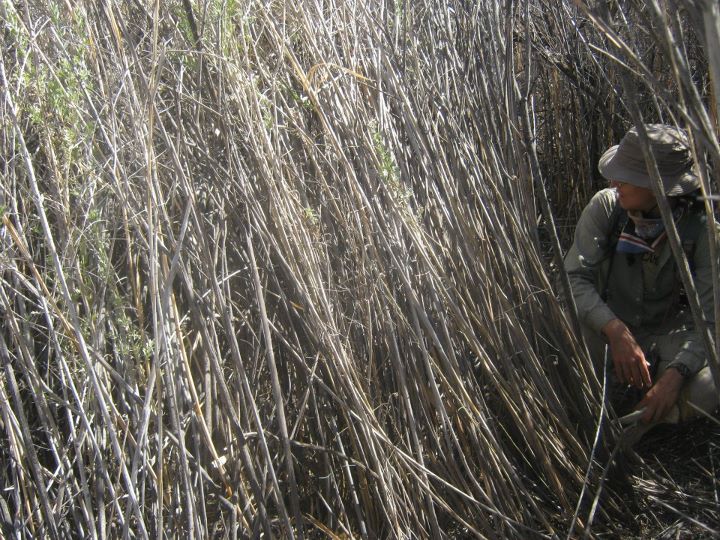
Resting on a small trail my crewmate and I carved through an arrowweed stand (Photo by Brandon Breen)

During this first tour, the crew spent several nights camping at Fishers Landing on Martinez Lake.  The campground itself was nothing to write home about, but the birding in the area was pretty good.  One thing we noticed at our campsite was that streams of hundreds of Tree Swallows would pass overhead each evening.  This was no surprise to any of us who had spent a spring along the Colorado River before, as migrating streams of swallows are a common sight out here.  One evening, though, we went up to an overlook point to scan the lake and we were impressed by the number of swallows streaming over the water, swirling over the marsh, and gathering in flocks high over the lake.  Eventually, all the swallows gained elevation and streamed into the masses high in the sky.  Numbers increased rapidly, from a few thousand to more than 20,000 as we stood and watched, estimating numbers repeatedly.  The ball of swallows moved through the sky with the liquidity of smoke, merging and splitting, climbing and shifting as the light dimmed.  Eventually, a few hundred birds broke off from the flock, diving almost straight down toward the marsh before breaking at the last moment and settling into the cattails, preparing to roost for the night.  As more and more birds joined in the plummet to the marsh, they appeared as whirling vortices to the naked eye, like twisting pillars of smoke.  Soon the clouds of swallows had drained to nothing, and as darkness fell, and two Black Rails began calling from the marsh, we headed back to the campsite.

The next night, having heard from us the spectacle we'd seen, most of the crew took the walk to the viewpoint.  The swallows were out again, streaming over the water and building in flocks over the marsh.  Eventually the flock built to an estimated 50,000 birds, more than twice the size of the previous evening's flock, and twice as spectacular!

The swallows' marsh
The crew enjoying the swallows (Both photos above by Brandon Breen)
Watching the swallows spiraling down to roost

I've seen some fantastic migration events, with the raptor migration of Veracruz topping the list: a constant stream of Broad-winged Hawks, Swainson's Hawks, Turkey Vultures and others topping 250,000 in one day!  At Hazel Bazemore near Corpus Christi, TX, I've seen kettles over 10 and 20 thousand.  This sight of swallows gathering at dusk was equally spectacular to me as those kettles of hawks.  It occurred to me while I watched this that this surpassed any gathering of cranes in Arizona or New Mexico.  Why not have a March Swallow Festival?  After all, our count of 50,000 wasn't even very high--last year's high count was about one million, and that wasn't unprecedented.  In early March last year, I counted nearly 3,200 Violet-green Swallows migrating over Rotary Park in an hour and a half.  This is a regular phenomenon in this area--even researchers are beginning to look at it using radar.  I would like to see a time in the near future when wildlife enthusiasts from all over the country (the world?) come to the Lower Colorado River Valley to see the swallow migration!

Saturday, August 27, 2011

Short-billed Dowitchers

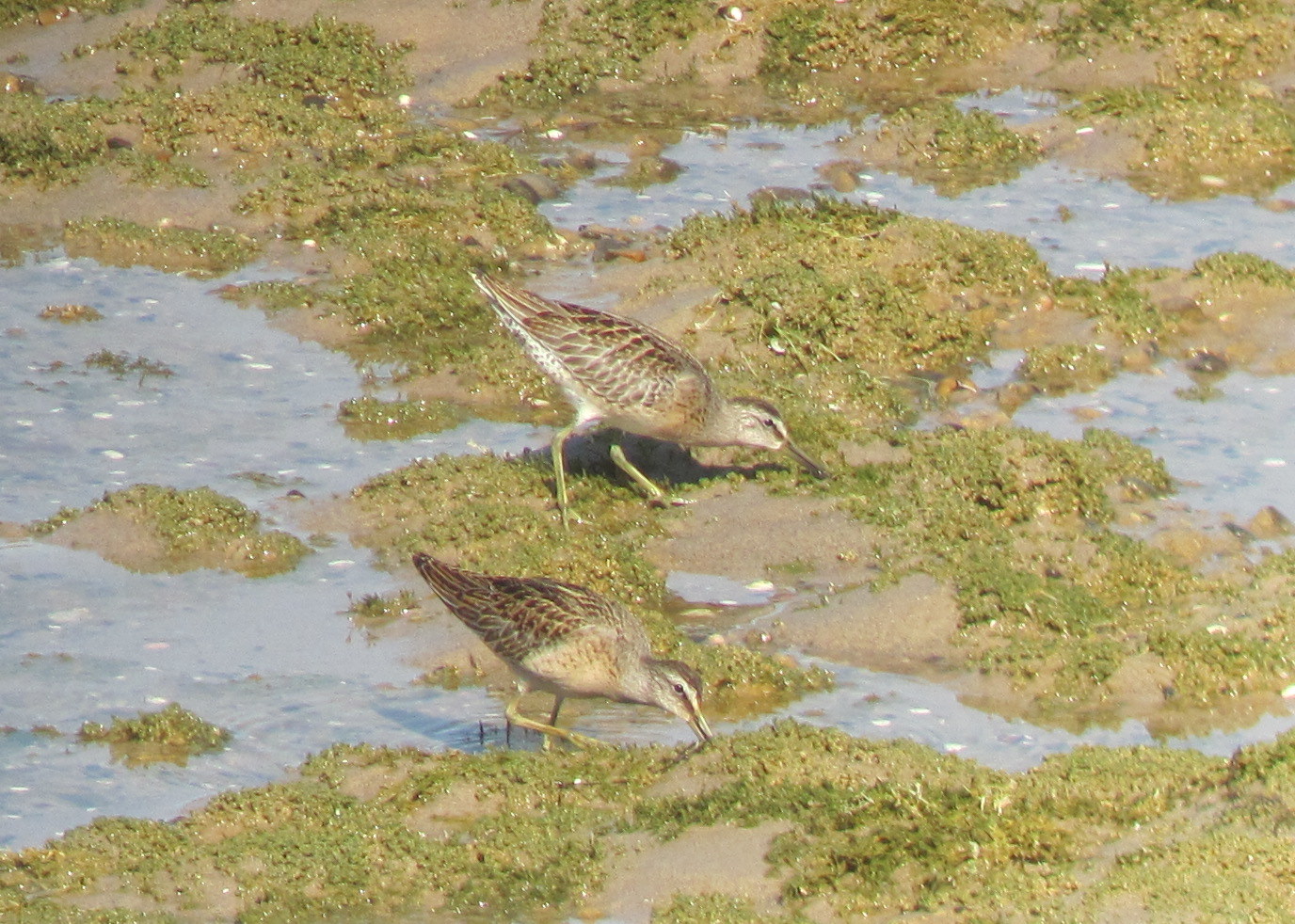
As I mentioned in my Beal Lake post, we have had quite a few Short-billed Dowitchers in the area lately.  Our first was at the Island STP August 24.  The next day, David and I counted 18 on Beal Lake.  Today, we counted 16 there, plus another 27 along the Colorado River in a 4-mile stretch near the CA/NV/AZ state lines.  A total of 43 Short-billed Dowitchers, with only ONE Long-billed!  Rosenberg et al. lists Short-billed Dowitcher as rare but regular in fall, with a high count of 13 between Parker and Lake Havasu.  Perhaps the real surprise, then, is not the number of Short-bills but the scarcity of Long-bills.  Hopefully, continued coverage this season and in subsequent years will tease out the status of both species.

While Beal Lake is not ideally suited for photography (bad light and distant birds are the rule), I did manage to photograph several of the Short-billed Dowitchers along the river today.  Several are below.  These birds are all juveniles - adults would be obvious with mainly reddish underparts.  Note the reddish blush on the breast, a good mark for juvenile Short-billed Dowitcher, as well as general shape.  The most important mark visible in the photos is the well-patterned wing coverts and tertials.  On juvenile dowitchers, rufous internal markings on the tertials is a great ID clincher - but note that it only works for juveniles.  Not visible in photos is the call note - a "tututu" reminiscent of yellowlegs, very different from the frequent "kik" calls of Long-billed.

The first photo is David's shot of the bird at the Island STP in Lake Havasu City.  All the rest are my photos of birds along the Colorado R. today.


Friday, August 12, 2011

Shorebird migration begins!

I guess I jinxed myself the other day when I said birding has been slow around Lake Havasu.  The next morning (August 10), David and I went to the north end of the lake and found an adult Tricolored Heron!  Since then, we've been birding every morning (and will try to continue it) and enjoying some movement of terns and shorebirds.

The Tricolored Heron was particularly exciting because it flew from the Arizona shore, across the lake until it landed in California!  For me, it was a new bird in both states.  More importantly, it was a first for both Mohave and San Bernardino Counties.

Ganked from http://en.wikipedia.org/wiki/File:Tricolored_Heron_by_Dan_Pancamo.jpg

Tricolored Herons are a widespread species, found year-round along the Atlantic coast from Virginia south to Brazil.  They are widespread on the Pacific coast as well, from Baja south to Ecuador.  Only in Mexico and central America are they regularly found inland.  (That information could be outdated, so any correction is welcome.)  In Arizona, the species is casual, most often found from the Tucson area south.  There are only about four previous sightings in the LCRV, which is surprising, since the birds that show up in Arizona are individuals dispersing north from Mexico, and Tricolored Herons are found around the mouth of the Colorado River.

Other exciting birds we saw that day were the first migrant terns of the fall!  Okay, to be fair, a Common Tern in early July was probably a fall migrant, and Caspian Tern fall migration has been happening since the beginning of June.  But now Black Tern migration has begun, with several individuals seen on every visit to the lake.  A few Sterna terns have been seen as well: two Forster's and one Common were on Havasu on the 10th.  Also worth noting, Ring-billed Gulls have started arriving, including the lovely juveniles.

(not a lovely juvenile)
We have a few favorite shorebird spots in the area.  In Lake Havasu, the beach at Rotary Park sometimes has shorebirds, but the Island STP is generally better habitat.  For a longer morning of birding, the Havasu NWR has some excellent shorebird habitat at Pintail Slough and Beal Lake.  We've checked all these sites in the past few days and have been excited to see lots of shorebirds turning up - small flocks of Western and Least Sandpipers, a few Marbled Godwits and Long-billed Curlews, some Black-necked Stilts and American Avocets, several Spotted Sandpipers, a Solitary, a handful of Willets, a few Dowitchers, Greater Yellowlegs, decent numbers of Wilson's Phalaropes.  Today we visited Pintail Slough hoping for a Semipalmated Plover reported by DeeDee DeLorenzo - not only was there one there, but about ten were at Beal Lake.  The highlight, though, was a Snowy Plover among the Semis at Beal Lake - a scarce migrant in the LCRV.  No real rarities on the list, but I'm always on the lookout for something good on the shimmering mudflats.

What's weird is that a lot of these birds are showing up late, according to The Book.  When other desert shorebird sites were swimming in sandpipers, all I could turn up here was a single Least!  Terns have been very scarce, as well, with very few in July - Forster's Terns should already have peaked.  It will be interesting to see if the majority of the birds are just moving south later than usual, or it turns out to simply be a poor year.  I'm hoping for the former!

Wednesday, July 20, 2011

How I Spent My Spring

To say I had a busy spring would be an impressive understatement!  I continued my part-time job with the City of Lake Havasu, but caved to my desire to get out in the field by working for the Great Basin Bird Observatory.  The GBBO is doing work for the U.S. Bureau of Reclamation, which is doing a lot of work creating and monitoring habitat on the LCRV.  The main part of this work that I've been involved in is the Multi-Species Conservation Plan (MSCP), through which the Bureau monitors certain focal species that are not federally listed.  Those that are listed or candidates - Yuma Clapper Rail, Yellow-billed Cuckoo, Southwestern Willow Flycatcher - are covered by species-specific projects.  The Bureau has done a lot of great work with the MSCP and gathered an impressive amount of data.  The technical reports are available online here, a very interesting resource.

The project I helped with this spring was aimed at quantifying the use of different riparian habitats by breeding birds, especially MSCP covered species - Gilded Flicker, Gila Woodpecker, Yellow Warbler, Bell's Vireo, Summer Tanager, and Vermilion Flycatcher.  Essentially, we were surveying 400m x 400m (ish) plots, recording migrants and mapping every breeding bird we could locate in a morning.  The plots were randomly selected, falling from Laughlin to Yuma, and up the Bill Williams River almost to Alamo Dam.  I won't go over the protocols and study design in detail here - you can read about it in the 2009 report.

Since I was also working for the city, I was working a bit less than the others on the project, but I was still plenty busy.  I surveyed one site twice a week, another site once a week, and several sites only twice over the season.  The twice a week site was my "extreme intensive" at 'Ahakhav Tribal Preserve.  I was pleased as punch to visit that site 16 times over the field season!  Since it's a habitat creation site, it's easy to walk around and find nests, and it is also full of birds.  The Vermilion Flycatchers and Lawrence's Goldfinches breeding there were especially fun to watch.  The site I visited once a week was actually immediately adjacent to the hill we scan the north end of Lake Havasu from, which we call "Lehman Hill".  The hill is the southern boundary of the plot, which extends north about a kilometer in a dense tamarisk/mesquite stringer with patches of arrowweed and some big willows.  The breeders weren't as interesting, but the site was great for migrants.  Since the site ran along the shore of the lake, I surveyed it by kayak several times.

Ahakhav, great spot to spend two days a week
Vermilion Flycatcher babies!

Kayaking the north end

My other surveys were mainly in La Paz County.  Several were in Cibola NWR, one was in Mosquito Flats on the Bill Will, and one was up the Bill Will at Lincoln Ranch, about six miles downstream from the Alamo Dam.  One fell in San Bernardino County near Needles, and I also surveyed the Island STP in Lake Havasu City.

Lincoln Ranch Rd
Lincoln Ranch

Just for fun, I put together this summary of spring migration on the LCRV.  This only includes regular migrants, not rarities.  I also omitted any species for which I didn't get a good sense of their migratory patterns - for example, I missed the arrival of Lucy's Warblers and saw my FOS long after many had arrived.  This only includes my sightings, so it is by no means a complete summary of migrants this spring.  To read about rarities and overall sightings, we'll have to wait for AZFO's spring Seasonal Report.

This being a 12-page word document, I thought I'd stick it behind a cut...

Tuesday, July 5, 2011

Monsoon

I promise I am working on a post to explain my long blogging hiatus.  But for right now, I just have to note that our first monsoon storms paid us a visit!  On July 3, a thick, dusty haze blocked out our view of the mountains.  That night, a thunderstorm rolled into town, producing some impressive winds (chairs ended up in pools), dazzling lightning, and turned the streets of Lake Havasu City into temporary torrents.

So far, we haven't seen anything crazy, but we have the whole monsoon ahead of us!  July 4 we did spot a Common Tern at the north end of Lake Havasu, and two biologists working at the Bill Will spotted a Brown Pelican there.  Who knows what fall will bring!

Saturday, April 9, 2011

Migration and Big Year Update, spring storms

Blogging has been put on the back-burner in the past few weeks, due to increased demands from birding, work, and my immune system.  I'm starting to get back into the swing of things, though, so here is an update about avian goings-on around here!

Life became exciting on March 30, when a scan from the north end of Lake Havasu produced a push of waterbird migrants!  Among the birds moving by were a flock of 45 Bonaparte's Gulls, 35 Long-billed Curlews, 3 American Avocets, and 45 Red-breasted Mergansers.  Another flock of 44 Bonaparte's Gulls was at Rotary Park that day.  This was a great count, given that Bonaparte's Gull is considered rare in the LCRV!  The next day, we went back to the north end and observed moving north: 6000 Tree Swallows, 23 California Gulls, 10 Bonaparte's Gulls, a Marbled Godwit, and a smattering of waterfowl.

Marbled Godwit
Since then, the waterbirds have been shuffling about and moving through.  Scaup, Redhead and Red-breasted Mergansers have been on their way out, while Bufflehead have also gradually decreased.  The Black Scoters and Long-tailed Duck consistently seen at Bill Williams Delta seem to have taken their leave.  Today, 83 Marbled Godwits graced the beach at Rotary Park.  Caspian Terns are moving through as well.

Songbirds have been late to arrive.  Typically, the LCRV leads the rest of Arizona in spring arrivals.  This year, however, we have lagged well behind.  The sudden arrival of White-winged Doves around April 3-4 was a welcome change (remember the early loner that showed up at Rotary Park in late February?).  Male Lucy's Warblers are singing up a storm, but Wilson's Warbler migration is still just a trickle, and no Yellow Warblers or Yellow-breasted Chats have been reported yet.  A few Bullock's Orioles have arrived and started singing, and a Western Kingbird in Needles today was my FOS.  Meanwhile, the resident birds - Anna's Hummingbirds, Great-tailed Grackles, Abert's Towhees, Black-tailed Gnatcatchers - have already begun nesting.


Just passin' through - Wilson's Warbler
The Big Year stands at 181.  Since my last update, my 16 new species have all, save two, been migrants.  Most were listed above.  Most were expected or overdue, although a few, such as American Goldfinch and Cattle Egret, are less common in the area.  For those who are wondering, #166 was Virginia Rail, heard on a solo night hike around Pintail Slough.  And the newest addition, seen today, at long last, was my big year nemesis, Common Moorhen!  After a thorough scope of Beal Lake searching every visible cranny for this recently-elusive Rallid, I decided to double-check one nice-looking patch of marsh...and there it was, swimming across the open water as fast as its lobed toes would take it!

I would be remiss not to mention the storms going through town the past few days.  Last week, temperatures broke 100, and I was preparing to live in a furnace until October.  Relief came swiftly, with highs below 70 (!) and rain falling Thursday, Friday, and today (Saturday).  I-40 was closed today due to snow at higher elevations, and trucks piled into the gas stations at Highway 95.  As we were leaving Beal Lake, great big gloppy raindrops began to splatter on my windshield, and before long it was pouring, with freezing rain, and lightning striking around us.  As we were driving, paralleling Topock Marsh, I noticed a plume of black smoke.  Getting closer, we could see it was a fire in the marsh - presumably caused by lightning - with tall flames licking the damp sky, pouring out a stream of cattails reduced to ash.  It was a memorable sight to see, a completely natural process at work.  In the short term, habitat was burning up, undoubtedly taking some wildlife with it.  In the long term, though, fires open up the marsh, recharge the soil, and keep the marsh healthy and functional.

Topock Marsh fire

Snowing in the Hualapais

The north end of Lake Havasu after a storm

Wednesday, March 2, 2011

First spring migrants

Migration is complex in the LCRV.  Spring migration begins in January, when swallows and some waterfowl begin to move north.  The latest of spring migrants are here in June, which is also when fall shorebird migration begins.  November marks the arrival of many wintering duck species.  At practically any time of year, something is migrating in the LCRV.

The appearance of spring migrants in late winter is probably related to the mild climate and abundant food resources of the region.  Also, some of these movements may not pertain to migration as much as shifts in the wintering range.  According to Rosenberg et al. (Birds of the Lower Colorado River Valley, 1991),

 "...there is evidence that some species may make midseason adjustments in their winter quarters in response to sudden changes in local weather or food supply.  These moves may be in the form of continued migratory behavior, as in some small insectivores, or as massive invasions into more suitable habitat, as in berry-eating waxwings and thrushes.  ...Thus, the notion of a static winter range for many species may be inappropriate, as winter in the lower Colorado River Valley is very much a time of flux."

Below, I've recorded some of the early movements that we have seen in January and February.  (This only includes a few observations from other birders.)  Our field observations are compared with Rosenberg et al., the standard reference for the region.

Cinnamon Teal
The first report of this species in the region this year was by John West, who counted nine in the Castle Rock area on January 2.  David and I had two at Pintail Slough January 24, and Kathleen Blair had two on the Bill Williams January 25.  Our first flock of the season was at Pintail Slough February 20, when we had ten.  By February 26, the number at Pintail Slough increased to about 80.  It is not unusual for a few individuals to arrive in early to mid-January, with migration picking up in early February.  It seems that Cinnamon Teal migration is happening a few weeks later than "typical".

Blue-winged Teal
Our first and only Blue-winged Teal this season was a drake in Lake Havasu City January 27.  This species occurs irregularly in the LCRV, though spring migration typically begins in mid-February.

Red-breasted Merganser
David's FOS Red-breasted Merganser was off Take-Off Point on February 4.  Sightings of one on Lake Mohave February 20 and two on Lake Havasu February 22 were more typical of early migrants, which usually appear around mid-February.
 
Turkey Vulture
This winter had Turkey Vultures wintering further north and migrating earlier than listed in Rosenberg et al.  While this species was formerly absent in winter north of Parker, we had about 11 wintering in the Parker Strip, as well as one individual in the Mohave Valley seen January 5.  We observed migration beginning in mid-January, when scattered individuals arrived around Lake Havasu City.  The first flock we saw north of Parker Dam was of 19 birds near Catfish Paradise on February 22.  Other flocks have been observed since that date.  This is slightly earlier than noted in the book, when spring migration began in early March.
 
Ash-throated Flycatcher
This species is an uncommon winter resident.  Our first migrant of the season, a singing bird at Pintail Slough February 20, was right on time.
 
Tree Swallow
We observed the largest concentrations of wintering birds on Lake Havasu, especially the north end.  Estimates of larger flocks during the winter ranged from 200-400.  We observed the first influx on February 18, with 770 at the north end.  Flock sizes then began to increase throughout the region, and our high count in February was 1200 at the north end of Lake Havasu February 26.  Distribution of this species is complex and highly variable year-to-year, though peak spring migration occurs in March.

Violet-green Swallow
Migration of this species began as a trickle this year.  The first report of the season was January 19, when Kathleen Blair recorded five at Kohen Ranch.  My FOS was one in Lake Havasu City February 1; I saw another on the Parker Strip February 3.  We didn't see more until February 20, with two at Pintail Slough and one on Lake Mohave.  Since February 21, numbers have greatly increased, with a few counts of 10 to 30 birds and widespread scattered individuals.  This seems to be a slightly late arrival of this species; migration typically begins in early February.
 
Northern Rough-winged Swallow
Numbers of this species seem to be low this year.  Small numbers wintered south of Parker Dam.  Beginning in late January (as is typical), we began to see small numbers as far north as Willow Beach.  Our high count is 15, from Pintail Slough February 26.

Cliff Swallow
Arrival of Cliff Swallows this year seems typical.  The first reported in the region was on February 22, when Kathleen Blair had one at the Bill Williams NWR HQ.  David and I had our FOS two days later in Lake Havasu City.