Showing posts with label Trip reports. Show all posts

Monday, January 21, 2013

Christmas Birding Trip: Bill Williams to Yuma

This post is a bit belated, but December 15 was my first Christmas Bird Count of the season, the Yuma/Martinez Lake count.  Centered on Imperial Dam, the count circle is equal parts Yuma County, AZ and Imperial County, AZ.  Since Yuma is a good three hour drive, I thought it might be wise to camp down there so I could be fresh for bird counting first thing in the morning!  Naturally, that meant a day of birding my way south.

My first stop was a brief one at the Bill Williams Delta, where our first winter storm of the season had brought overcast skies and drizzle. I was hoping to see the recently reported Long-tailed Duck, but it continued to elude me.  I left before long without seeing much of interest.  A quick stop at Parker Oasis was similarly quiet.  I buzzed through the northern Parker Valley, stopping briefly to watch dancing Sandhill Cranes, check out the continuing Harlan's Hawk, and count a field full of Killdeer.

Cranes in the Parker Valley
Flocks of hundreds of Killdeer can sometimes be seen in the Parker Valley in winter
Flipping to the California side, my next stop was Palo Verde Diversion Dam.  The wind was blowing so hard I didn't think I'd be able to bird outside of the car, but a quick scan with binoculars produced a Black Scoter on the water.  A review species in Arizona and a good bird in Riverside County, especially on the Colorado River, I had to figure out a way to get my scope on the bird without being blown into the lake myself.  I repositioned the car so that it would block the wind, which worked out nicely, and I was able to get good looks and some terrible photos of this rarity.

The Loch Ness Scoter
Unfortunately it didn't move to the Arizona side, but it did fulfill the Prophecy of Three.  David and I have noticed that Black Scoters in Arizona occur in threes.  Either they turn up in a flock of three, or three separate individuals are found in an area in a season.  This is Black Scoter #3 for the LCRV this winter.

My next stop on my way south was Cibola NWR.  I had hoped to check a few spots, but strong winds kept me out of landbirding spots like CVCA and Nature Trail.  It seemed like a good idea to just start with the Goose Loop nature drive and see what was out on the fields.

Before long, I came to a field of recently cut corn, covered in Sandhill Cranes and Canada Geese.  I pulled over here and started counting: 1000 Sandhill Cranes (including one banded bird I was able to get a resight on) as well as several hundred Canada Geese.  I sat in the car, scanned the flock, took photos and sound recordings.

Cranes and geese under moody skies

Sandhill Cranes and Canada Geese at Cibola NWR
I got a few recordings of the foraging flocks.  At first the soundscape was dominated by the lovely rattling crane calls and honking of incoming geese.


Soon, as the sun began to sink, more flocks of geese started to join the throng.  Then Mallards came in.  Since I happened to be running a BirdLog checklist, I counted every flock as it came in and BirdLog added it to the totals.  By the time I left an hour later, I had counted about 800 Canada Geese and 2,285 Mallards, along with 110 American Wigeon and 30 Northern Pintails mixed in with the Mallards.  You can view the eBird checklist here.

It was a sea of green heads once these guys joined in
Just before I left, I took another sound recording.  In this one, Canada Geese are a much more significant part of the soundscape, and the quacking of Mallards is audible in the background.  A faint buzzing noise is the cumulative sound of 800 Canada Geese making soft calls while foraging.


That was all the birding I could fit in for the day, so from there I went straight to Imperial Dam and headed to Ferguson Road, which took me to the shore of Ferguson Lake.  There I found the perfect campsite by the lake, where I sat with a beer under dark skies (no stars, all clouds), did a one-species eBird checklist (American Coots in the dark), and contemplated the day.

I woke well before dawn the next morning to start the CBC with a bit of owling.  Although I couldn't get any Western Screech-Owls or Common Poorwills to call, I did count four countercalling Great Horned Owls.  I stood over the marsh at the south end of the lake as the light started to bleed onto the eastern horizon and noted several Least Bitterns and a few Soras calling. As the sky grew lighter, more birds started chiming in: Marsh Wrens, Song Sparrows, a few Common Yellowthroats. A chupping Hermit Thrush and a few chattering Ruby-crowned Kinglets.

A hike up the nearby wash was surprisingly birdy.  One of the first birds I heard was an Ash-throated Flycatcher, a very uncommon wintering bird in the area.  It turned out to be a good day for them, and over the course of the day I recorded nine of these critters. Some of the other notable birds among the flocks in the wash were two Green-tailed Towhees and a Bewick's Wren.

The rest of the morning was spent scanning Ferguson Lake between intermittent bouts of drizzle.  Despite fair numbers of birds like Western and Clark's Grebes, Double-crested Cormorants, and American Wigeon, I wasn't able to turn up anything unusual on the water.

Ferguson Lake in the rain

After the afternoon lunch at Phil Swing Park with the rest of the bird counters, I spent some time wandering around desert washes, then headed toward Bard to look for rarities. During this time I realized I wasn't finding any sparrows!  In areas where I've previously seen hundreds of sparrows in winter, I was seeing one or two White-crowned Sparrows at best. No Black-throated Sparrows, and only a handful of Savannah. The habitat seemed grassy enough, so I'm at a loss to explain the absence of sparrows and other grass-eating birds.

One of the highlights of my afternoon, a chilled tarantula

As the sun started to drop, I buzzed over to Betty's Kitchen to look for the previously reported Thick-billed Kingbird, which would be a Yuma County bird.  Before long I heard a call I didn't recognize, like a big squeaky Lesser Goldfinch.  I tracked it down, and sure enough, it was the kingbird! It posed for photos and great looks before moving further into the cottonwoods. I walked around the restoration area, tromping through the mud while trying to pick out different species at this incredibly birdy spot.  Not a bad end to a nice day of birding!

My first Yuma County Thick-billed Kingbird. Success!

Sunday, October 14, 2012

Big Sit 2012: Cape Havasu

This weekend, everyone is talking about the Big Sit, a national birding event hosted by Birdwatcher's Digest, which falls every year on the second Sunday in October.  (This year, they added the preceding Saturday as a possible count day.)  This is one of the few events in birding that is purely for fun!  There's no scientific analysis of the data (unless you submit to eBird, of course), and no one is making comparisons of trends from year to year.  The event is supposedly non-competitive, but of course there is some competition among the circles to try to see the most species in the country or in the state.  The New Haven Bird Club, founders of the event, also pick a "Golden Bird" every year after the count, and every circle that recorded that species is entered for a chance to win $500 for a favorite conservation program.

I had been thinking that the Big Sit sounded like fun, and have also been increasingly interested in spending extended periods of time at Cape Havasu to see what may come by (for example, I spent five hours there last week).  With that motivation, I registered Cape Havasu as a circle for the Big Sit, and decided to spend my Saturday on the hill.

When people ask me what my favorite birding location in the LCRV is, I always say Cape Havasu.  It is situated just right at the north end of Lake Havasu, providing views of both the deep, open water on the main body of the lake, and the marshes on the northern end.  A narrow strip of mesquite, willow, and tamarisk runs along the shore, creating a corridor for landbird migrants.  Small stands of marsh vegetation along the water's edge harbor rails and herons.  Most of the surrounding land is desert, with rolling hills and deep washes of creosote and palo verde.  Lake Havasu City is nearby to the south, and Desert Hills to the north.  Also visible to the north is The Refuge, a golf course and country club.  The hill on Cape Havasu is tall enough to provide views of all these habitats, making it possible to see a great diversity of birds!

A Google Map showing Cape Havasu and the surrounding area.  Cape Havasu is the northernmost spit of land jutting into the lake, in the center of the screen.
I should note that this place has many names, and none of them are official.  In eBird it is called "north end viewpoint," which is how birders usually refer to the place.  David and I long called it "Lehman Hill" because it was Paul Lehman who told us about it, although I believe that Mark Stevenson discovered the spot.  Some call it "Pluym Point" for David.  It was Tom Johnson who, this spring, came up with the name Cape Havasu.  I think this is the most appropriate name for this amazing birding spot!

The diversity of birds seen at this spot is amazing, considering it has only been regularly checked for about the past two years.  I've seen nearly 200 species there.  The list of rarities includes Red-throated and Pacific Loons, Neotropic Cormorant, Tricolored Heron (the first for both Mohave and San Bernardino Counties), Red Phalarope, Arizona's second Little Gull, Parasitic and Long-tailed Jaegers, Purple Martin, Chestnut-collared Longspur, Prothonotary Warbler, Virginia's Warbler, Blackpoll Warbler, Clay-colored Sparrows, Bobolink, and (IMO the most unusual rarity for this location) Cassin's Sparrow.  Photos and details about many of those sightings are here.

All of these factors combine to make this my favorite birding spot in the LCRV, and an ideal location for a Big Sit!

On the morning of Saturday, Oct 13, I arrived at 4:15.  It was still completely dark out.  Immediately as I climbed the hill, I heard the "cree-cree" of Western Grebes, and accompanying begging calls.  As it turns out, apparently, Western Grebes do not sleep.  American Coots called occasionally, and before long I heard a brief call from a Pied-billed Grebe.  I listened intently for Great Horned Owls, but didn't hear a hoot.  I kept my digital recorder handy, and recorded several flight calls of migrating Passerines.  I'm not very good at identifying flight calls, but one Savannah Sparrow flew over, giving its distinctive "chintz" call, and I got a decent recording with a nice spectrogram.  Looking at spectrograms of other calls, I see a few of what I believe are Song Sparrows, and lots of unknowns.

Pre-dawn on the hill.  Photo by John West.
For a brief period before sunrise, local birder and photographer John West joined me in listening for the calls of the birds as they stirred.  Unfortunately he had to head down to the Bill Williams for the day, so he headed off before the sun rose.

John joins me on the hill.
Sunrise
 The birds woke with the sun, and I quickly started tallying new species: Ladder-backed Woodpecker, Great-tailed Grackles, Audubon's Warblers, Abert's Towhees.  Clark's Grebes calling "creeee" among the many Western Grebes.  Thousands of swallows started swarming out of the marshes, mostly Tree and Barn Swallows.  As they streamed past the hill, I picked out single Violet-green and Bank Swallows among them.  Scanning the lake added quickly to the species tally: Eared Grebes, Gadwall, Buffleheads (my first of the season), Ruddy Ducks, a distant Forster's Tern.  Gulls are early risers, and within a few minutes of sunrise I saw Ring-billed, California, a continuing Sabine's Gull, and my first Herring Gull of the season.

I turned my scope on the land as well as the water.  In the nearby community of Desert Hills I could see flocks of Eurasian Collared-Doves as well as Rock Pigeons (the latter a new addition to my Cape Havasu list!) and a few Mourning Doves.  A few American Kestrels were flying around the desert hills and washes, and a Prairie Falcon perched on a distant snag, stretching its wings.  Orange-crowned Warblers and Lincoln's Sparrows began calling from the trees and bushes next to the water.  Four hours went by in a flash, and I already had 55 species.

After several scans, I started thinking about the easier species that I was missing.  Northern Rough-winged Swallow immediately came to mind.  Loggerhead Shrike, Gambel's Quail, Greater Roadrunner, and Say's Phoebe were species that should be easy to see by scanning the desert.  I knew I would have to keep an eye out for migrating raptors: I expected to see Turkey Vulture, Northern Harrier, Osprey, Sharp-shinned Hawk (Cooper's was surprisingly easy, with a big female calling from the nearby trees early in the morning), and Red-tailed Hawk.  I hoped for Peregrine Falcon as well.  I was missing Gambel's White-crowned Sparrow, Wilson's Warbler, Blue-gray Gnatcatcher, and Crissal Thrasher, all species I hoped to get in the riparian vegetation around me.

At first I focused my attention on scanning the desert hills to come up with those missing species.  A single Greater Roadrunner stood sentinel atop a distant hilltop.  A very, very distant Say's Phoebe flew around, barely identifiable (one would visit the hill later in the day).  I spotted Turkey Vultures roosting in cottonwoods, the local Osprey began terrorizing goldfish in golf course ponds on The Refuge, and I saw a Northern Harrier cruising over the marsh.  Loud call notes brought my attention to the trees below me, and a flock of Gambel's White-crowned Sparrows flew in to the tamarisks--amazingly, they stayed only for about 15 minutes, and I didn't see any others all day.  Twice I thought I heard a calling Wilson's Warbler, but I couldn't hear it clearly enough to count.  Eventually, a Blue-gray Gnatcatcher came by, its whining calls standing out among the calls of the resident Black-tailed Gnatcatchers.

I listened carefully for new birds as I continuously scanned the skies and the water for new birds.  Green-winged Teal and Northern Pintail were visible only briefly.  A strange call coming from the water below me turned out to be a small group of Horned Grebes, early arrivals to the lake.  A distant small flock of teal flew over the marshes, either Cinnamon or Blue-winged, but I never got identifiable looks at either species.  A Lawrence's Goldfinch passed over the hill, calling its bell-like "dee-dee" as it went.  A single Pine Siskin was a welcome surprise, and an American Robin calling from the nearby willows was unexpected.

Late in the morning, the biggest surprise of the day showed up.  I was checking out warblers in a small flock below the hill, when a yellow one caught my eye--at first I thought it was an Orange-crowned Warbler, but something about it made me do a double-take.  Then it popped up and I saw white wing-bars, and realized it was a Baypoll Warbler!  A better look confirmed that it was a Blackpoll Warbler, a very rare bird in Arizona.  I managed to get it in my scope, and it gave me good looks for about 45 seconds before dropping out of sight.  The really mind-boggling thing about this sighting: it was in exactly the same place where the Blackpoll Warbler was found in the spring of 2011!!  I took my point and shoot camera to the trail below, leaving the circle to try to get photos of the bird.  It never showed up again.  I did see a Black-throated Gray Warbler, which I couldn't refind from the hill, so I wasn't able to count that species for the Big Sit.

As the morning became afternoon, the wind started to pick up.  The sun was shining, but it never got too warm, topping out around the upper 70s.  The wind was chilling, with gusts eventually reaching about 13 mph.  It wasn't so windy that I couldn't bird, but I did have to rescue my chair twice as it started blowing down the hill!

My setup.  I had to set my backpack in my chair when I wasn't using it, or it would blow away in the strong winds!
The wind did make listening a bit more difficult, and abundant boats and jet skis on the water had shooed away most of the water birds, so new species were suddenly much more difficult to come by.  Scanning the hills for quail, I finally spotted a Sharp-shinned Hawk.  I kept looking through the swallows flying by, amazed that I hadn't seen a Northern Rough-winged Swallow, but eventually a few came by.  After thirteen hours on the hill, I hit the milestone of 80 species when I clearly heard the Wilson's Warbler call.  I scanned the hills, golf course, towns and streets continuously, looking for Gambel's Quail, one of the most common and widespread species in this area.  As the sun set and the light began fading, I gave up on the quail quest.  John and Lorraine West joined me for a few minutes in watching the orange and red sunset, and the three of us enjoyed the sight of a few Lesser Nighthawks emerging from the dusky sky.

With the light gone, I settled back into my chair to listen once again for Great Horned Owls.  A chorus of "WOK!"s came from the marsh across the lake, Black-crowned Night-Herons emerging to feed.  A few times I heard calling Green Herons, which I had expected to see foraging along the shoreline during the day.  Finally, just before I left for the night, I heard an owl call, but not the one I expected!  It was the screech of a Barn Owl, species #84.

Looking for Great Horned Owls on the hills and snags.  Photo by John West.
Overall it was, I think, a very successful day!  Surprisingly tired from the day's adventure, I returned home, typed up an eBird checklist, and fell asleep.  The list has been submitted to Birdwatchers Digest, and right now Cape Havasu is leading in the rankings.  I hear that will change, though, as soon as a certain other Cape enters their list!  I should note that the night before the Big Sit, I asked some friends to predict how many species would be counted.  Amazingly, Jennifer Willcox guessed 84 species.

The Big Sit was a lot of fun, and a very different birding experience.  I hope to repeat the experience next year, hopefully with fewer scheduling conflicts so that others will be able to join in the fun!

Saturday, September 1, 2012

White Ibis in Baker, CA

The summer doldrums are a thing of the past here in the desert, and I'm doing my best to forget them until next year.  Temperatures have been kindly staying below 110, monsoons have been passing through on a weekly basis, and fall migrants are steadily streaming through.  The past several weeks have been spent in and around Blythe, providing a nice change of scenery with some great birding locations that receive little coverage throughout the year.

David and I were wrapping up a week of work when we got word of a White Ibis discovered yesterday morning in Baker, CA--a neighboring desert locale a few hours from the LCRV.  There are only three previous records of this bird in California.  This status is somewhat surprising given their range: White Ibis are common along the coast of the Gulf of California.  Like Tricolored Heron, which shares a similar range, the ibis has turned up many more times in south-central and southeastern Arizona than in the deserts of western Arizona and eastern California.  The ibis is the much rarer bird out of range, however, and does not share the heron's tendency to turn up on the Pacific coast of California.

Naturally, we rushed to get home as soon as possible.  After dealing with paperwork issues that had to be resolved, we stared at Mapquest and weighed our options.  Two hours and 45 minutes from Lake Havasu City, sunset at 7:15.  Could we get there on time?  Should we wait until the next morning?  After waffling a few times, we threw scopes and snacks in the car and sped off towards Baker.  Two hours later (rare birds and setting suns wait for no man), we arrived in Baker in the middle of a torrential downpour.  Parked at the sewage ponds, we huddled in the car with lightning striking all around, rivers flowing down the roads, and bushes waving wildly in the wind.  Soon the storm abated, the rain let up, and the sun settled in just above the mountains to the west.  A flock of ibis lifted off the ponds and circled around, all White-faced.  We stood in the mud watching the birds, hoping the lone white bird would appear, when the rain started again.  The wind had shifted and seemed to be blowing the storm back towards us.  This is it, I said, the sun is about to set behind the mountains and we won't have enough time to wait it out again.

Off we went, wading through the red puddles and up to the ponds, walking as quickly as we could without risking flushing the birds.  Fortunately, the wind slowed and the rain stopped after a few minutes, leaving us free to scan the ponds.  We checked each pond carefully but could not spot the White Ibis.  As we were slogging through ankle-deep mud to check the next pond and the next, we heard voices behind us and spotted Jim Lomax and Bruce Barrett.  They circled back around the ponds while I walked out to the edge to scan the temporary mudflats covering the desert.  Suddenly David and I heard a piercing whistle, and looked up to see a large flock of ibis circling over the ponds, wheeling dark birds with one glowing white beacon among them.  The black storm clouds lingered to the northeast, in stark contrast to the one pure white bird against the lightning-laced clouds.

We joined Jim and Bruce to watch the flock fly up, gaining altitude as it circled.  They flew to the north as the rays of the sun grew dimmer behind the mountains, turned back and headed southwest of the ponds, apparently scanning the area for a better roost site.  Finding nothing, they set their wings and dropped back, circling repeatedly over the ponds before settling into the trees.  We were finally able to get scope views of the White Ibis (thanks to Jim!) as it struggled to gain a purchase in the dead branches with its gangly red legs.  Very much satisfied, the four of us slowly and carefully retraced our muddy steps, returning to the cars just as the sun's last rays faded, and the glow of the blue moon peeked out from behind the clouds.

Sunday, July 1, 2012

Early Fall Birding

It feels a little weird to call it "fall birding" on July 1st, but with temperatures spiking over 115 recently*, it is much more pleasant to think of fall than summer.  Besides, as I have written before, something is always moving in the LCRV, and a few species begin to migrate south by mid-June, which is when the last of the spring migrants pass us by.

*Temperature range for today's outing: low 66; high 110

Today's birding trip with David to the Blythe area had many purposes.  Primary among those was just to get out birding, as I haven't had much chance lately.  Then there were the cuckoos, the shady forest birds known to be inhabiting the restoration sites in the Blythe area, representing potential ticks in La Paz and Riverside Counties.  Not to mention, of course, that they are all-around cool birds.  Finally, as always, there were migrants to track, and potential vagrants to find!

Today started where every good birding trip starts, 3:00 a.m.*  The plan was roughly to work out way south through western sites, then back north through eastern sites.  We started at Palo Verde Ecological Reserve (PVER), one of the Bureau of Reclamation's excellent riparian restoration sites.  It is particularly interesting being located in California, since most restoration sites (as well as remaining riparian habitat) fall in Arizona.  Along with Picacho State Recreation Area, PVER has some of the best landbird habitat along the California side of the lower Colorado River.

*I do not stand by this statement.

Dawn at PVER.  Tiny Bigfoot at the edge of the trees in the distance is a cuckoo researcher.
Breeding season at PVER.  Park in the parking area and you will be greeted by the cacophony of calls typical of an active Red-winged Blackbird colony.  Birds are abundant here, although most are blackbirds, cowbirds, and doves.  Several countersinging Blue Grosbeaks provided an easy Riverside County tick for me, but we were there for the cuckoos.  Sauntering along the road pictured above, it was not long before we heard the series of knocking calls typical of Yellow-billed Cuckoo.  Success!  Icing on the cake were flyby Long-billed Curlews and a single Whimbrel, and a female Indigo Bunting on our way out.

Today's INBU at PVER looked much like this one, but less thoughtful.
After a quick stop to check on a small heron colony and ogle fledgling Great Egrets, we were off to our next cuckoo stop, Cibola Valley Conservation Area!  I was glad to explore a plot I surveyed in 2011 that seemed great for cuckoos.  It took a bit of walking, but we finally heard a slow knocking, quickly answered by another bird hidden in the willows.  While walking out, we heard another bird knocking to itself.

Our next stop was at a most intriguing place, a Birding Site Without a Name in Imperial County, CA.  This is one of the earliest restoration plots along the river, and its character is very different from its younger siblings.  Dead and half-alive cottonwoods stand along the levee road adjacent to the river for the long stretch of this site, while healthier, bigger cottonwoods share the other side of the road with a mixture of Eucalyptus, Athel tamarisk, mesquite, and palo verde.  The site is narrow but long, with farm fields on the other side.  David and I birded this area once before, but approached from the farm field side and found it difficult and unsatisfying to bird.  Today, we discovered the access from the Levee Rd near CVCA, and were excited to see this habitat was not only very nice for migrating birds, but also very easy to bird.

"Palo Verde--Old Restoration Site"
The site is reminiscent of Parker Oasis on a grander scale.  I can imagine this spot being very good birding in winter or fall, but it could really have some amazing birding in spring, when birds gravitate to trees along the river as they work their way north.  Today, it was hot by the time we reached this spot, and birds had gotten quiet.  Still, I was surprised to pick up two Imperial County birds, Brown-crested Flycatcher and Lucy's Warbler!

Now on to fall migration.  La Paz County doesn't have a lot of shorebirding spots, but what it has is quality.  No mediocre sewage treatment plants around here.  The three main sites are the Parker Valley (pretty good), the Bill Williams Delta (great, as long as there are veg mats for the birds to loaf on), and Hart Mine Marsh (solid gold!).  Once the day had gotten too hot for landbirding, we cranked up the AC and rode on to Hart Mine Marsh.

Hart Mine Marsh, home to shorebirds, herons, rails and many other marsh fowl
Most of our notable birds here turned out to be ducks, which are likely oversummering birds.  In addition to the expected Mallards and Ruddy Ducks, there were Gadwall, Cinnamon Teal, a Northern Shoveler, and a Redhead.  Fall migrants were numerous: an avocet, a Greater Yellowlegs, 2 Willets, 3 Marbled Godwits, a Least Sandpiper, and 2 Caspian Terns.  Two Snowy Plovers were good to see, although we don't know whether these were early migrants or potential (failed?) breeders.  This was my first real taste of fall migration this season!  Still, the highlight here was an unusual short-tailed bird that crossed the road in front of us...

Photo of a (different) bobcat by David Vander Pluym

After this fine morning it was time to head home, but since the Parker Valley lies between Blythe and Lake Havasu City, there was still more birding to do.  Several flooded fields in the area hosted gobs of Cattle Egrets and White-faced Ibis along with a few Long-billed Curlews and Marbled Godwits.  We made a thorough check of the Twelvemile Slough Rookery, which includes nesting Cattle and Snowy Egrets and White-faced Ibis.  None of these are common nesting birds in the LCRV, and this may be the only active nesting location for Cattle Egret and White-faced Ibis.  All the more exciting to come here and count 950 Cattle Egret and 50 White-faced Ibis nests!  The Cattle Egrets were particularly exciting, most nests holding two near-fledging chicks at varying stages of awkwardness.

Cattle Egret awaiting its next meal

Each pair of white specks represents a Cattle Egret nest
Despite temperatures creeping into triple digits at this point, we decided to make a quick stop at 'Ahakhav Tribal Preserve to check on the Tropical Kingbirds.  This pair returned to the same spot where they raised two chicks last year, and had already been found nest-building in May.  More recently, incidentally, the pair at Pintail Slough returned to their territory as well.  Since we hadn't had any recent news on the 'Ahakhav birds, we wanted to find out how they were doing.  Long story short:  three chicks in a nest!

Tropical Kingbird broods its chicks
Next, our requisite shorebirding stop in the Parker Strip: Emerald Cove sewage ponds.  The habitat looks nice, but there was not a lot around today.  One surprise was a pure-looking drake Mexican Duck that stood out from all the other brown male Mallards in eclipse plumage.  Not only was he darker overall, but the clincher was his tail: medium brown, not white.

Finally, we had to make one last stop at the Bill Williams Delta, premier Arizona birding location for Just About Everything. Of course, it's not such a happening place in early July, but we did see two Black and three Caspian Terns and three Eared Grebes as well as the continuing Neotropic Cormorant.  As I said earlier, it is a very attractive place to shorebirds when there are vast veg mats for the birds to loaf and gather on.  Even before the summer bloom of these mats, though, we found shorebirds trying to use the available space:  40 Marbled Godwits were crammed onto a small spit of rocks jutting into the water, and the Caspian Terns were repeatedly trying to land among them (without success)!

Today was filled with some wild temperature extremes (44 degrees difference!), great birds, exciting migration, good food (burritos from Ruperto's in Parker), good company, and all you expect from a birding trip.  When all is said and done, I just have to say it was good to get outside.

Thursday, April 26, 2012

Spring Migration Birding

With temperatures creeping above 100 in the past week, those of us along the river here were happy to hear that a front was coming through, bringing possible rain and highs in the 80s.  Of course, there is always a potential for a front like this to drop migrants and make for good birding.

In general, spring migration has been fairly slow along the Bill Williams River this spring.  I've had most of the expected species (including my FOS Hermit Warbler yesterday), but numbers have been fairly low.  My high count of Wilson's Warbler for a survey, for example, is only 15.  Western Flycatchers have been moving through in small numbers, as well.  With reports of dozens of migrants around Yuma and Blythe, we've been eagerly anticipating some real numbers coming through.  With overcast skies yesterday and anticipation of a temperature drop, there was hope for a good day of birding soon (predicted by radar this morning by Tim Schreckengost).

This morning, David and I met Tom Johnson for a morning of birding on Lake Havasu.  We started at the north end viewpoint (which Tom has renamed Cape Havasu, a name I find very fitting), but the wind was gusting so hard it was difficult to stand on top of the hill, let alone set up a scope!  We estimated the swarms of Tree Swallows (2000) and headed to Rotary Park, hoping it would be more sheltered.  There wasn't much on the beach at the park, but the wind turned to rain so we were able to amble around the park and look at (soggy) migrant Passerines.  It was a good thing we did, as there were plenty of birds to see, including an estimated 60 Wilson's Warblers.

With some signs of movement in Lake Havasu City, we decided to head down to the Bill Williams Delta to look for waterbirds.  The Delta was slow, but we did have some lingering Greater Scaup and the continuing male Surf Scoter.  Before long, the rain stopped, and we felt inspired to continue further south.

After the customary stop at Ruperto's in Parker, we arrived at 'Ahakhav Tribal Preserve.  We checked out the park area, typically the best spot at the preserve for migrants, and were not disappointed.  A good variety of migrants was present, including about 11 Empids and eight species of warblers (about 60 were Wilson's and 15 were Nashville).  As we were walking out of the park I stopped to look at a hummingbird, and immediately called David and Tom to check it out, as I knew from its buffy underparts that it was something good.  At first I thought it was a Broad-tailed Hummingbird, but was not disappointed when I realized it was a Calliope Hummingbird!  A county bird for David and I, which Rosenberg et al. list as rare and irregular in the LCRV.  Naturally, it flew away as soon as I called out "Calliope", and was not cooperative in allowing more good looks.  Eventually, while it was skulking in a big mesquite, David got a look at it sitting next to another small hummingbird--amazingly, it was another Calliope!  We all got looks at both birds, and 'Ahakhav lived up to its reputation as a magnet for rare birds.  Check out the eBird list for our full bird count.


Calliope Hummingbirds (note difference in throat patterns).  Photos by Tom Johnson.
On our way north, we passed by Parker Oasis, and at first were thinking of passing it by.  David decided to stop briefly just to see if there were birds around, and good thing he did!  As soon as we pulled in, we saw dozens of warblers flying between trees.  After 45 minutes picking through warblers and other migrants, we estimated there were 150 Audubon's Warblers and 100 Wilson's Warblers in this small patch of habitat!  Six species of flycatcher and of swallows, nine species of warbler and others.  No rarities, but it was an exhilarating stop with migration in full swing!  Check out the eBird list here.

We then birded our way north along the California side, not running into any more huge numbers but finding decent numbers of migrants at Quail Hollow and good shorebird habitat (but low diversity) at Emerald Cove.

With this weekend's upcoming AZFO Expedition to the Big Sandy Wash and several more weeks of surveying in the Bill Williams ahead of us, I'm excited to see what will happen next!

Thursday, January 12, 2012

2011 Big Year Summary!


I guess it was a strange thing to do, trying a Big Year as soon as I moved to a new county.  I was mainly inspired by Tommy D’s awesome Maricopa Big Year-ing, and I figured it would be a great way to get to know my new home county.  It turned out to be a lot of things: not only was it a lot of fun, and got me to explore the far corners of vast Mohave County, but it gave me incentive to get out there and bird as much as possible in 2011.  It turned out very well:  my goal was 300, but I managed to see 310 species in the county this year.  I should mention that David Vander Pluym, often my companion in the field, saw an impressive 307 species.

There were a lot of challenges to this endeavor.  To start with, I had only lived in Lake Havasu City a month before January 1 rolled around.  Of course, there aren’t a lot of local birders, and visits by out-of-area birders are infrequent.  I am very, very thankful for the birds I was able to chase, but it is a handicap that the area just isn’t well-covered.  Finally, there is the topography of the county itself.  Mohave is the 5th largest county in the U.S., and there is a significant crack down the middle of it.  It was funny to head to Colorado City or Mount Trumbull, and reflect that I had to pass through California, Nevada, and Utah just to get there!  Of course, much of the county is desert, but there are a lot of gems with access to a variety of habitats in the county.  It was very convenient to have Kingman and the Hualapai Mountains only an hour’s drive from home, but places like Alamo Lake, Peach Springs and Wikieup really took a day’s commitment to bird.

Of the many locations I visited in 2011, my favorite spot is the viewpoint at the north end of Lake Havasu.  I got a whopping 68 year birds at this one location.  That high count is partially because I birded there January 1, but the rarities there were pretty amazing.  The best were Little Gull, Blackpoll Warbler, and Bobolink.  Cassin’s Sparrow was an astonishing rarity there as well, but I’ll talk about that later.  Next on the list of most year birds was the Hualapai Mountains, with 39 year birds!  This isn’t surprising, as I saw most of my pinyon/juniper/pine/mixed conifer species there.  Havasu NWR was a big help, with 20 year birds at Pintail Slough, 11 at Beal Lake, and 7 at Bermuda Pasture.  Of course I have to mention the always amazing Bill Williams River NWR—I saw 14 year birds in the Delta, and 22 along the river!

Considering first the birds I did see, the list of rarities is pretty amazing, and it’s interesting to compare the groups I did well in, and the groups I did not (note that all the Review Species below are pending review by the ABC).  Waterfowl were definitely in the former category.  I saw all but eight of the 40 waterfowl species ever seen in Arizona.  All four loons were seen; the Yellow-billed took a lot of luck, as it was only seen once (to my knowledge) on the Mohave side of the Bill Williams Delta.  Tricolored Heron was a second? county record (first for San Bernardino), and Glossy Ibis was a first.  Raptors were an interesting category, as I had some good ones but I missed some that I should have gotten.  Harris’s Hawk was the best.  I couldn’t have asked for better luck with shorebirds, with 18 species on my list!  Highlights were Buff-breasted Sandpiper (sixth record for the state and first for the county) and Stilt Sandpiper (likely first for the county).  Gulls did not disappoint, either.  Little Gull was the second for the state and county, and Glaucous Gull was fourth for the state, first for the county.  Mew and Thayer’s Gulls were great additions as well.  A jaeger slam was very much hoped for, but unexpected!  My flycatcher list seems about average, except for the genus Myiarchus.  I was happy to hear the mournful calls of the county’s first Dusky-capped Flycatcher, but of course that pales in comparison to the Nutting’s Flycatcher!  Tropical Kingbird was another goodie.  Large thrushes were cooperative, including a Rufous-backed Robin (second for the county?) and a Varied Thrush.  I was hoping for one or two longspur species, so three was a great surprise—Lapland is a rarity but McCown’s may have been the county’s first.  I consider warblers to be one of the categories I didn’t do well in, but there were some good highlights.  I ended up with 18 species plus Olive Warbler.  This year saw the first documented Olive Warblers in the county.  A male Blackpoll Warbler was a very nice surprise, the county’s second.  Twenty species of sparrows isn’t bad, including Lark Bunting and Golden-crowned Sparrow.  Rufous-crowned Sparrow proved very difficult.  A lot of effort was put in looking for them, and all I got were a few call notes from a rocky slope!  The best sparrow was Cassin’s.  No previous county records, and David and I had at least seven in one morning near Peach Springs.  It was a great year for them across northern Arizona.  Still, I was not expecting to see one on the shore of Lake Havasu at the north end viewpoint!  As far as I know, this was only the second ever seen in the LCRV.

I didn’t list all the highlights above, but my full county year list is posted here.

Clearly, the birds I did get outweigh the birds I missed.  But any good Big Year comes with its painful misses, so I want to dedicate some space to them.  I consider White-throated Sparrow to be my biggest miss.  I had no idea that one could look through so many White-crowned Sparrows without finding a White-throated!  Bendire’s Thrasher was another that I put quite a bit of effort into with no results, which was particularly odd because I picked up the very difficult LeConte’s Thrasher.  I had hoped for either Yellow-bellied or Red-breasted Sapsucker, but at least I did get Williamson’s.  Eastern warblers are nearly absent from my list.  I eventually picked up Northern Parula and Black-and-white Warbler, but missed American Redstart and Northern Waterthrush (the latter wasn’t seen in Mohave this year at all).  Other birds seen in the county this year but not by me were Brant (I was working), Chukar (two trips to the Virgin Mtns didn’t pay off), Common Black-Hawk (I missed the birds at Beaver Dam, and never went to Mineral Wash), Black Rail, Sandhill Crane, Elf and Long-eared Owls (needed to have done the Bill Williams at night), Downy Woodpecker, Golden-crowned Kinglet (a frustrating miss), Black-capped Chickadee, and Painted Bunting (a great find by David Rankin at Esquerra Ranch).

As I mentioned above, one of the difficult aspects of a Mohave County Big Year is the fact that there are few birders out here.  For this reason, I am especially thankful for those who do bird out here, and the amazing birds that I was able to chase as well as their company out in the field.  So thanks to Jan Richmond (Long-tailed Duck), John West (Red-throated Loon and Red-shouldered Hawk), Paul Lehman and Barbara Carlson (Glossy Ibis), Sonia Kirkendall (Harris’s Hawk), Michael Nicosia and Rich Aracil (Black-bellied Plover), Chris McCreedy (Thayer’s Gull), John Saba and Chris Benesh et al. (Glaucous Gull), DeeDee DeLorenzo (Tropical Kingbird, American Crow), Dan Pittenger and Nathan Marcy (Olive Warbler), David Rankin (Bobolink) and of course David Vander Pluym.

There were some amazing moments this year.  Every new county bird was exciting, but some moments stand out.  I’ve already mentioned the Cassin’s Sparrows.  When a Bobolink flew overhead at the north end viewpoint, David Rankin and I thought it would be a bird that got away.  But when we pulled in at Rotary Park, several miles away, one of the first birds David spotted was the Bobolink foraging on the golf course!  I’ve only seen five birds in Mohave County that I didn’t see in 2011 (Western Gull, Black-legged Kittiwake, Downy Woodpecker, Clark’s Nutcracker, and Dickcissel), so many of the 2011 birds were county birds.  A good number were even state birds, and one (Nutting’s Flycatcher) was an ABA bird.  But only two were life birds.  The Little Gull was one, and it was incredible to see one foraging over the familiar north end of Lake Havasu.  The other was totally unexpected, spotted when I stopped to scan a small field on a whim: the Buff-breasted Sandpiper.  My goal for the year was 300, so when I saw a flock of Wild Turkeys in the road for #300, I was very pleased.  My last two birds of the year were two of the best moments of the year.  The Nutting’s Flycatcher was exciting far beyond the scope of a county big year, but imagine my glee when I checked a coordinate I got with my GPS against the official county map to see that I had indeed seen the bird ONE TREE on the Mohave side of the county line!  That was 309, and after adding that bird, I really had no desire to add something like White-throated Sparrow or Yellow-bellied Sapsucker as my last bird of the year.  I was content with 309, and considered my Big Year more or less over as of December 22.  I worked all day Dec 23, and was leaving for California before dawn on the 24th.  A wrench was thrown into that plan when the Glaucous Gull was refound while I was at work on the 23rd.  It was too dark to bird by the time I left that day, so plans were changed to try for it the morning of the 24th.  We didn’t have much time, though, since we had a long drive ahead, and the Glaucous is now notorious for being a very tough bird.  To my great relief and amazement, it took less than half an hour to find it on the 24th, and we even had time to watch it battle with a Herring Gull over a dead coot, and to show it to Tom Linda and Terry Blows.  I left for California on the 24th at 9 a.m., fully satisfied with my Big Year.

The past year was big for Arizona county big years.  Tommy DeBardeleben covered Maricopa, Shaun Putz birded Coconino, Doug Jenness did Pinal, and Mark Stevenson covered Pima.  The county big year is about discovery more than chasing.  It requires that birders visit areas seldom covered, and every one adds to our knowledge of birds in the state.  For anyone willing to put in some time, money, and miles on their car, a county big year is a very rewarding experience!

Tuesday, November 22, 2011

The Arizona Strip, v.2

With the mid-November chill in the air, it was time for a second visit to the Arizona Strip!  Why go again in mid-November?  Well, mostly to look for Black-capped Chickadees in Colorado City.  I was also hoping for wandering non-breeders to show up on Mt. Trumbull, such as Williamson's Sapsucker, Downy Woodpecker, and Golden-crowned Kinglet.  Then there's the influx of Ferruginous Hawks that happens in winter in northern Arizona, with birds from further north replacing the scarce breeding population that I missed this summer.  Of course, rarities are always a possibility, and November is a great time to find rarities in Arizona!

As it turned out, I saw little that I had hoped for, but did see a few less-expected species.  Birding will surprise you every time!

Our plans went through several forms.  We had planned on going November 11-13, but the weather called for rain, which does a nasty number on the Strip's dirt roads.  The 19th and 20th provided less time and windier weather, but staying dry (and out of the ditches) was a big bonus.  Barbara Carlson, a friend from San Diego, decided she wanted to join us at the beginning of our journey to look for Chukar.  A wrench came into those plans when a Harris's Sparrow turned up at Catfish Paradise, about 30 minutes north of Lake Havasu City!  Since it would be a state bird for all three of us (Barbara, David and I), we decided to start at dawn at Catfish instead of leaving earlier.  The Chukar, we figured, would still be wandering by late morning.

Catfish was perhaps birdier than I've ever seen it, with flocks of Red-shafted Flickers, plus one rare Gilded Flicker!  The Harris's Sparrow never materialized, unfortunately, and we left after about an hour of poking through every tamarisk and patch of arrowweed in the place.

The drive to the Strip from Lake Havasu is a long one, taking about four hours to get back into Arizona after driving through California and Nevada to get around the Grand Canyon and Lake Mead.  We arrived in Lime Kiln Canyon in the Virgin Mountains hoping for Chukar, a partridge introduced to the western United States.  They had been seen recently in the area, but despite much climbing around and scanning distant hillsides, none materialized for us.

With two dips already for the day, we parted ways with Barbara, feeling a little down.  David and I continued on to Beaver Dam, where Barbara and Paul Lehman had recently found a White-throated Sparrow on the golf course.  It's always a bit nerve-wracking walking into a golf course pro shop to ask permission to bird the course!  To our amazement, though, the slightly confused-looking lady behind the desk told us it should be fine, and would we please sign this release to rent a golf cart!  Declining her generous offer, we wandered around the course on foot.  A few birds were about but the hoped-for Zonotrichia flocks were meager, and no rarities were seen.  Strike three!  Our one highlight was a Bobcat sunning itself in the afternoon sun, more or less oblivious to any danger from us.


Next, with a short detour through Utah, we pointed the car south toward Mount Trumbull.  In the faint evening light I scanned fenceposts for Short-eared Owls, but the drive proved uneventful.  Arriving at my favorite campsite on Mt. Trumbull, the car's temperature gauge read 37--pretty chilly for a couple of desert dwellers!  Nonetheless, we bundled up and took a walk under starry skies, listening for owls.

Dawn, looking toward Mt. Logan

The next morning, the temperature gauge didn't budge from 37, and the skies were overcast.  Since we didn't have enough time to hike Mt. Trumbull (and it didn't seem worth the effort in any case), we tried the drive up Mount Logan, stopping periodically at likely birding spots.  It was on this road that I got the magic 300, my goal for my Mohave County Big Year, in the form of a flock of 13 Wild Turkeys in the road!


Not exactly a rarity for #300, but it is very local and hard to get in the county, besides being fitting for Thanksgiving-time.


Overall there were plenty of birds to see, the most interesting to me (besides the turkeys) being Cassin's Finches and lots of juncos: Oregon, Gray-headed, a few Pink-sided, and a handful of birds that looked like Red-backed but with paler bills.  We eventually reached the top of the road at Mt. Logan, where a lovely viewpoint overlooks the Strip to the northwest and Mount Trumbull.

The view to the west from Mt. Logan
Before long we decided it was time to go, if we wanted to bird Colorado City before heading home.  We stopped at a few tanks along the way but found the birding slow overall.  The welcome highlight was a Rough-legged Hawk flying over a tank about 10 miles south of Colorado City!

Rough-legged Hawk.  Photo by David Vander Pluym.
Colorado City itself is a strange place.  Its existence and the habits of its population are interesting topics, but perhaps for another blog!  The small town is situated among red rocks, with the green ribbon of Short Creek running through it.  Located directly on the Utah border, the riparian habitat there can turn up some good birds, especially Black-capped Chickadee, our target bird.  After covering the area for a few hours, we weren't able to turn up any chickadees, but we did find a rare Yellow-shafted Flicker and a county bird, Varied Thrush!

Varied Thrush.  Photo by David Vander Pluym.
Although this trip didn't produce the species we had hoped for, I did manage to get several county year birds, and enjoyed some good birding, nice scenery and great company!

Tuesday, August 9, 2011

Birding the Arizona Strip

I admit it, birding around here has been slow lately.  It's hard to get the motivation to bird when it's over 110 out, but it's worth it if there are birds!  Unfortunately, shorebird migration around Lake Havasu has been little more than a few birds here and there.

So to maintain sanity in the desert, I've found that an escape to the mountains usually does the trick.  In figuring out birds I need for my Big Year, a number of them fell into the Arizona Strip region.  The Arizona Strip is the part of Arizona north of the Colorado River - largely Mohave County, with few real roads and even fewer people.  Birders seldom venture out there, so there is usually something to discover.  I've only done one serious trip out there before, a successful early spring venture in 2008.  I decided to go this past weekend, for two or three days, and see how many year birds I could find.

My itinerary went through several modifications.  At first I planned to visit Colorado City, and surrounding areas, but decided that it probably wasn't worthwhile in August.  I eventually decided to make a brief visit to the Virgin Mountains to look for Chukar, check Beaver Dam wash for its famous Common Black-Hawks, then drive to Mount Trumbull, where I would camp and hike in search of several species not easily found in Mohave County.  I drummed up a list of 18 target species, of which I found seven, a somewhat disappointing total.  Even though it was only a quick trip and the birding fell a bit short of expectations, it was nice to get away from the heat and enjoy some time in this remote region.

I started my trip Saturday morning, when I awoke at 2:30 am to get on the road.  I arrived in Mesquite, Nevada around 8 in the morning and ventured up Lime Kiln Canyon Road into the Virgin Mountains.


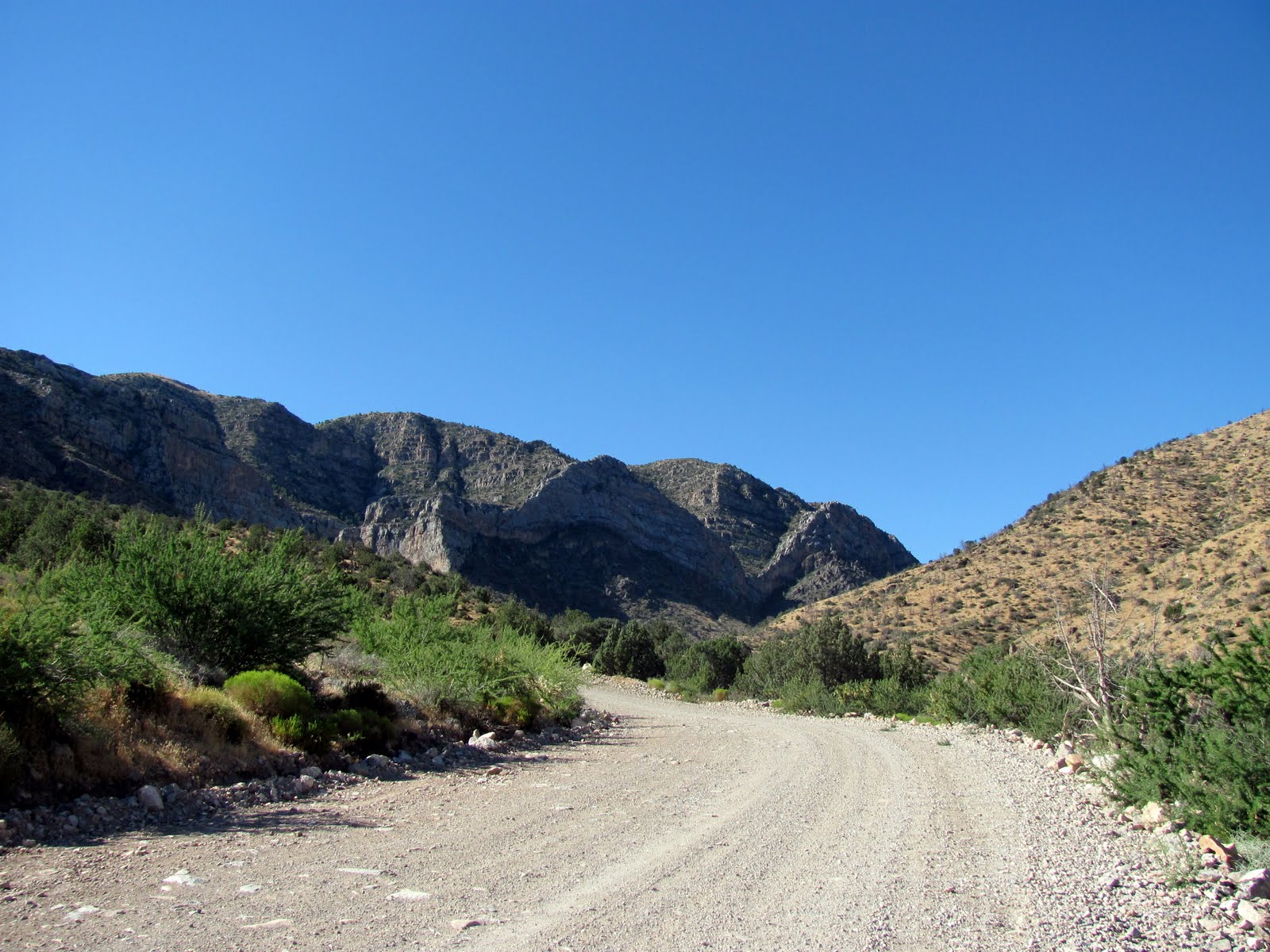
What I found there wasn't entirely what I had expected...rather than rocky canyons crawling with Chukar (ha), the road passed through former juniper grasslands, which had apparently burned some time ago.  Scattered charred junipers have been replaced by acacia and other desert plants, as well as desert willow and oak.  The avifauna was interesting, including desert species (Black-throated Sparrow), chaparral species (Black-chinned Sparrow), and a few more typical of juniper woodland (Blue-gray Gnatcatcher, Woodhouse's Scrub-Jay).  It looked like it could have had a few Chukar running about, but all I encountered were Gambel's Quail.  The highlight wasn't a bird, but a butterfly:


This is a Meridian Duskywing, a new species for me.  It's an uncommon southwestern skipper, specializing on oaks.


Another fun sight was this White-tailed Antelope Squirrel chowing down on acacia seeds.

I moved on from the Virgin Mountains, eager to check the confluence of the Virgin River and Beaver Dam Wash for Common Black-Hawks.  The day was already hot and I had been seeing plenty of raptors up and soaring.  I started in Littlefield, a nice little agricultural community, but didn't see any real habitat for black-hawks.  Around the town of Beaver Dam, there are plenty of cottonwoods, but accessing Beaver Dam Wash is fairly difficult.  I found several vantage points from which to scan and listen for hawks, but came up with very little.  Most interesting to me was a family of Brown-crested Flycatchers.  From an ecological perspective, the most interesting sight in this area was the sea of brown tamarisk lining the waterways.  The tamarisk aren't dead, but defoliated, by the introduced Tamarisk Beetle that has been hard at work in the area.  The introduction of the beetle is somewhat controversial, perhaps a post for another time, but it was fascinating to see the effect it has had on the tamarisk in the area.

Defoliated tamarisk along the Virgin River

Feeling a bit disheartened by two misses, I continued on to St. George then made my way towards Mount Trumbull.

Utah, bzz bzz
The road to Mount Trumbull from St. George is long, winding in places, and kicks up a lot of red dust.  On my spring trip several years ago, there had been recent rain, and some parts of the road had become very slick.  This time, I actually pushed back my trip a few weeks to avoid rain, and I was glad of it.  Though the roads were completely dry, I saw plenty of evidence of trucks skidding through the muck, leaving some deep ruts.

High desert, BLM lands on the Arizona Strip

At first, the road passed through some really nice high desert scrub.  It looked good for Bendire's Thrasher, my biggest miss so far in my big year.  Unfortunately, it was about noon by the time I got this far, and the desert was completely silent.  Soon I climbed up into hills cloaked in pinyon-juniper, and I rolled my windows down to listen for Pinyon Jays.  A few short stops were, again, very quiet.  I started getting birds once the road dropped into the Wolf Hole Valley.  From that point until I reached the town of Mount Trumbull, I passed through vast grasslands.  Some were covered in sage, some with scattered junipers, some obviously overgrazed.  Throughout this section of the drive I kept my eyes to the sky for Ferruginous Hawk, a low-density breeder in these grasslands.  Though I didn't end up seeing one, I was happy to watch a soaring Golden Eagle.

 
The road through the Strip


Strip grasslands
The most abundant birds in these grasslands were Lark Sparrows.  I flushed several flocks of 40 or so, mostly young birds.  Both Cassin's and Western Kingbirds were common, as were Loggerhead Shrikes.  My first county year bird of the trip was Mountain Bluebird, a pair of youngsters in an area with some scattered junipers.

The "town" of Mount Trumbull is really little more than a crossroads with an old schoolhouse and a few ranches in the area.  From there, the road turns east and begins to climb toward the mountains.


By the time I arrived at the trailhead leading up to Mount Trumbull, it was already past 4 in the afternoon.  I still wanted to do some birding, though it was hot and quiet.  A bit of excitement came when I was at the trailhead and noticed a few White-throated Swifts overhead.  Suddenly I heard the tearing sound of wings moving very fast through the air - and looked up to see a Peregrine Falcon pursuing a swift.  It missed, and dove once more half-heartedly before taking off.  I headed a short way up the trail, enjoying the view and a few birds.  One that caught my attention was a screeching raptor call that left me puzzled - not a Red-tail, and not the right habitat for Swainson's or Ferruginous.  I wasn't able to spot it, so I continued on.  On my way up, I had noticed a small plume of smoke coming from the area.  It turned out to be a small wildfire on Mount Logan, which was burning at a low intensity under the control of firefighters.  I have been around a fire like this before - the Warm Fire on the Kaibab Plateau in 2006 - which ended up burning out of control and toasting over 50,000 acres.  This made me just a tad nervous.  Still, fire is an essential part of this ecosystem, and it was interesting to see natural processes at work.


While the scenery was beautiful, I wasn't picking up many birds, so I headed back down to the road, found a campsite, and set out a plan for the evening.  Some of my biggest targets for the trip were night birds, so I wanted to use my time well if I was only going to be there one night.  Just before sunset, I headed back to the trailhead, which is located next to a big meadow.  I sat and waited.  A cloud of Violet-green Swallows flew over, heading to their roost.  Eventually the bluebirds and Cassin's Kingbirds quieted down, and a few Mule Deer ventured out into the meadow.  Finally, once dusk was setting in, a few Common Nighthawks appeared over the meadow.  It must have been a long time since I'd seen Common Nighthawks, because I was struck by how different their flight style is from a Lesser Nighthawk.  While Lessers flutter with relatively shallow, quick wingbeats, these Commons were floating, reminding me of Black Storm-Petrels with their deep wingbeats.

My next target was Common Poorwill.  These birds are widespread in the county, including rocky cliffs and canyons in the LCRV, but I hadn't managed to find any for my big year.  Fortunately, they have a habit of sitting in roads right after dusk, so I figured I'd be able to find one.  After cruising for a little while without any luck, I was thinking that I wasn't in optimal habitat.  As soon as I approached a rocky flank of Mount Trumbull that looked good for poorwills, I stopped to listen.  It was only a minute before I picked out the distinctive song of a Common Poorwill, soon answered by another.  I tried whistling for Western Screech-Owl here, but got no response, so I headed back to my camp.  Along the way, I stopped suddenly when I came upon a poorwill sitting in the road!  It flew ahead of me, and I saw it look back at me a few times when its eyes flashed their distinctive red eyeshine.

I took a little time to settle into my camp and make myself dinner before I went on an owling excursion.  I had chosen a campsite within a nice stand of Ponderosa Pine, with some pinyon-juniper in the area, that looked good for Flammulated and Western Screech-Owls.  I enjoy hiking at night without the use of a light, and a half-moon made this easy, so I never took out my headlamp.  As I walked down the road, I played the song of Flammulated Owl a few times, never hearing a response.  At the point I decided to turn around, the Ponderosa-pinyon-juniper interface looked particularly good for Western Screech-Owl, so I whistled an imitation of their song a few times.  Silence, except for the yipping of a Gray Fox somewhere nearby.  I turned back and headed toward camp again, and before long I heard the single low hoot of a Flammulated Owl!  It called incessantly for a few minutes, and I stood quietly to listen to it.  While I was listening, I noticed a whistle coming from behind me, which turned out to be a Western Screech-Owl!  I stayed until both birds became quiet, then headed back and settled into my sleeping back, elated to have had such good luck with night birds.

When I woke up to the gray light of pre-dawn the next morning, the forest was eerily silent.  I had hoped for some dawn singing, maybe an Olive-sided Flycatcher, but all I heard singing were a Plumbeous Vireo and a few Western Wood-Pewees.  Still, I felt optimistic about my planned hike to the summit of Mount Trumbull.  Nine of my target birds were possible on this hike, so I hoped to find some mixed conifer or aspen forest, and hopefully a cold-air drainage that may harbor a goshawk.

The most difficult section of the 5-mile trail is the first part, which switchbacks up through pinyon-juniper forest on the south slope of the mountain.  I encountered very few birds here, focusing on getting up into higher forest.  Eventually the trail levels out, entering a beautiful Ponderosa Pine forest with plenty of huge old pines.  I spent more time birding this area, checking several flocks of Pygmy Nuthatches and picking out a decent number of species.  At one point, while I was stopped looking at a Hairy Woodpecker, I heard the single "rawk" call of a Pinyon Jay.  I wasn't able to see it from where I stood, but I was surprised that it was apparently a single individual (called a few times) and was in Ponderosa Pine forest, not in the extensive pinyon forest nearby.  Still, I was happy to hear it - not only a county year bird, but one of my favorite birds, which I studied as an undergraduate.  The other avian highlight in this area was an adult Zone-tailed Hawk, which gave me great views as it flew low overhead, perching several times in the tops of nearby Ponderosas, and calling all the while.  Its behavior led me to suspect that it had a nest or young nearby.  The range of this species has expanded rapidly in recent years, but it still appears to be very local in this region - maybe another blog post for another time!

I continued slowly up the trail, eventually following it up to (what I thought was) the summit.  Abundant flowers here attracted numerous Broad-tailed and Rufous Hummingbirds, and a small flock included my first Hermit Warbler of the year.  From my vantage point at the top, I had a beautiful view of the Arizona Strip to the north and east.  Reading about the trail on the web, however, it seems that the trail I followed did not exist until recently (which would explain all the rock cairns higher up), and the true summit has an old weather station and USGS marker.  I saw nothing to mark the summit, which I thought was odd at the time.  So, who knows where I was standing!  Anyway, I was disappointed on my hike up that I didn't see any fir or aspens, habitat for several of my target species.  I took advantage of a decent view of the mountain to scan with my binoculars, looking for canyons that may have patches of fir or aspen, but saw none!  Next time, I'll have to take my GPS, a compass, and a good topo map to do a bit more exploring.

It was past 9 by the time I headed down, and I knew I'd have to make good time to get home at a decent hour - it's a long drive back to Lake Havasu City!  I considered staying for another night, but the birding was just too slow to justify it, and I had no idea where I could look for better habitat.  Hopefully I'll make it up there in the fall, when birds will have moved downslope.  I thought about my missed target species and when I might be able to get them.  Goshawk is never likely, but it's possible even in the Hualapais.  Northern Pygmy-Owl as well.  Williamson's Sapsucker may move to the Hualapais in winter.  Olive-sided and Dusky Flycatchers are possible elsewhere on migration.  Clark's Nutcracker will probably take another trip to Mount Trumbull, but they're present year-round.

My hike back down the mountain was birdier than the hike up, with some really big flocks of Pygmy Nuthatches accompanied by Mountain Chickadees, White-breasted Nuthatches, Brown Creepers, and even some migrants.  I saw a few more Hermit Warblers, a Townsend's Warbler, and several Warbling Vireos.  I reached the bottom feeling satisfied with a great hike and two more county year birds, and made the final decision to head home.  The long drive back went quickly - I felt recharged even by a brief trip to the Strip, and I look forward to my next adventure up there.

View of the Arizona Strip from Mt. Trumbull


Addendum.  It was a good trip for mammals, and I want to share my trip list since there is no eMammal.
Desert Cottontail
Black-tailed Jackrabbit
Kaibab Squirrel (a definite trip highlight!)
chipmunk sp. (on Mt. Trumbull, chipmunks were common but didn't look right for Cliff)
White-tailed Antelope Squirrel
Rock Squirrel
Northern Raccoon
Coyote
Gray Fox
Mule Deer
Merriam's Kangaroo Rat
Botta's Pocket Gopher (I didn't actually see it, but saw a plant being tugged underground by it)
Bats - several species seen and heard, none identified of course!