I admit it, birding around here has been slow lately. It's hard to get the motivation to bird when it's over 110 out, but it's worth it if there are birds! Unfortunately, shorebird migration around Lake Havasu has been little more than a few birds here and there.
So to maintain sanity in the desert, I've found that an escape to the mountains usually does the trick. In figuring out birds I need for my
Big Year, a number of them fell into the
Arizona Strip region. The Arizona Strip is the part of Arizona north of the Colorado River - largely Mohave County, with few real roads and even fewer people. Birders seldom venture out there, so there is usually something to discover. I've only done one serious trip out there before, a successful early spring venture in 2008. I decided to go this past weekend, for two or three days, and see how many year birds I could find.
My itinerary went through several modifications. At first I planned to visit
Colorado City, and surrounding areas, but decided that it probably wasn't worthwhile in August. I eventually decided to make a brief visit to the
Virgin Mountains to look for Chukar, check Beaver Dam wash for its famous Common Black-Hawks, then drive to
Mount Trumbull, where I would camp and hike in search of several species not easily found in Mohave County. I drummed up a list of 18 target species, of which I found seven, a somewhat disappointing total. Even though it was only a quick trip and the birding fell a bit short of expectations, it was nice to get away from the heat and enjoy some time in this remote region.
I started my trip Saturday morning, when I awoke at 2:30 am to get on the road. I arrived in Mesquite, Nevada around 8 in the morning and ventured up Lime Kiln Canyon Road into the Virgin Mountains.
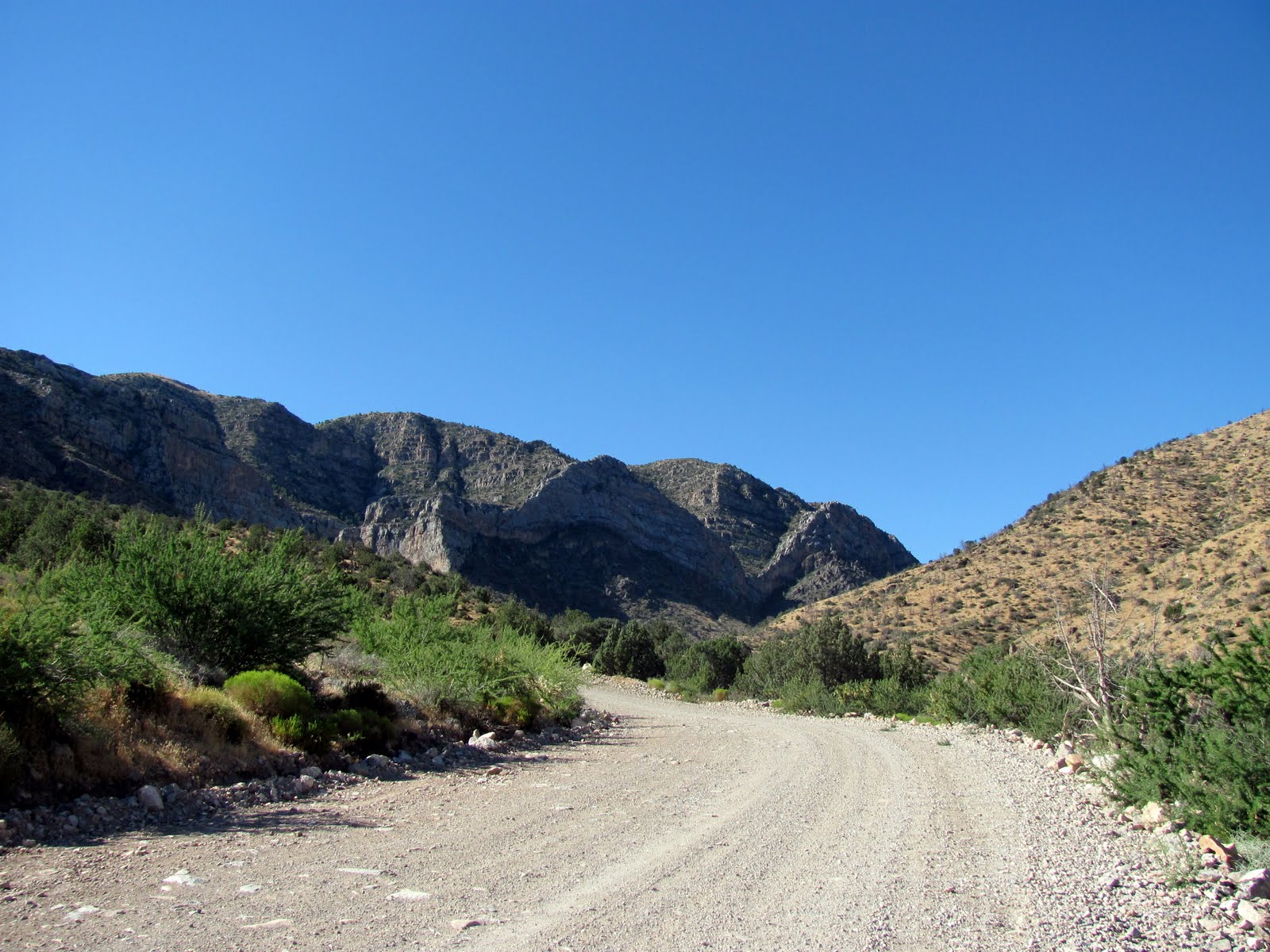
What I found there wasn't entirely what I had expected...rather than rocky canyons crawling with Chukar (ha), the road passed through former juniper grasslands, which had apparently burned some time ago. Scattered charred junipers have been replaced by acacia and other desert plants, as well as desert willow and oak. The avifauna was interesting, including desert species (Black-throated Sparrow), chaparral species (Black-chinned Sparrow), and a few more typical of juniper woodland (Blue-gray Gnatcatcher, Woodhouse's Scrub-Jay). It looked like it could have had a few Chukar running about, but all I encountered were Gambel's Quail. The highlight wasn't a bird, but a butterfly:
This is a Meridian Duskywing, a new species for me. It's an uncommon southwestern skipper, specializing on oaks.
Another fun sight was this White-tailed Antelope Squirrel chowing down on acacia seeds.
I moved on from the Virgin Mountains, eager to check the confluence of the Virgin River and Beaver Dam Wash for Common Black-Hawks. The day was already hot and I had been seeing plenty of raptors up and soaring. I started in Littlefield, a nice little agricultural community, but didn't see any real habitat for black-hawks. Around the town of Beaver Dam, there are plenty of cottonwoods, but accessing Beaver Dam Wash is fairly difficult. I found several vantage points from which to scan and listen for hawks, but came up with very little. Most interesting to me was a family of Brown-crested Flycatchers. From an ecological perspective, the most interesting sight in this area was the sea of brown tamarisk lining the waterways. The tamarisk aren't dead, but defoliated, by the introduced
Tamarisk Beetle that has been hard at work in the area. The introduction of the beetle is somewhat controversial, perhaps a post for another time, but it was fascinating to see the effect it has had on the tamarisk in the area.
 |
| Defoliated tamarisk along the Virgin River |
Feeling a bit disheartened by two misses, I continued on to St. George then made my way towards Mount Trumbull.
 |
| Utah, bzz bzz |
The road to Mount Trumbull from St. George is long, winding in places, and kicks up a lot of red dust. On my spring trip several years ago, there had been recent rain, and some parts of the road had become very slick. This time, I actually pushed back my trip a few weeks to avoid rain, and I was glad of it. Though the roads were completely dry, I saw plenty of evidence of trucks skidding through the muck, leaving some deep ruts.
 |
| High desert, BLM lands on the Arizona Strip |
|
|
At first, the road passed through some really nice high desert scrub. It looked good for Bendire's Thrasher, my biggest miss so far in my big year. Unfortunately, it was about noon by the time I got this far, and the desert was completely silent. Soon I climbed up into hills cloaked in pinyon-juniper, and I rolled my windows down to listen for Pinyon Jays. A few short stops were, again, very quiet. I started getting birds once the road dropped into the Wolf Hole Valley. From that point until I reached the town of Mount Trumbull, I passed through vast grasslands. Some were covered in sage, some with scattered junipers, some obviously overgrazed. Throughout this section of the drive I kept my eyes to the sky for Ferruginous Hawk, a low-density breeder in these grasslands. Though I didn't end up seeing one, I was happy to watch a soaring Golden Eagle.
 | | | | |
| The road through the Strip |
|
|
 |
| Strip grasslands |
The most abundant birds in these grasslands were Lark Sparrows. I flushed several flocks of 40 or so, mostly young birds. Both Cassin's and Western Kingbirds were common, as were Loggerhead Shrikes. My first county year bird of the trip was
Mountain Bluebird, a pair of youngsters in an area with some scattered junipers.
The "town" of Mount Trumbull is really little more than a crossroads with an old schoolhouse and a few ranches in the area. From there, the road turns east and begins to climb toward the mountains.

By the time I arrived at the trailhead leading up to Mount Trumbull, it was already past 4 in the afternoon. I still wanted to do some birding, though it was hot and quiet. A bit of excitement came when I was at the trailhead and noticed a few White-throated Swifts overhead. Suddenly I heard the tearing sound of wings moving very fast through the air - and looked up to see a Peregrine Falcon pursuing a swift. It missed, and dove once more half-heartedly before taking off. I headed a short way up the trail, enjoying the view and a few birds. One that caught my attention was a screeching raptor call that left me puzzled - not a Red-tail, and not the right habitat for Swainson's or Ferruginous. I wasn't able to spot it, so I continued on. On my way up, I had noticed a small plume of smoke coming from the area. It turned out to be a small wildfire on Mount Logan, which was burning at a low intensity under the control of firefighters. I have been around a fire like this before - the Warm Fire on the Kaibab Plateau in 2006 - which ended up burning out of control and toasting over 50,000 acres. This made me just a tad nervous. Still, fire is an essential part of this ecosystem, and it was interesting to see natural processes at work.

While the scenery was beautiful, I wasn't picking up many birds, so I headed back down to the road, found a campsite, and set out a plan for the evening. Some of my biggest targets for the trip were night birds, so I wanted to use my time well if I was only going to be there one night. Just before sunset, I headed back to the trailhead, which is located next to a big meadow. I sat and waited. A cloud of Violet-green Swallows flew over, heading to their roost. Eventually the bluebirds and Cassin's Kingbirds quieted down, and a few Mule Deer ventured out into the meadow. Finally, once dusk was setting in, a few Common Nighthawks appeared over the meadow. It must have been a long time since I'd seen Common Nighthawks, because I was struck by how different their flight style is from a Lesser Nighthawk. While Lessers flutter with relatively shallow, quick wingbeats, these Commons were floating, reminding me of Black Storm-Petrels with their deep wingbeats.
My next target was Common Poorwill. These birds are widespread in the county, including rocky cliffs and canyons in the LCRV, but I hadn't managed to find any for my big year. Fortunately, they have a habit of sitting in roads right after dusk, so I figured I'd be able to find one. After cruising for a little while without any luck, I was thinking that I wasn't in optimal habitat. As soon as I approached a rocky flank of Mount Trumbull that looked good for poorwills, I stopped to listen. It was only a minute before I picked out the distinctive song of a Common Poorwill, soon answered by another. I tried whistling for Western Screech-Owl here, but got no response, so I headed back to my camp. Along the way, I stopped suddenly when I came upon a poorwill sitting in the road! It flew ahead of me, and I saw it look back at me a few times when its eyes flashed their distinctive red eyeshine.
I took a little time to settle into my camp and make myself dinner before I went on an owling excursion. I had chosen a campsite within a nice stand of Ponderosa Pine, with some pinyon-juniper in the area, that looked good for Flammulated and Western Screech-Owls. I enjoy hiking at night without the use of a light, and a half-moon made this easy, so I never took out my headlamp. As I walked down the road, I played the song of Flammulated Owl a few times, never hearing a response. At the point I decided to turn around, the Ponderosa-pinyon-juniper interface looked particularly good for Western Screech-Owl, so I whistled an imitation of their song a few times. Silence, except for the yipping of a Gray Fox somewhere nearby. I turned back and headed toward camp again, and before long I heard the single low hoot of a Flammulated Owl! It called incessantly for a few minutes, and I stood quietly to listen to it. While I was listening, I noticed a whistle coming from behind me, which turned out to be a Western Screech-Owl! I stayed until both birds became quiet, then headed back and settled into my sleeping back, elated to have had such good luck with night birds.
When I woke up to the gray light of pre-dawn the next morning, the forest was eerily silent. I had hoped for some dawn singing, maybe an Olive-sided Flycatcher, but all I heard singing were a Plumbeous Vireo and a few Western Wood-Pewees. Still, I felt optimistic about my planned hike to the summit of Mount Trumbull. Nine of my target birds were possible on this hike, so I hoped to find some mixed conifer or aspen forest, and hopefully a cold-air drainage that may harbor a goshawk.
The most difficult section of the 5-mile trail is the first part, which switchbacks up through pinyon-juniper forest on the south slope of the mountain. I encountered very few birds here, focusing on getting up into higher forest. Eventually the trail levels out, entering a beautiful Ponderosa Pine forest with plenty of huge old pines. I spent more time birding this area, checking several flocks of Pygmy Nuthatches and picking out a decent number of species. At one point, while I was stopped looking at a Hairy Woodpecker, I heard the single "rawk" call of a Pinyon Jay. I wasn't able to see it from where I stood, but I was surprised that it was apparently a single individual (called a few times) and was in Ponderosa Pine forest, not in the extensive pinyon forest nearby. Still, I was happy to hear it - not only a county year bird, but one of my favorite birds, which I studied as an undergraduate. The other avian highlight in this area was an adult Zone-tailed Hawk, which gave me great views as it flew low overhead, perching several times in the tops of nearby Ponderosas, and calling all the while. Its behavior led me to suspect that it had a nest or young nearby. The range of this species has expanded rapidly in recent years, but it still appears to be very local in this region - maybe another blog post for another time!
I continued slowly up the trail, eventually following it up to (what I thought was) the summit. Abundant flowers here attracted numerous Broad-tailed and Rufous Hummingbirds, and a small flock included my first Hermit Warbler of the year. From my vantage point at the top, I had a beautiful view of the Arizona Strip to the north and east. Reading about the trail on the web, however, it seems that the trail I followed did not exist until recently (which would explain all the rock cairns higher up), and the true summit has an old weather station and USGS marker. I saw nothing to mark the summit, which I thought was odd at the time. So, who knows where I was standing! Anyway, I was disappointed on my hike up that I didn't see any fir or aspens, habitat for several of my target species. I took advantage of a decent view of the mountain to scan with my binoculars, looking for canyons that may have patches of fir or aspen, but saw none! Next time, I'll have to take my GPS, a compass, and a good topo map to do a bit more exploring.
It was past 9 by the time I headed down, and I knew I'd have to make good time to get home at a decent hour - it's a long drive back to Lake Havasu City! I considered staying for another night, but the birding was just too slow to justify it, and I had no idea where I could look for better habitat. Hopefully I'll make it up there in the fall, when birds will have moved downslope. I thought about my missed target species and when I might be able to get them. Goshawk is never likely, but it's possible even in the Hualapais. Northern Pygmy-Owl as well. Williamson's Sapsucker may move to the Hualapais in winter. Olive-sided and Dusky Flycatchers are possible elsewhere on migration. Clark's Nutcracker will probably take another trip to Mount Trumbull, but they're present year-round.
My hike back down the mountain was birdier than the hike up, with some really big flocks of Pygmy Nuthatches accompanied by Mountain Chickadees, White-breasted Nuthatches, Brown Creepers, and even some migrants. I saw a few more Hermit Warblers, a Townsend's Warbler, and several Warbling Vireos. I reached the bottom feeling satisfied with a great hike and two more county year birds, and made the final decision to head home. The long drive back went quickly - I felt recharged even by a brief trip to the Strip, and I look forward to my next adventure up there.
 |
| View of the Arizona Strip from Mt. Trumbull |
Addendum. It was a good trip for mammals, and I want to share my trip list since there is no eMammal.
Desert Cottontail
Black-tailed Jackrabbit
Kaibab Squirrel (a definite trip highlight!)
chipmunk sp. (on Mt. Trumbull, chipmunks were common but didn't look right for Cliff)
White-tailed Antelope Squirrel
Rock Squirrel
Northern Raccoon
Coyote
Gray Fox
Mule Deer
Merriam's Kangaroo Rat
Botta's Pocket Gopher (I didn't actually see it, but saw a plant being tugged underground by it)
Bats - several species seen and heard, none identified of course!