Showing posts with label Havasu NWR. Show all posts

Saturday, August 27, 2011

Short-billed Dowitchers

As I mentioned in my Beal Lake post, we have had quite a few Short-billed Dowitchers in the area lately.  Our first was at the Island STP August 24.  The next day, David and I counted 18 on Beal Lake.  Today, we counted 16 there, plus another 27 along the Colorado River in a 4-mile stretch near the CA/NV/AZ state lines.  A total of 43 Short-billed Dowitchers, with only ONE Long-billed!  Rosenberg et al. lists Short-billed Dowitcher as rare but regular in fall, with a high count of 13 between Parker and Lake Havasu.  Perhaps the real surprise, then, is not the number of Short-bills but the scarcity of Long-bills.  Hopefully, continued coverage this season and in subsequent years will tease out the status of both species.

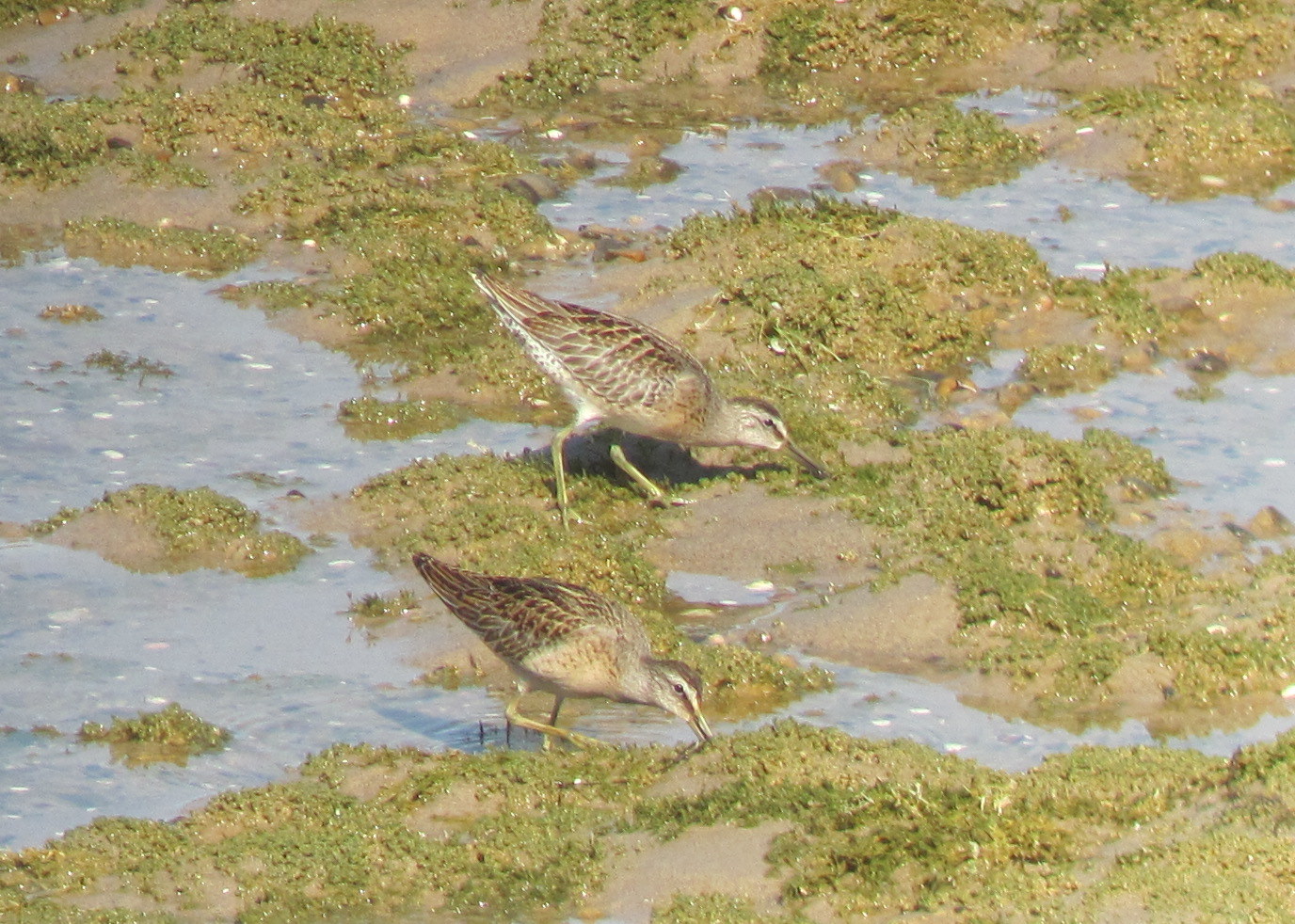
While Beal Lake is not ideally suited for photography (bad light and distant birds are the rule), I did manage to photograph several of the Short-billed Dowitchers along the river today.  Several are below.  These birds are all juveniles - adults would be obvious with mainly reddish underparts.  Note the reddish blush on the breast, a good mark for juvenile Short-billed Dowitcher, as well as general shape.  The most important mark visible in the photos is the well-patterned wing coverts and tertials.  On juvenile dowitchers, rufous internal markings on the tertials is a great ID clincher - but note that it only works for juveniles.  Not visible in photos is the call note - a "tututu" reminiscent of yellowlegs, very different from the frequent "kik" calls of Long-billed.

The first photo is David's shot of the bird at the Island STP in Lake Havasu City.  All the rest are my photos of birds along the Colorado R. today.


Birding Beal Lake

The past week, since returning from the Western Field Ornithologists meeting in Sierra Vista, David and I have made several trips to Beal Lake. When we moved to this area last December, we were only vaguely aware of Beal Lake, thinking it was an area closed to birders.  Our friend and local birder DeeDee DeLorenzo informed us otherwise, and showed us the location when we each tagged along with her on a weekly bird survey of Havasu NWR.  While we have been making infrequent stops there throughout the spring and summer, only now is it really turning into an amazing birding hotspot.

In August, our targets have mainly been shorebirds, and we haven't been disappointed!  A total of 22 shorebird species have been present in only a handful of visits in the past week, including several rarities, state birds and county birds.

Greater Yellowlegs have been surprisingly scarce, with only a few individuals noted
I won't list the entire suite of shorebirds, but some of the highlights have been Semipalmated and Snowy Plover, Solitary Sandpiper, Willet, Whimbrel, Semipalmated Sandpiper, Pectoral Sandpiper, Stilt Sandpiper, Baird's Sandpiper, and Short-billed Dowitcher.  Stilt Sandpiper in particular is a real rarity, with only a handful of records from the LCRV.  This is something of an enigma - they are found regularly at the Salton Sea and are seen every fall in other parts of Arizona, so it's not well understood why they are not more regular along the Colorado River.

Falling water levels have attracted swarms of other birds to Beal Lake, as well.  Herons have been feasting upon fish stranded in shallow water, while Rallids and ducks enjoy easy access to underwater vegetation.  Even a few migrant landbirds have been in the surrounding brush.

This spot is a real gem.  If our past few visits are representative of typical August shorebird migration, Beal Lake is right up there with the best shorebirding spots in Arizona, and is certainly underbirded!

Getting there: The quickest access is from Needles, CA.  From Needles, you'll have to navigate through town until you cross the bridge into Arizona (there is only one in town).  We prefer to exit at J Street and follow signs through town, but it's best to check a map as this can get pretty confusing.  Once across the bridge, move immediately into the right-hand turn lane and turn right (just before the car wash) onto Levee Rd.  Turn right when you reach a stop sign.

If you're coming from Bullhead City, you'll come south on Highway 95 to a stop light on Courtwright Rd.  Continue straight through the light, then make a quick left onto Barrackman Rd - this takes you straight to the "River Highway".  If you are birding Pintail Slough or Topock Marsh first, you will continue north on the highway until it turns west and becomes Courtwright Rd.  From the stop light at Hwy 95, follow the directions above.

Once on Barrackman Rd/River Hwy, continue south past a few developments.  One on the left has some canals that can be good for ducks in winter.  After this the road becomes gravel - continue on for several miles until the road appears to dead-end at a chain-link fence.  A curve to the left will take you to Beal Lake.  You will pass through a refuge gate - although it is supposed to be closed on weekends, we have never found it closed.  If it is locked, you can park at the gate and walk in - it's not far to the lake.  Otherwise, drive through and follow the first left-hand turn, just before a locked gate.  This spur will take you to a very nice, newly built platform overlooking the lake.
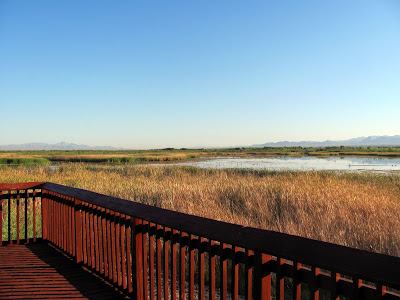

This platform provides the best overall view of the lake, overlooking most of the central portion.  This is the better place to go for a short visit, birders without scopes, and for most ducks and herons.  However, most of the shorebirds have been concentrating at the south end of the lake, not readily visible from the new platform.  To get to the south end, park at that locked refuge gate and walk for a few hundred meters until reaching an opening with a view of the lake and an old, sketchy platform that looks like it's ready to fall with the next heavy wind.


The platform is sturdier than it looks, but I wouldn't recommend it for groups of more than two or for anyone without a sense of adventure.  Hopefully, the refuge will eventually get around to demolishing this and other older platforms and replace them with sturdy public viewing areas.  In the mean time, if you don't want to climb the rickety stairs, there is enough of an opening in the reeds to bird from the ground.  From here, you should be able to get a decent look at the bulk of the shorebirds on the lake.

When birding Beal Lake, I can't stress enough the importance of getting there early.  At any time of year, it is best to arrive before sunrise.  From the main platform, you will be looking east, straight into the rising sun.  With no shade in the area, it gets hot fast, and heat waves make the birding difficult!  At a cooler time of year, an evening visit would likely be worthwhile, when the sun is at your back.  If you choose to walk down the road to the old platform, bring water and a hat.  A scope is always a good idea - the lake is too large to bird easily with binoculars.

Fishing Snowy Egrets are a common sight on Beal Lake.
While Beal is really top-notch right now for shorebirds, I do recommend the spot any time of year - it is a good place to see ducks, rails, herons, gulls, and terns.  Plus, you never know what will turn up!

Tuesday, February 22, 2011

Spring Around the Corner

I have to admit, late February around here is starting to taste like a flat soda.  Several of the local rarities continue, but there don't seem to be many new birds moving into the area.  While there has been some notable gull movement, they just seem to be leaving - without new birds coming in.  Birding is getting rather predictable.  Caught in the late-winter doldrums, the best we can do is keep monitoring the wintering birds, see how long the rarities will stick, and watch out for new migrants.  While doing just that this weekend, it was refreshing to see some signs of spring.

Starting at Rotary Park on Sunday, David and I found that gull numbers were down, and none of the eleven California Gulls I saw on Friday remained on the beach.  Starting the day off on a bright note, though, we saw our FOS White-winged Dove.  This was a surprise, since this species does not typically arrive until mid-March!

It didn't want its picture taken.
As we headed north to Havasu NWR, we noted large numbers of Tree Swallows foraging over the road.  Within the past week, we've seen Tree Swallow numbers skyrocket.  At Pintail Slough, we enjoyed the increase in bird activity that comes after a rain, though we didn't have any rare species.  A couple of Violet-green Swallows were good to see, indicating the beginning of their spring migration.  With the exception of a few sightings of single individuals in early Feb, this weekend was the first real movement of this species we've seen this year.  This is actually a late arrival, as Violet-greens should show up around the first week of February.  Another spring migrant, a singing Ash-throated Flycatcher, was right on time.  This was a county year bird for me, as was a flyover flock of White-faced Ibis.  After a bit of walking, we discovered a few swarms of Neuropterans.  Freshly molted adults were emerging en masse.  Surprisingly few birds were taking advantage of this easy food source, though I suspect all the swallows foraging over the road were doing just that.

Pintail Slough - leafy cottonwoods and storm clouds

We ended our Sunday birding around Bullhead City, where we saw the continuing Mew Gull twice.  While we were driving through Bullhead City in the mid-afternoon, we briefly saw it fly over the car.  Around 6 p.m., it showed up at Katherine Landing and loafed with the Ring-billed Gulls.  Alas, the Thayer's Gull seen earlier in the week did not show up.  It was interesting to note that numbers of California Gulls were way, way down, with only a handful of individuals seen.  Herring Gulls were absent altogether.  We did see five Horned Grebes on Lake Mohave, and three Wood Ducks in the area.  A male Red-breasted Merganser was unusual for this time of year, and another county year bird.

One of two males in the bread line at Katherine Landing

Monday was spent around the Bill Williams Delta.  We checked out Mosquito Flats, a beautiful stretch of riparian forest with complex structure and very little tamarisk.  The cottonwoods are fully leafed out, humming with the constant buzz of bees, and ready for migrant warblers.  The warblers, of course, are not migrating yet, and the birding was a little slow.  Fortunately there were other distractions.

 Cool fungus

Crayfish - an invasive species.  I managed to trap this one under my boot so we could get a better look at it.

Tent caterpillars were everywhere!

Most of the trees are fully leafed out.
We headed for the Bill Williams Delta, one of the best birding spots in the region.  There are almost always rare species to be found at this spot, and it is always exciting to bird, as it seems to offer more turnover than other places.  Some of the continuing rarities were Greater Scaup, Barrow's Goldeneye, and Black Scoter.  Almost all of the scaup, a flock of 230, were fairly close to our viewpoint, allowing us to get an accurate count and search for Lesser Scaup (none found).  The two female Black Scoters were with the scaup, as usual, and we counted eight Barrow's Goldeneyes, a new high count for us this winter.

Next, we headed for Parker Dam.  The birds there have been particularly predictable this winter, but we want to catch any changes as soon as they happen.  Lately, we have made it part of our routine to check Take-Off Point next to the dam.  Though it has been very quiet this winter, there had been sightings of the Yellow-billed Loon from there, and we have been checking for the bird (unsuccessfully) whenever we're at the dam.  To our surprise, on this particular check, there it was!  Along with five Common Loons, the Yellow-billed was in the Bill Williams Arm - in Mohave County!  An excellent county bird (year bird #149) for David and I, though one can't help but wonder - why does this bird bother to fly back and forth over Parker Dam?

A weekend of late February birding had the effect of getting us excited about April.  With so much habitat to cover, who knows what will turn up during migration!