Showing posts with label Vagrants. Show all posts

Monday, January 21, 2013

Christmas Birding Trip: Bill Williams to Yuma

This post is a bit belated, but December 15 was my first Christmas Bird Count of the season, the Yuma/Martinez Lake count.  Centered on Imperial Dam, the count circle is equal parts Yuma County, AZ and Imperial County, AZ.  Since Yuma is a good three hour drive, I thought it might be wise to camp down there so I could be fresh for bird counting first thing in the morning!  Naturally, that meant a day of birding my way south.

My first stop was a brief one at the Bill Williams Delta, where our first winter storm of the season had brought overcast skies and drizzle. I was hoping to see the recently reported Long-tailed Duck, but it continued to elude me.  I left before long without seeing much of interest.  A quick stop at Parker Oasis was similarly quiet.  I buzzed through the northern Parker Valley, stopping briefly to watch dancing Sandhill Cranes, check out the continuing Harlan's Hawk, and count a field full of Killdeer.

Cranes in the Parker Valley
Flocks of hundreds of Killdeer can sometimes be seen in the Parker Valley in winter
Flipping to the California side, my next stop was Palo Verde Diversion Dam.  The wind was blowing so hard I didn't think I'd be able to bird outside of the car, but a quick scan with binoculars produced a Black Scoter on the water.  A review species in Arizona and a good bird in Riverside County, especially on the Colorado River, I had to figure out a way to get my scope on the bird without being blown into the lake myself.  I repositioned the car so that it would block the wind, which worked out nicely, and I was able to get good looks and some terrible photos of this rarity.

The Loch Ness Scoter
Unfortunately it didn't move to the Arizona side, but it did fulfill the Prophecy of Three.  David and I have noticed that Black Scoters in Arizona occur in threes.  Either they turn up in a flock of three, or three separate individuals are found in an area in a season.  This is Black Scoter #3 for the LCRV this winter.

My next stop on my way south was Cibola NWR.  I had hoped to check a few spots, but strong winds kept me out of landbirding spots like CVCA and Nature Trail.  It seemed like a good idea to just start with the Goose Loop nature drive and see what was out on the fields.

Before long, I came to a field of recently cut corn, covered in Sandhill Cranes and Canada Geese.  I pulled over here and started counting: 1000 Sandhill Cranes (including one banded bird I was able to get a resight on) as well as several hundred Canada Geese.  I sat in the car, scanned the flock, took photos and sound recordings.

Cranes and geese under moody skies

Sandhill Cranes and Canada Geese at Cibola NWR
I got a few recordings of the foraging flocks.  At first the soundscape was dominated by the lovely rattling crane calls and honking of incoming geese.


Soon, as the sun began to sink, more flocks of geese started to join the throng.  Then Mallards came in.  Since I happened to be running a BirdLog checklist, I counted every flock as it came in and BirdLog added it to the totals.  By the time I left an hour later, I had counted about 800 Canada Geese and 2,285 Mallards, along with 110 American Wigeon and 30 Northern Pintails mixed in with the Mallards.  You can view the eBird checklist here.

It was a sea of green heads once these guys joined in
Just before I left, I took another sound recording.  In this one, Canada Geese are a much more significant part of the soundscape, and the quacking of Mallards is audible in the background.  A faint buzzing noise is the cumulative sound of 800 Canada Geese making soft calls while foraging.


That was all the birding I could fit in for the day, so from there I went straight to Imperial Dam and headed to Ferguson Road, which took me to the shore of Ferguson Lake.  There I found the perfect campsite by the lake, where I sat with a beer under dark skies (no stars, all clouds), did a one-species eBird checklist (American Coots in the dark), and contemplated the day.

I woke well before dawn the next morning to start the CBC with a bit of owling.  Although I couldn't get any Western Screech-Owls or Common Poorwills to call, I did count four countercalling Great Horned Owls.  I stood over the marsh at the south end of the lake as the light started to bleed onto the eastern horizon and noted several Least Bitterns and a few Soras calling. As the sky grew lighter, more birds started chiming in: Marsh Wrens, Song Sparrows, a few Common Yellowthroats. A chupping Hermit Thrush and a few chattering Ruby-crowned Kinglets.

A hike up the nearby wash was surprisingly birdy.  One of the first birds I heard was an Ash-throated Flycatcher, a very uncommon wintering bird in the area.  It turned out to be a good day for them, and over the course of the day I recorded nine of these critters. Some of the other notable birds among the flocks in the wash were two Green-tailed Towhees and a Bewick's Wren.

The rest of the morning was spent scanning Ferguson Lake between intermittent bouts of drizzle.  Despite fair numbers of birds like Western and Clark's Grebes, Double-crested Cormorants, and American Wigeon, I wasn't able to turn up anything unusual on the water.

Ferguson Lake in the rain

After the afternoon lunch at Phil Swing Park with the rest of the bird counters, I spent some time wandering around desert washes, then headed toward Bard to look for rarities. During this time I realized I wasn't finding any sparrows!  In areas where I've previously seen hundreds of sparrows in winter, I was seeing one or two White-crowned Sparrows at best. No Black-throated Sparrows, and only a handful of Savannah. The habitat seemed grassy enough, so I'm at a loss to explain the absence of sparrows and other grass-eating birds.

One of the highlights of my afternoon, a chilled tarantula

As the sun started to drop, I buzzed over to Betty's Kitchen to look for the previously reported Thick-billed Kingbird, which would be a Yuma County bird.  Before long I heard a call I didn't recognize, like a big squeaky Lesser Goldfinch.  I tracked it down, and sure enough, it was the kingbird! It posed for photos and great looks before moving further into the cottonwoods. I walked around the restoration area, tromping through the mud while trying to pick out different species at this incredibly birdy spot.  Not a bad end to a nice day of birding!

My first Yuma County Thick-billed Kingbird. Success!

Friday, January 18, 2013

Area megas: Ivory Gull and Common Crane!

It's been a wild week for the Colorado River below the Grand Canyon.

Two days ago (January 16), the news came in that an Ivory Gull had been photographed along the Colorado River somewhere near Willow Beach, but it had a broken wing and the report was a few weeks old.  I held out hope that it might be loafing at Willow Beach eating fish scraps, but in fact it was several miles below Willow Beach, on a small (likely ephemeral) sand bar, and it was photographed December 30--nothing encouraging about its continued survival or any likelihood of ever refinding it.

Still, this is an amazing first state record if accepted by the ABC! It's so fortunate that the observers, who I gather were not birders, thought to photograph the bird and send them to Andrew Core. Check out the stunning photos here!

Three days ago (January 15), Norman Parrish visited Overton WMA near the north end of the Overton Arm of Lake Mead and photographed a Common Crane! Carl Lundblad got the word out, and it was seen two days later by Rick Fridell, who posted early that it was indeed a Common Crane and still present. David and I debated for about 30 seconds before deciding to go for it! The drive only took about three and a half hours one way, completely reasonable for a lifer for both of us and first NV state record if accepted by the NBRC.

Often in birding we spend a lot of time looking at dull-but-exciting birds like Nutting's Flycatchers. The Common Crane combined local rarity with a high degree of sexiness, so much so that we watched it for about an hour and a half and only left because we realized it was getting late and we still had to drive three and a half hours home.

Common Crane
One of David's shots of this beautiful MEGA
After seeing the bird, we stopped to get gas and celebratory hot chocolate and I mentioned the bird to the attendant inside.  She was excited about it, and immediately said she'd take her son out to see it, since he loves birds and it sounded interesting. Cool!

Overton WMA, where we stood and watched the cranes feed
 Unfortunately there was a bit of a damper on the experience. When we arrived, a photographer was on the field, walking toward the cranes. The birds were clearly agitated, but she continued moving forward, slowly, in increments. Once it became clear that she was pushing the birds beyond reason, I started calling for her to back off, but she didn't hear me. Finally, she did hear David, and quickly turned and started walking back. At that point, though, she was about 20 meters from the birds, and the sudden movement caused them to flush. There was no reason for her to get that close to the birds. I don't quote the ABA Code of Ethics often, but it is worth a read once in a while.

This should not happen--and take note that this was taken with a 300mm lens (David's photo)
Fortunately, at least, the birds did not go far, just a few fields away. More information about this bird is here. Many thanks to Norman Parrish for finding the bird, to Carl Lundblad for getting the word out and nudging us to go, and to Rick Fridell for confirming that it was present Friday morning!

Sunday, December 2, 2012

ANOTHER Lesser Black-backed Gull

November 30th, after a lovely day rediscovering the now-returned Nutting's Flycatcher, hiking in the Bill Williams, and finding my La Paz County Winter Wren, I thought I had used up all my birding karma for a little while.  Still, when I pulled into the refuge headquarters to scan the Bill Williams Delta, a not insignificant part of me was hoping that the Lesser Black-backed Gull would show up (click the link for more on LBBG identification).  So while I was sitting in the car starting a BirdLog checklist and I happened to put my binoculars on a brown gull that looked awfully white-rumped, I wasted no time grabbing camera and scope, jumping out of the car and setting up to scan.  I quickly got the scope on a brown gull, but was disappointed to see just another California Gull.  Used to disappointment after three solid days doing nothing but looking for that LBBG, I sighed and scanned on.  Then immediately got on another brown gull, this one with a white rump and white-based tail with a contrasting black band.  The Lesser Black-backed Gull!!

Long wings, masked appearance and white tail with black band.
To say that I was excited to see this bird would be something of an understatement.  Not that it wasn't fun birding around Havasu for three days and finding some other rarities and all, but I kind of ran myself ragged looking for that bird in Lake Havasu City.  I chased and missed the first state record, as well, a bird near Phoenix in 2006.  So after snapping some photos, I laughed and danced a jig and I'm sure some refuge visitors wondered what was going on with the lunatic with the scope and camera.

Fishing with Ring-billed Gulls
Soon, David had arrived from Havasu.  The bird had flown to nearby Havasu Springs, so we drove over and found it loafing on a beach.  David, being the real photographer between us, had taken control of his camera and got some much better shots.  It was he who first wondered whether it might be a different bird.  I had noticed that it seemed much whiter than in John's photos, but I didn't think much of it.  Now much closer to the bird, I checked it out in the scope, and sure enough, it was messier-looking than John's bird, without those nice clean edgings on the mantle feathers.  It was a single feather, though, that finally convinced us that it was a different bird.  In the flight shots above, note an obvious missing primary on the left wing.  One of David's photos shows that this feather isn't missing altogether, but is actually growing in, and it's more than four days along.

Narrower tertial edgings and messier scapulars and wing coverts than the Lake Havasu City bird

Better photo showing how white the plumage is.  Photo by David Vander Pluym
White plumage streaked with brown, masked face.  Photo by David Vander Pluym
The magical photo showing the primary growing in!  Photo by David Vander Pluym
Exciting times here on the river!

Friday, November 30, 2012

The Nutting's Flycatcher is back!

Just after 8:00 this morning, after about 15 minutes of birding, I was walking down the road at Mosquito Flats in Bill Williams River NWR, planning out my post to the listserv about the continued absence of the Nutting's Flycatcher.  Of course it was at that moment that I heard that singular "WHEEP!"  I didn't think I had missed it so much, but that sound brought a huge smile to my face. It's back!

The flycatcher is behaving much the same way it did last year.  It called infrequently and was difficult to pin down, but once I located it foraging next to the road, it gave me some great looks.  Photos and sound recordings below from this morning.

"Miss me?"

Eating a mantid.  Check out the cinnamon secondaries!

Short, stout bill, bright yellow belly, cinnamon secondaries, and a greenish back are all good field marks.


The Bill Williams River NWR is about halfway between Parker and Lake Havasu City.  You can get to the flycatcher from Highway 95.  Take Planet Ranch Rd east from the highway (between the refuge headquarters and the Bill Williams bridge) and drive to mile marker 2, where cliffs rise on the east side of the road and riparian vegetation borders the left side.  Also check out the map.

Wednesday, November 28, 2012

Lesser Black-backed Gull - Lake Havasu

Two days ago (26 November 2012), John West photographed an odd gull on the beach at Rotary Park.  He sent the photos to David Vander Pluym, who immediately identified it as a juvenile Lesser Black-backed Gull!

Photos by John West

Above are two of John's photos of the Lesser Black-backed Gull.  I have fairly limited experience with Lesser Black-backed Gull, but I do see California and Herring Gulls regularly.  This bird is striking to me because the scapulars, tertials, and some of the wing coverts are solidly dark with narrow white edging.  Some important ID points are the long wings, narrow white edging on the tertials not reaching the greater coverts, fairly small black bill (though it seems to be on the large side for LBBG), fairly white ground color, masked face and streaked sides, and a dark bar on the greater coverts formed by dark bases growing broader distally.  In flight, it shows a black band on the tail (white bases to the outer rects) and plain dark underwing coverts.

There are two records of Lesser Black-backed Gull for Arizona.  Photos of those birds are here and here.

I've spent the past two days running around Havasu looking for this bird, without success.  However, I have seen a number of other goodies just being out and about.  In the Bill Williams, David and I saw the continuing two White-winged and four Surf Scoters.  At Rotary Park, we saw the two Pacific Loons which John found two days ago.

Pacific Loon on Thompson Bay, photographed 28 November
Also on Thompson Bay yesterday were two Arizona Review Species, a Black Scoter and a Red-throated Loon.

Red-throated Loon on Thompson Bay, photographed 27 November

Black Scoter on Thompson Bay, photographed 27 November
Today, I did something new, and bought a day pass to Lake Havasu State Park.  I think $10 is a bit steep to walk around on otherwise abundant lakeshore, but there is usually a nice gull flock there.  Not so today, but I checked the small cactus garden there, where I ran into a male Yellow-bellied Sapsucker.

Yellow-bellied Sapsucker at Lake Havasu SP, photographed 28 November
Best of all these birds, though, was a White-winged Scoter on the California side of the lake.  A county bird for me yesterday, and for David today.  I'm planning to give the Lesser Black-backed Gull another day of searching.  After all, the Glaucous Gull was notoriously difficult to find, and that bird was a cinch to pick out and ID even when it was over a mile away!

Saturday, September 1, 2012

White Ibis in Baker, CA

The summer doldrums are a thing of the past here in the desert, and I'm doing my best to forget them until next year.  Temperatures have been kindly staying below 110, monsoons have been passing through on a weekly basis, and fall migrants are steadily streaming through.  The past several weeks have been spent in and around Blythe, providing a nice change of scenery with some great birding locations that receive little coverage throughout the year.

David and I were wrapping up a week of work when we got word of a White Ibis discovered yesterday morning in Baker, CA--a neighboring desert locale a few hours from the LCRV.  There are only three previous records of this bird in California.  This status is somewhat surprising given their range: White Ibis are common along the coast of the Gulf of California.  Like Tricolored Heron, which shares a similar range, the ibis has turned up many more times in south-central and southeastern Arizona than in the deserts of western Arizona and eastern California.  The ibis is the much rarer bird out of range, however, and does not share the heron's tendency to turn up on the Pacific coast of California.

Naturally, we rushed to get home as soon as possible.  After dealing with paperwork issues that had to be resolved, we stared at Mapquest and weighed our options.  Two hours and 45 minutes from Lake Havasu City, sunset at 7:15.  Could we get there on time?  Should we wait until the next morning?  After waffling a few times, we threw scopes and snacks in the car and sped off towards Baker.  Two hours later (rare birds and setting suns wait for no man), we arrived in Baker in the middle of a torrential downpour.  Parked at the sewage ponds, we huddled in the car with lightning striking all around, rivers flowing down the roads, and bushes waving wildly in the wind.  Soon the storm abated, the rain let up, and the sun settled in just above the mountains to the west.  A flock of ibis lifted off the ponds and circled around, all White-faced.  We stood in the mud watching the birds, hoping the lone white bird would appear, when the rain started again.  The wind had shifted and seemed to be blowing the storm back towards us.  This is it, I said, the sun is about to set behind the mountains and we won't have enough time to wait it out again.

Off we went, wading through the red puddles and up to the ponds, walking as quickly as we could without risking flushing the birds.  Fortunately, the wind slowed and the rain stopped after a few minutes, leaving us free to scan the ponds.  We checked each pond carefully but could not spot the White Ibis.  As we were slogging through ankle-deep mud to check the next pond and the next, we heard voices behind us and spotted Jim Lomax and Bruce Barrett.  They circled back around the ponds while I walked out to the edge to scan the temporary mudflats covering the desert.  Suddenly David and I heard a piercing whistle, and looked up to see a large flock of ibis circling over the ponds, wheeling dark birds with one glowing white beacon among them.  The black storm clouds lingered to the northeast, in stark contrast to the one pure white bird against the lightning-laced clouds.

We joined Jim and Bruce to watch the flock fly up, gaining altitude as it circled.  They flew to the north as the rays of the sun grew dimmer behind the mountains, turned back and headed southwest of the ponds, apparently scanning the area for a better roost site.  Finding nothing, they set their wings and dropped back, circling repeatedly over the ponds before settling into the trees.  We were finally able to get scope views of the White Ibis (thanks to Jim!) as it struggled to gain a purchase in the dead branches with its gangly red legs.  Very much satisfied, the four of us slowly and carefully retraced our muddy steps, returning to the cars just as the sun's last rays faded, and the glow of the blue moon peeked out from behind the clouds.

Thursday, March 15, 2012

Nutting's Flycatcher

By now, the Bill Williams Nutting's Flycatcher is anything but news.  In the first week or two after its discovery, it was fun to see the bird mentioned in blog posts, Facebook feeds, and websites.  Now, more than five weeks later, I still enjoy being out there with people seeing it for the first time, and generally hearing from visitors.  One of my favorite stories that I've heard of the bird was from Joe Kahl, a biologist on the Lower Colorado River.  He was checking in to a hotel in Lake Havasu City, staying the night for some local bat research.  He only heard about the Nutting's when a clerk at the hotel asked him, "Are you here for the rare bird?"  It's a great thing for birders to be able to see a new species, but even better when locals learn that said bird brings in tourist dollars!  More recently, the Nutting's has even been featured in the local newspaper.

 The Discovery

The discovery of this bird took a lot of luck.  Since I was working on my Mohave County Big Year, David and I decided to do a day hike in the Bill Williams River riparian area on December 18.  We entered at what field biologists call the Cross-River Trail, which is the only point in the riparian where you enter Mohave County almost immediately (usually it takes at least a half-hour trek).  Soon after entering the forest, we found ourselves among a mixed flock of birds.  David started pishing, and then we heard this weird call.  We puzzled over it for a few minutes, eventually agreeing that it sounded like a Myiarchus flycatcher.  The only Myiarchus around, though, is Ash-throated Flycatcher, and this didn't sound like one.  We puzzled some more, until David finally said what we were both thinking: "Maybe it's a Nutting's."  I should add here that Nutting's Flycatcher is always on our minds when we enter the Bill Williams riparian area, after one was recorded there in fall of 2008.

I got out my iPhone and flipped through every bird sound on it, but there was no Nutting's Flycatcher.  We tried to find the bird, but it was invisible among the cottonwoods.  Eventually it moved away from the trail, and we were left to wonder.  We continued our hike, four hours of winding through the trail system on the river.  As we arrived back at the road further west of our entry point, the mystery call came up again.  Nutting's Flycatcher seemed like the best possibility.  We went back to where we had heard the bird, and we did hear a single, distant call, but couldn't get through the dense mesquite to where it had called from.

So it was back home for the day, and straight to xeno-canto.  It took some digging through all the songs of Nutting's Flycatcher, but eventually I came across a recording of the single, long "wheep!"  I turned to David and said, "That was it.  It was a Nutting's."  Just to be sure, I went through the pages for other species, and Great Crested Flycatcher gave me pause.  A similar call, similar quality, but it seemed disyllabic, whereas the Bill Williams bird gave a call that was rising, but distinctly monosyllabic.  Clearly, though, we needed to be there the next day, better prepared for what was out there.

Armed with recordings, we arrived the next morning (December 19) to find a silent forest.  It took about an hour of wandering and listening before David's sharp ears picked up a "wheep".  We hurried toward the source of the call, playing "wheep"s back at it and confirming that they sounded identical.  We began to get frustrated, though, when the bird didn't come in to the recordings.  It was only after David and I split up, and I crouched in a thick stand of black tamarisk trunks and played the song, that I heard a short, burry response, and the bird popped up in front of me.  It was a glorious thing!  Right there at eye level, with a tiny bill and lemon-yellow belly, it struck me how much it looked like a Dusky-capped Flycatcher.  After a moment, it flew over my head and flew toward the stream bank behind me.  The significance of this hit me quickly.  We understood that stream bank to be the county line, so it was possible that the bird had just flown from La Paz into Mohave County.  I hurried back to the stream bank and waited with David, and after a few seconds the bird popped up in the brush on the La Paz side, giving short, burry "wheep" calls in response to the tape.  I felt my heart skip a beat as the bird took wing, crossing over our heads and into a willow just on the Mohave side of the stream bank.  Now we had ample time to study the bird, to take photos and recordings, and to marvel at how this Mexican species could turn up on this river again.

We eventually dragged ourselves away from the bird to get the word out.  We ran into Refuge volunteers Bobby and Wayne Paintner on our way to the Headquarters, and told them of the bird.  We made excited phone calls from a rare point of cell reception at the Headquarters, then visited Refuge Ecologist Kathleen Blair to tell her all about it.  Over the next few days, we went out several times with friends to see the bird.  At first there were surprisingly few visitors.  Then calls and emails started coming in, and positive reports continued while David and I were in California from late December into early January.  Planet Ranch Road has now seen hundreds of visitors, and I still find birders there every time I visit.  The Nutting's was even the last new species seen by John Vanderpoel in his recent Big Year.  A near-constant stream of friends has been coming to see the bird as well.  As much as I enjoy seeing and finding rare birds, it is a whole other dimension of birding to be able to share something exciting with fellow birders.

Saturday, January 28, 2012

Guest Blogger: Arizona's Next Ten

While I'm occasionally adding to a blog post I'm writing about the Nutting's Flycatcher, David Vander Pluym has been working on a very interesting project: a list of the birds he thinks will be added next to Arizona's state list.  Only time will tell how accurate it is, but such projects always give birders something to think about and something to study up on for the next outing in the field.  Enjoy!


---------

I’ve long been interested in vagrants and what might be the next birds to occur in an area. I’ve been
meaning to put together a next 10 for Arizona and so a recent question by Jason Wilder and Brain Gatlinon the Northern Arizona Birds Forum got me thinking once again and I managed to come up with a “Next 10” list. I decided not to rank them and so the only order they are in is taxonomic.  I first started with a list of nearly 130 species of birds that seemed reasonably possible though some were very remote possibilities and there was a certain wishful thinking on some species. This larger list was easily whittled down to about 50 species but after that it got harder and I found it difficult to just pick 10 species. Nonetheless here is my pick of 10.

1. Surfbird – Uses the Gulf of California as a major stopover point in spring and is casual in spring in
the Salton Sink. A spring migrant up the Colorado River (Yuma?) seems likely, but with records
east to Texas and Florida (as well as the Black Turnstone record from Wilcox) a southeast Az
record is not out of the question.
2. Curlew Sandpiper – with every surrounding state boasting records this seems long overdue
for the state. Most interior records are for spring, when it is also easiest to identify, but pay
attention in fall as well!
3. Ancient Murrelet – With records from the surrounding states and multiple records for the Salton
Sink it seems a matter of time before one is recorded. Most likely in late fall but there are several late
spring records for the Salton Sink (coming out of the Gulf of California?). Most suspect a record
from Lake Havasu or elsewhere along the Colorado River, but this species is possible on any body
of water or even in a parking lot!
4. Red-billed Pigeon – Occurs as close as 150 miles south of the border and like most pigeons is a
strong flyer. Movements are not well known to me, but a vagrant seems plausible. It could be
overlooked and hard to document, though, if one blasts by.
5. Alder Flycatcher – This one is almost certainly overlooked due to identification problems but
with multiple records for the southeast deserts of California (including one from the Salton
Sink) this species likely passes through Arizona. Either late spring or fall could produce this species at migrant traps across the state. Studying Willow Flycatchers and its whole range of variation in both plumage and vocalizations will help one prepare for the possibility of this species. Though vocalization recordings will be needed to confirm identification, some potential birds can be picked out by plumage. A willow flycatcher with a green back and crown, along with bold edgings to the flight feathers that strongly contrast with the rest of the wing, would be worth a closer look and perhaps enticed to call.
6. Fork-tailed Flycatcher – A species that could turn up anywhere, with records from both Nevada
and California. Its penchant for wandering, as well as being easily identifiable, makes it a likely candidate to occur in the state.
7. Mangrove Swallow – Likely has some seasonal movements in the NW, as well as movements
based on local conditions. This combined with its regular range extending nearly to the head of the Gulf of
California makes it a prime candidate for occurrence. Should be looked for in large flocks of
swallows moving north in spring as well as other seasons. Note that given its white rump, it may be passed off as a Violet-green Swallow.
8. White-throated Thrush – Similar range in west Mexico to Rufous-backed Robin (though not as far north) with known casual dispersal into Texas gives potential for wandering into Arizona as well. To be looked for anywhere robins occur.
9. Rusty Sparrow – A record seems overdue as it occurs very close to the border. Though it can be
difficult to detect, learning the song and calls would be helpful in finding one.
10. Tricolored Blackbird – Though there are few records for the eastern deserts of California there are now
multiple fall/winter records for the Salton Sink in the large blackbird flocks there. This may be
the reward for anyone willing to pick through the large blackbird flocks in Yuma or elsewhere
along the Colorado River.

Given the difficulties in predicting vagrant species the next new species to occur could easily be one
not mentioned above as I left off many plausible species. White-tipped Dove, for example, was just recently mentioned on the AZ/NM listserve.  This species would have easily made a top 20 list of mine as it just barely didn’t make the cut (mainly as I thought a Red-billed Pigeon may be easier to document). One should study up on the identification of any of the possible species as who knows what may cross your path. Part of finding rare birds is knowing what to look for and how to pick one out from the common species (and how to document them), and of course getting out there regularly is also a major part of it.

See also articles on predicting vagrants in Birding May 2010 and Dec 2008 (as well as articles mentioned
within).

What are your Next Ten?

David Vander Pluym

Thursday, January 12, 2012

2011 Big Year Summary!


I guess it was a strange thing to do, trying a Big Year as soon as I moved to a new county.  I was mainly inspired by Tommy D’s awesome Maricopa Big Year-ing, and I figured it would be a great way to get to know my new home county.  It turned out to be a lot of things: not only was it a lot of fun, and got me to explore the far corners of vast Mohave County, but it gave me incentive to get out there and bird as much as possible in 2011.  It turned out very well:  my goal was 300, but I managed to see 310 species in the county this year.  I should mention that David Vander Pluym, often my companion in the field, saw an impressive 307 species.

There were a lot of challenges to this endeavor.  To start with, I had only lived in Lake Havasu City a month before January 1 rolled around.  Of course, there aren’t a lot of local birders, and visits by out-of-area birders are infrequent.  I am very, very thankful for the birds I was able to chase, but it is a handicap that the area just isn’t well-covered.  Finally, there is the topography of the county itself.  Mohave is the 5th largest county in the U.S., and there is a significant crack down the middle of it.  It was funny to head to Colorado City or Mount Trumbull, and reflect that I had to pass through California, Nevada, and Utah just to get there!  Of course, much of the county is desert, but there are a lot of gems with access to a variety of habitats in the county.  It was very convenient to have Kingman and the Hualapai Mountains only an hour’s drive from home, but places like Alamo Lake, Peach Springs and Wikieup really took a day’s commitment to bird.

Of the many locations I visited in 2011, my favorite spot is the viewpoint at the north end of Lake Havasu.  I got a whopping 68 year birds at this one location.  That high count is partially because I birded there January 1, but the rarities there were pretty amazing.  The best were Little Gull, Blackpoll Warbler, and Bobolink.  Cassin’s Sparrow was an astonishing rarity there as well, but I’ll talk about that later.  Next on the list of most year birds was the Hualapai Mountains, with 39 year birds!  This isn’t surprising, as I saw most of my pinyon/juniper/pine/mixed conifer species there.  Havasu NWR was a big help, with 20 year birds at Pintail Slough, 11 at Beal Lake, and 7 at Bermuda Pasture.  Of course I have to mention the always amazing Bill Williams River NWR—I saw 14 year birds in the Delta, and 22 along the river!

Considering first the birds I did see, the list of rarities is pretty amazing, and it’s interesting to compare the groups I did well in, and the groups I did not (note that all the Review Species below are pending review by the ABC).  Waterfowl were definitely in the former category.  I saw all but eight of the 40 waterfowl species ever seen in Arizona.  All four loons were seen; the Yellow-billed took a lot of luck, as it was only seen once (to my knowledge) on the Mohave side of the Bill Williams Delta.  Tricolored Heron was a second? county record (first for San Bernardino), and Glossy Ibis was a first.  Raptors were an interesting category, as I had some good ones but I missed some that I should have gotten.  Harris’s Hawk was the best.  I couldn’t have asked for better luck with shorebirds, with 18 species on my list!  Highlights were Buff-breasted Sandpiper (sixth record for the state and first for the county) and Stilt Sandpiper (likely first for the county).  Gulls did not disappoint, either.  Little Gull was the second for the state and county, and Glaucous Gull was fourth for the state, first for the county.  Mew and Thayer’s Gulls were great additions as well.  A jaeger slam was very much hoped for, but unexpected!  My flycatcher list seems about average, except for the genus Myiarchus.  I was happy to hear the mournful calls of the county’s first Dusky-capped Flycatcher, but of course that pales in comparison to the Nutting’s Flycatcher!  Tropical Kingbird was another goodie.  Large thrushes were cooperative, including a Rufous-backed Robin (second for the county?) and a Varied Thrush.  I was hoping for one or two longspur species, so three was a great surprise—Lapland is a rarity but McCown’s may have been the county’s first.  I consider warblers to be one of the categories I didn’t do well in, but there were some good highlights.  I ended up with 18 species plus Olive Warbler.  This year saw the first documented Olive Warblers in the county.  A male Blackpoll Warbler was a very nice surprise, the county’s second.  Twenty species of sparrows isn’t bad, including Lark Bunting and Golden-crowned Sparrow.  Rufous-crowned Sparrow proved very difficult.  A lot of effort was put in looking for them, and all I got were a few call notes from a rocky slope!  The best sparrow was Cassin’s.  No previous county records, and David and I had at least seven in one morning near Peach Springs.  It was a great year for them across northern Arizona.  Still, I was not expecting to see one on the shore of Lake Havasu at the north end viewpoint!  As far as I know, this was only the second ever seen in the LCRV.

I didn’t list all the highlights above, but my full county year list is posted here.

Clearly, the birds I did get outweigh the birds I missed.  But any good Big Year comes with its painful misses, so I want to dedicate some space to them.  I consider White-throated Sparrow to be my biggest miss.  I had no idea that one could look through so many White-crowned Sparrows without finding a White-throated!  Bendire’s Thrasher was another that I put quite a bit of effort into with no results, which was particularly odd because I picked up the very difficult LeConte’s Thrasher.  I had hoped for either Yellow-bellied or Red-breasted Sapsucker, but at least I did get Williamson’s.  Eastern warblers are nearly absent from my list.  I eventually picked up Northern Parula and Black-and-white Warbler, but missed American Redstart and Northern Waterthrush (the latter wasn’t seen in Mohave this year at all).  Other birds seen in the county this year but not by me were Brant (I was working), Chukar (two trips to the Virgin Mtns didn’t pay off), Common Black-Hawk (I missed the birds at Beaver Dam, and never went to Mineral Wash), Black Rail, Sandhill Crane, Elf and Long-eared Owls (needed to have done the Bill Williams at night), Downy Woodpecker, Golden-crowned Kinglet (a frustrating miss), Black-capped Chickadee, and Painted Bunting (a great find by David Rankin at Esquerra Ranch).

As I mentioned above, one of the difficult aspects of a Mohave County Big Year is the fact that there are few birders out here.  For this reason, I am especially thankful for those who do bird out here, and the amazing birds that I was able to chase as well as their company out in the field.  So thanks to Jan Richmond (Long-tailed Duck), John West (Red-throated Loon and Red-shouldered Hawk), Paul Lehman and Barbara Carlson (Glossy Ibis), Sonia Kirkendall (Harris’s Hawk), Michael Nicosia and Rich Aracil (Black-bellied Plover), Chris McCreedy (Thayer’s Gull), John Saba and Chris Benesh et al. (Glaucous Gull), DeeDee DeLorenzo (Tropical Kingbird, American Crow), Dan Pittenger and Nathan Marcy (Olive Warbler), David Rankin (Bobolink) and of course David Vander Pluym.

There were some amazing moments this year.  Every new county bird was exciting, but some moments stand out.  I’ve already mentioned the Cassin’s Sparrows.  When a Bobolink flew overhead at the north end viewpoint, David Rankin and I thought it would be a bird that got away.  But when we pulled in at Rotary Park, several miles away, one of the first birds David spotted was the Bobolink foraging on the golf course!  I’ve only seen five birds in Mohave County that I didn’t see in 2011 (Western Gull, Black-legged Kittiwake, Downy Woodpecker, Clark’s Nutcracker, and Dickcissel), so many of the 2011 birds were county birds.  A good number were even state birds, and one (Nutting’s Flycatcher) was an ABA bird.  But only two were life birds.  The Little Gull was one, and it was incredible to see one foraging over the familiar north end of Lake Havasu.  The other was totally unexpected, spotted when I stopped to scan a small field on a whim: the Buff-breasted Sandpiper.  My goal for the year was 300, so when I saw a flock of Wild Turkeys in the road for #300, I was very pleased.  My last two birds of the year were two of the best moments of the year.  The Nutting’s Flycatcher was exciting far beyond the scope of a county big year, but imagine my glee when I checked a coordinate I got with my GPS against the official county map to see that I had indeed seen the bird ONE TREE on the Mohave side of the county line!  That was 309, and after adding that bird, I really had no desire to add something like White-throated Sparrow or Yellow-bellied Sapsucker as my last bird of the year.  I was content with 309, and considered my Big Year more or less over as of December 22.  I worked all day Dec 23, and was leaving for California before dawn on the 24th.  A wrench was thrown into that plan when the Glaucous Gull was refound while I was at work on the 23rd.  It was too dark to bird by the time I left that day, so plans were changed to try for it the morning of the 24th.  We didn’t have much time, though, since we had a long drive ahead, and the Glaucous is now notorious for being a very tough bird.  To my great relief and amazement, it took less than half an hour to find it on the 24th, and we even had time to watch it battle with a Herring Gull over a dead coot, and to show it to Tom Linda and Terry Blows.  I left for California on the 24th at 9 a.m., fully satisfied with my Big Year.

The past year was big for Arizona county big years.  Tommy DeBardeleben covered Maricopa, Shaun Putz birded Coconino, Doug Jenness did Pinal, and Mark Stevenson covered Pima.  The county big year is about discovery more than chasing.  It requires that birders visit areas seldom covered, and every one adds to our knowledge of birds in the state.  For anyone willing to put in some time, money, and miles on their car, a county big year is a very rewarding experience!

Tuesday, September 27, 2011

LCRV Rarity Photos

I've been promising for a while to post photos of rarities that have been seen lately in the LCRV.  The thing is, the rarities just keep coming!  I have finally caught up, for now, and I present a suite of photos of recent rarities (all photos by Lauren Harter unless otherwise stated).

First, remember the Long-tailed Jaeger from my last post?  Since that sighting, we were having continual sighting of distant jaegers identified as "probable Long-tailed".  I was getting pretty sick of jaegers after a while.  Finally, though, David managed to get some good, identifiable photos of a Long-tailed Jaeger.  Then, David and I spotted the bird sitting on the water not far off Pittsburgh Point.  It was gorging on a dead fish.  We were puzzled when it flew up into a cove and out of sight, and we couldn't refind the bird!  I scanned from a rocky ridge while David walked the shoreline, both of us trying to turn up this bird.  Eventually David gave up and started walking up the next ridge over, only to see the jaeger sitting on top of the ridge!  David having inadvertently flushed it, the bird flew back to its dead fish--and right over my head.  I mean if I had stretched out my arm I could have pet this bird's belly.  With the jaeger back at its fish, I digiscoped some better photos.

Photo by David Vander Pluym

These photos show the most important marks for Long-tailed Jaeger - lack of cinnamon tones in the plumage, bold black-and-white barring on the undertail coverts, two white primary shafts, boldly marked underwing coverts, whitish tips to upperwing coverts, and especially the two long central tail feathers.  The bill does look a little large for LTJA - remember that was one of the confusing features I mentioned in my earlier post - and just shows how important it is to note multiple features in juvenile jaeger ID!
In case anyone is wondering why I think this is the same bird I photographed before...

Photo from 15 Sept
Photo from 9 Sept
To get a bit more chronological, I'll go back to August and our great shorebird migration.  Several Sanderlings were seen, particularly in the Bill Williams Delta, where up to nine were present at a time.  This bird was photographed in the Parker Strip on the California side, at Emerald Cove Sewage Ponds, August 30.


On a county level, one of the "better" birds in the LCRV this fall is the Tricolored Heron at the north end of Lake Havasu.  If accepted by the CBRC, this will be a first county record for San Bernardino County (CA) as well as Mohave (AZ)!  Oddly enough, Tricolored Heron turns up regularly in southern Arizona, but there are few records for the LCRV, and it is rare enough to be a review species in California.  This bird is also unusual because it is an adult.  It was first spotted August 10, and as far as I know it is still around!

Sept 4, being chased by a Ring-billed Gull
Sept 12 photo by David Vander Pluym
John West has gotten some beautiful shots of this bird, which will hopefully be posted at the link above.

Back to jaegers for a moment is a single photo of our first jaeger this fall, a Parasitic.  This bird flew by us on the hill without stopping for a moment, heading north.  It came by close enough for photos, but not close enough for good photos!

Sept 6 photo by David Vander Pluym
Next up is a round of photos of Spizella sparrows.  Usually, there is little difficulty in distinguishing Clay-colored and Brewer's Sparrows.  Clay-colored is a much brighter, more distinctly marked bird, with a broad buffy supercilium and gray nape, both unmarked.  Clay-colored also has a distinct dark lateral throat-stripe and a less distinct, partial eye-ring.  Brewer's typically shows a much more muted face pattern, with short dark streaks on the supercilium and nape, a dull, indistinct lateral throat-stripe, and a bright, complete eye-ring.  Clay-colored also shows a distinct pale central crown-stripe - Brewer's can show a less distinct stripe, but this is one feature that doesn't seem to overlap.

On Sept 9, I encountered a flock of Spizellas that seemed to be mixed Clay-colored and Brewer's.  Being inexperienced with fall Clay-colors, I just started snapping photos of every bird I could get close to.  Later I examined the photos and read up on Spizella identification.  An excellent article by Peter Pyle and Steve Howell can be found in Birding 28:5 (Oct 1996), "Spizella Sparrows: Intraspecific Variation and Identification".  After reading this article and other information on Spizella ID, studying my photos and grouping photos of individuals based on individual feather patterns, I concluded that I had photographed four Clay-colored Sparrows in this flock.  As Brewer's Sparrow migration has continued, I have come to appreciate the range of variation that this species shows.  Many of the birds I encounter have gray napes and broad supercilia only slightly marked with streaks, as well as distinct dark lateral throat-stripes.  The mark that these birds do not show is the distinct pale central crown-stripe.

I would be interested in hearing comments on the four birds that follow from anyone familiar with fall Clay-colored Sparrow, as none of these birds are quite as bright as I would expect from a typical CCSP.  I have plenty more photos and full-size versions for anyone who is interested.

Bird #1 (left) with Brewer's Sparrow (?)

Bird #1, showing central crown-stripe

Bird #1, closer look at face and nape pattern
Bird #2, the most confusing individual to me.  It has a muted face pattern, although the supercilium and nape do not seem to be streaky, but it shows a distinct central crown-stripe.

Bird #2, side view.  Is this a Brewer's Sparrow with an unusually distinct central crown-stripe, or a very dull Clay-colored Sparrow?
This was bird #4, but as I went to add these photos I realized that it's the same as bird #2...

Bird #2, blurry but in better light?  Looking much more distinctly patterned...
Bird #3

Bird #3 and its central crown-stripe
The next Clay-colored Sparrow showed up September 10-11, and this bird was a beauty!  After straining my eyes looking at individual feathers on the preceding birds, it was nice to see a CCSP that was very brightly marked, and buffy on the breast.


Both photos Sept 11 by David Vander Pluym
But that's not all the CCSP observations!  At the same location, I saw one September 14.  I saw it well but briefly when I first arrived at the spot, then later I believe I got a fuzzy photo of the bird (below) - I was focusing on taking pictures so I didn't get a clear view in the field the second time I saw it.

CCSP?

Just for fun, I think this is one of those well-marked Brewer's Sparrows that shows a central crown-stripe.  Or maybe it's another Clay-colored...

Birding the same spot Sept 25, I saw yet another CCSP - this really seems to be a hotspot.  Finally, I have heard that David found on on the California side of the Parker Strip this morning!

Back to September 14, a day when the north end viewpoint was alive with migrants.  In addition to the Clay-colored Sparrow, I had a Virginia's Warbler and Dusky Flycatcher, both good birds in the LCRV.
Virginia's Warbler
Dusky Flycatcher.  The short primary projection and long tail are visible in the photo; it was also giving a "whit" call in the field.

Moving on to the next bird, the Bobolink.  The story of its discovery is pretty amazing, I think.  I was birding the north end viewpoint with my friend David Rankin.  While he was standing on the hill and I was birding the riparian below, I saw him suddenly look at something with binoculars, and I heard this weird soft call.  As a bird flew over his head, he took his binoculars down, pointed at it, then raised his binoculars again.  I got my binoculars on it as it flew over, calling again, "boink".  I saw a yellow bird with a few distinct streaks on the flanks.  We both agreed that this had to have been a Bobolink, but for such a rare bird in Arizona, our view was frustratingly brief.  I had to forget about it, because as I told David, there was no way we would be able to find it again - it showed no signs of stopping, and even if it did, there is plenty of potential habitat for it along the lake shore!  So we continued birding and, over an hour later, made our way to Rotary Park.  David got out of the car and started scanning the golf course--and almost immediately spotted a yellow bird among the sparrows.  I got my scope on it and, sure enough, it was the Bobolink!  It happened to land on this golf course, over 4 miles from the north end where it had flown over us, and in a place where David was able to find it again!  This was September 21, and it was still present as of yesterday (Sept 26).  It has been seen by many birders, fortunately.  Following are a few of my photos from the day it was found, but better photos can be seen here.


The next bird was very frustrating in the field.  Birding 'Ahakhav Tribal Preserve, I spent quite a bit of time in pursuit of an Empidonax flycatcher giving a "whit" call.  Typically the only two species that give such a call in the LCRV are Willow and Gray Flycatchers.  Once I got a brief view of the bird, I could see that it wasn't a Willow, and the bill wasn't right for Gray.  I tried to get a better view, thinking it may be a Dusky, a fairly rare bird in the LCRV.  Eventually the bird sat in the open for a moment, and I saw very contrasty wings, and odd tail-flicking behavior - it was flicking its tail quickly down.  Both are features of Least Flycatcher.  David and I spent the next few hours trying to get good views of the bird, and David finally managed to get some decent pictures.  It's the bill that clinches the ID - the long narrow bill with about a substantial dusky tip points to Dusky Flycatcher, not Least.  Not the rarity we would have liked, but still a good bird!


Both photos Sept 25 by David Vander Pluym.  Bill shape and pattern characteristic of Dusky Flycatcher shown well in the first photo.  Wings looked more contrasty in the field than they do in the second photo.
Birding along the state line between Arizona and California produces some interesting patterns.  One thing we have noticed is that sometimes, you see a bird that is a much more interesting record on one side of this imaginary line than the other.  Neotropic Cormorant is one example--they always seem to turn up in Arizona, but they are a Review Species in California.  Similarly, a jaeger on the California side is a good bird for the inland counties, but all three jaegers are Review Species in Arizona.  Yesterday, I saw one of these species: a Cassin's Sparrow.  While this species is common in southeastern Arizona, there are few records for the northern and western regions of the state.  Rosenberg et al. only lists one record from the LCRV, in La Paz County.  This summer, David and I found the first in Mohave County - around Peach Springs, we had several singing birds.  This was a good year for them in northern Arizona, with reports across the northern tier of the state.  Across the lake in California, Cassin's Sparrow is a Review Species.  There have been several records of singing and even breeding birds in San Bernardino County, but only in very good years.

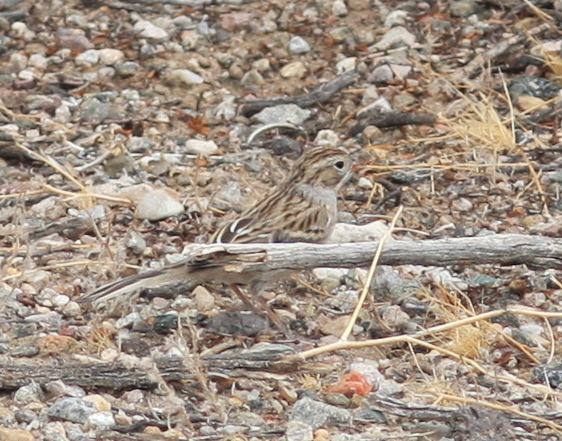
The Cassin's Sparrow I saw yesterday was in Mohave, at the north end viewpoint.  This was a very surprising find, with the bird not only out of range but in unusual habitat.  I came around a corner to see a sparrow feeding on the edge of some dense vegetation on the lake shore.  Thinking it would be a Brewer's Sparrow, I got my binoculars on it in time to see a scaly pattern on the back and crown, and I knew it was a Cassin's Sparrow.  It disappeared into the brush as soon as it saw me, peeking out only for a moment so I could see a distinct eye-ring.  I then waited and waited, staring at the brush pile and trying to ignore all the Brewer's and Chipping Sparrows, Orange-crowned Warblers, and other birds flitting all around me.  Eventually, the Cassin's Sparrow did come out, and I managed to get some decent photos.

Note plain dark tertials with distinct white edging, scaly-striped back pattern, eye-ring, and yellow supraloral, as well as shape.

Note faintly streaked breast, yellow at bend of wing, and dull yellow supralorals
That's it for now.  Until next time!